Key Takeaways:
- Healthy adults can drink caffeine in high altitude, within about 400 mg a day, but it never replaces slow acclimatization.
- Caffeine makes effort feel easier without adding oxygen. Lab trials at a simulated 3,500 m showed lower perceived effort but no gain in total work.
- Tea did not dehydrate 13 expedition members at 5,345 m. They passed the same share of urine, about 84 ml per 100 ml drunk.
- The real cost of caffeine is lost sleep, about 45 minutes on average, so finish your last cup roughly 8 to 9 hours before bed.
- Coffee has about 90 mg, an energy drink 80 mg and chiya 50 mg of caffeine.
- One or two cans fit Nepal’s October 2026 advisory, but blood pressure, uncounted extra cans and false confidence is a poor plan on a pass-day.
- Coffee raises stomach acid, yet on a trek altitude and infection are bigger suspects. Sort your symptoms first, and drink your cup with breakfast.
- Black, green, milk and butter tea all carry caffeine, while ginger and lemon usually do not. Chiya boiled longer has stronger caffeine.
- Coke does not cure altitude sickness. A cold, sugary fizz just goes down easily when appetite fades, and Diet Coke has more caffeine than regular.
- Chocolate, gels, bars and headache tablets hide 5 to 100 mg per serving, so count snacks on the same daily tally as your chiya.
- A hot cup warms your mood, not your body. Caffeine adds only a few percent more energy burn, so jackets and hot-water bottles do the work.
- Eight factors decide your reaction: sleeping height, total dose, body weight, timing, effort, water and food, drink type, and medicines like Diamox.
- Skipping your usual coffee can cause a headache that mimics altitude sickness. Keep your usual intake and never start caffeine at 4,000 m.
- Follow simple rules: keep your usual dose, count every source, swap the afternoon cup, watch your urine colour, and test everything at home.
On October 28, 2026, Nepal’s Department of Food Technology and Quality Control told the public to drink no more than two cans of energy drink a day. It also said children, pregnant and breastfeeding women, people with diabetes, and anyone sensitive to caffeine should avoid them!
Every trekking season, the same question comes up in teahouses and trekking groups: how good is caffeine in high altitude? It is a fair question, because teahouse menus are full of hot drinks!
Here is my position, and I will tell you right away. Caffeine is not the villain, and it is not a magic helper either!
A few cups of coffee or chiya a day are fine for a healthy adult. Trouble comes from three small things: drinking more than you realise, losing sleep, and believing a stimulant can replace acclimatization.
IMPORTANT NOTE: this article is for healthy adults. If you have a heart problem or high blood pressure, are pregnant, or plan to take altitude medicine, talk to your doctor before the trek.
Quick Answer: What Caffeine Does and Does Not Do?
| Question | Short Answer |
|---|---|
| Does it make you feel more awake? | Yes |
| Does it make walking feel easier? | Yes (proven in lab tests) |
| Does it help you do more work at about 3,500 m or higher? | Not in the best as shown in test |
| Does it prevent altitude sickness? | No |
| Does it dehydrate you? | Not in people who drink it regularly |
What Caffeine Really Does in Thin Air
Caffeine makes hard work feel easier. It does not give you more oxygen.
Think of it like snoozing an alarm clock. Your body is still tired, but you stop hearing the alarm. EFSA, Europe’s food safety authority, describes the effect as more alertness and less sleepiness.
Scientists tested this in a lab. In a 2025 trial, healthy adults breathed air as thin as at about 3,500 m, took a big dose of caffeine and then cycled. They said the effort felt easier, and their hearts beat faster, but they could not do more total work than without caffeine.
Another 2025 study at about 2,000 m of simulated height found a small gain of about 5% to 6% in sprint work.
The catch: all these volunteers were young and fit, took one large dose, and cycled in a lab. They were not trekkers walking 8 hours with a backpack!
So what does this mean for you? A coffee at 4 am may make the start of a pass day feel kinder. It cannot make the pass any lower!
Here is my opinion: tiredness is sometimes your body’s early warning. If caffeine mutes it (just like how I explained alcohol does), you may miss the signal. So, check your symptoms first (headache, nausea, dizziness, poor sleep), then have your coffee, not the other way round!
Can Caffeine Dehydrate You at High Altitude?
Many trekkers fear that tea makes you pee more and dries you out. So researchers tested it at 5,345 m on 13 expedition members for two days: one day with plenty of tea, one without. Urine amounts and hydration checks came out almost the same.
They were regular tea drinkers, so the result is for people who drink tea as they normally do!
Here is a simple calculation I did with their numbers: out of every 100 ml people drank, how much came out as urine?
| Day | Drank | Urine | Out of Every 100 ml Drunk |
|---|---|---|---|
| With tea | 3,193 ml | 2,686 ml | about 84 ml |
| Without tea | 3,108 ml | 2,625 ml | about 84 ml |
Same result. Tea did not change it!
So, where does real dehydration come from? Cold, dry air and fast breathing make you lose water at altitude anyway, and many trekkers simply forget to drink!
A cup of tea is mostly water, so it counts toward what you drink.
Here is another example. If you take Diamox, the medicine itself makes you pee more. If you wake up at night needing the toilet, do not blame your morning coffee or tea first.
Do not go to the other extreme either. Guidance from the Wilderness Medical Society says forcing extra water does not prevent altitude illness and can make the salt in your blood too low!
It also says dehydration can feel like altitude sickness, with headache, nausea, tiredness, dizziness and poor sleep. So drink enough, and check your urine colour. Pale yellow is a good sign; dark yellow or amber isn’t!
Your Sleep is the Real Casualty!
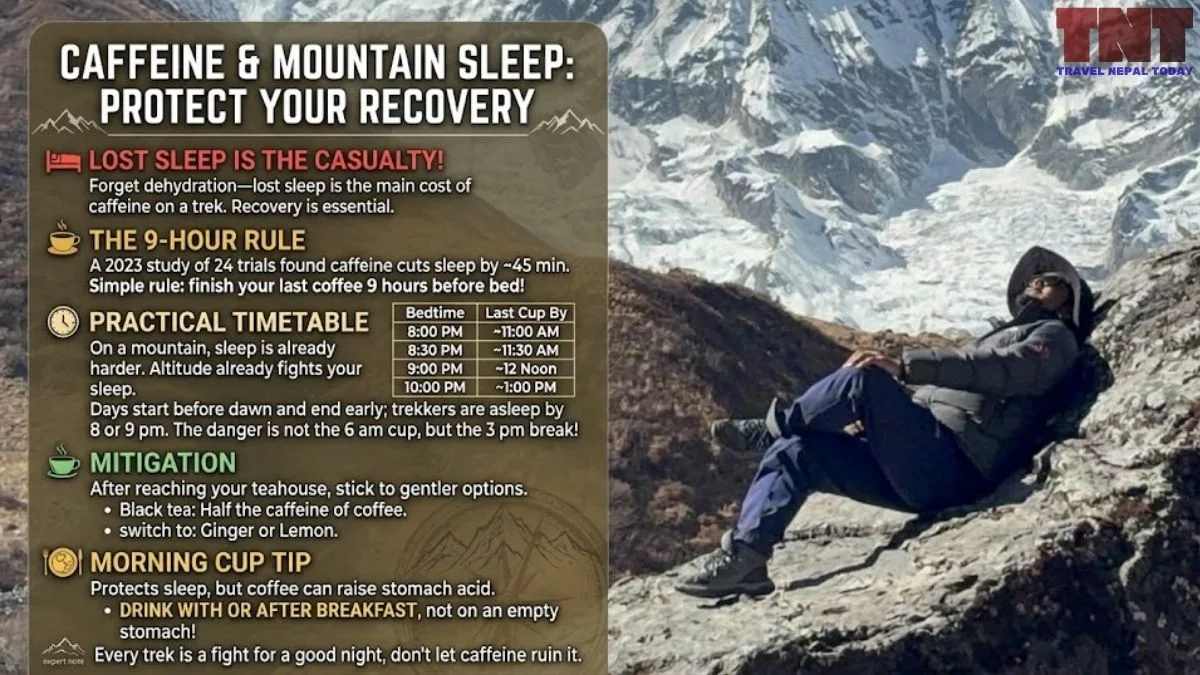
Caffeine’s highest cost on a trek is lost sleep. This is where I would put your worry, not on dehydration.
Here is an example. You drink a cup of chiya at 3 pm and go to bed at 8:30 pm. Caffeine stays in your body for hours, so part of that cup is still awake with you at bedtime.
A 2023 study that combined 24 trials found that caffeine cuts sleep by about 45 minutes on average.
A simple rule came out of it: finish your coffee about 9 hours before bed.
On a mountain, sleep is already harder! The CDC says getting used to altitude improves sleep, so every trek is already a fight for a good night.
Here is the thing: teahouse days start before dawn and end early, so many trekkers are asleep by 8 or 9 pm. The danger is not your 6 am coffee. It is the 3 pm coffee break!
I did a simple math for you to better understand. Take your bedtime and go back about 9 hours.
| Your Bedtime | Last Coffee/Tea By |
|---|---|
| 8:00 pm | about 11 am |
| 8:30 pm | about 11:30 am |
| 9:00 pm | about 12 noon |
| 10:00 pm | about 1 pm |
Black tea has about half the caffeine of coffee, so it is gentler. In the afternoon, switch to ginger or lemon.
Here is my own example. After reaching teahouse in the evening during my ABC Trek, we drank a cup of black tea, and it did not affect our sleep at all.
I think the reason is the small amount of caffeine. A cup of black tea has about 50 mg, which is half of the 100 mg that EFSA says can start to affect sleep close to bedtime.
That is my experience and my guess, not a rule. Everyone’s sleep reacts differently, so watch your own!
One note on the morning cup: Drinking caffeine early protects your sleep, but it may not protect your stomach. Coffee can raise stomach acid, and some people get heartburn from it. So, have your morning cup with or after breakfast, not first thing on an empty stomach!
Energy Drink, Coffee, and Chiya: The Caffeine Math
Is an energy drink much stronger than coffee? No. They are about the same!
Caffeine is measured in mg (milligrams). Here is how much is in one cup or can:
| Drink | Caffeine |
|---|---|
| 1 cup of coffee | about 90 mg |
| 1 can of energy drink | about 80 mg |
| 1 cup of tea | about 50 mg |
A healthy adult should stay under about 400 mg in a whole day. That is about 4 cups of coffee.
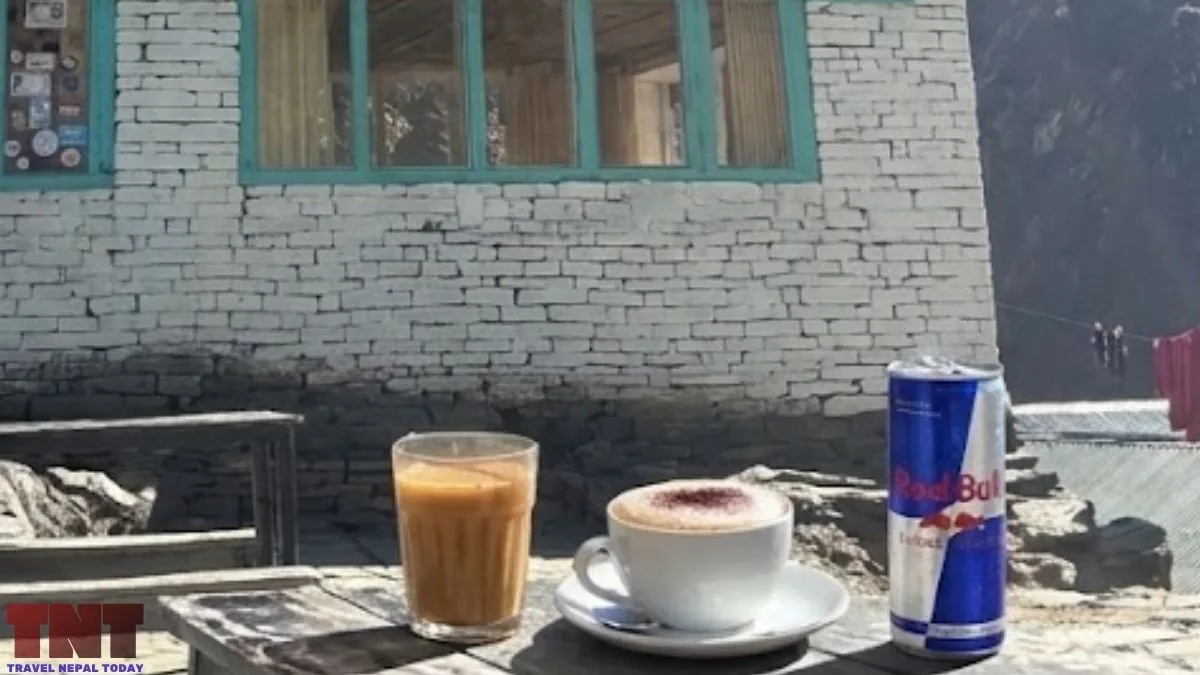
Nobody drinks 4 coffees at once. But the problem is small drinks adding up. Look at this typical day of some trekkers:
- Coffee at breakfast: 90 mg
- Two cups of chiya during the trek (during breaks): 100 mg
- An energy drink before a steep uphill: 80 mg
- Coffee after lunch: 90 mg
That is about 360 mg! You are almost at the daily limit by the time you reach your teahouse, but that doesn’t feel like you drank much, does it?
Well, about 200 mg is the most a healthy adult should take at one time. And 100 mg close to bedtime can already affect sleep!
Are Energy Drinks Safe on the Trail?
For a healthy adult, one or two cans a day are inside the limits of Nepal’s regulators and EFSA. The trail adds three problems, though: blood pressure, uncounted extra drinks and false confidence.
Here is what Nepal’s advisory of October 28, 2026 says that I mentioned in the intro:
- Healthy adults should have no more than two cans a day.
- Children, pregnant and breastfeeding women, people with diabetes or other diseases, and anyone sensitive to caffeine should avoid them.
- Labels and lab reports show 100 mg of caffeine per can. And an energy drink should never replace water, juice, milk or buttermilk.
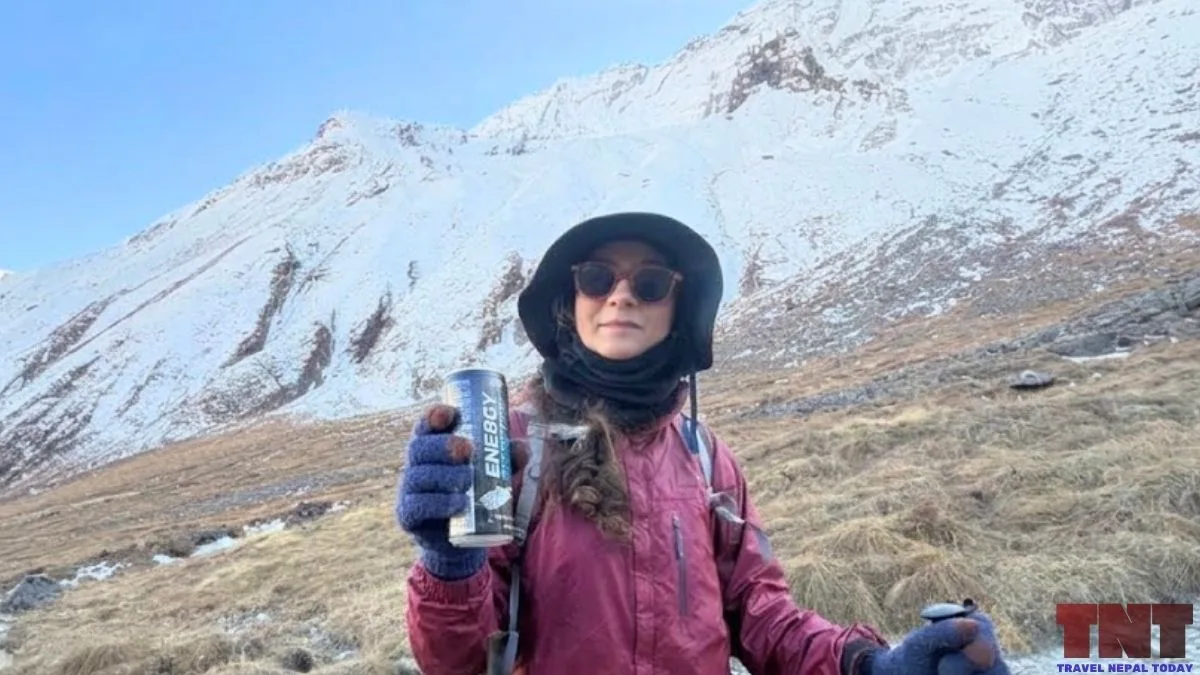
What about taurine, the ingredient everyone worries about? EFSA concluded that the other usual ingredients, at normal amounts, do not change the safety of a single 200 mg dose of caffeine.
So, the number that matters is milligrams. The FDA’s own table shows energy drinks ranging from 41 to 246 mg, so read the label on the can in your hand.
The real argument is blood pressure. A 2024 review of 17 trials found that energy drinks raised blood pressure within 30 to 120 minutes in healthy adults. The authors warned that the studies were few and some were weak.
Separately, going above about 2,500 m is known to push blood pressure up too!
Nobody has proved that these two add up to harm on a trek. But if you already have high blood pressure, a can on a steep climb is a bad experiment to run on yourself.
We’ll try to do a similar experiment soon and post our results here (if you’re interested, leave a comment and bookmark this article so you can come back later to read).
My verdict: one can, early in the day, for someone who already drinks caffeine, is acceptable. A can as a rescue plan on a pass day is a poor plan. It quiets tiredness without fixing the thin air behind it.
Will Coffee Wreck Your Stomach?
Coffee can stir your stomach and bowels, but on a Nepal trek the cup is one suspect among several.
A 2022 research found that coffee clearly increases stomach acid and gut movement, while links to reflux and ulcers are still debated. You may know this already: some people rush to the toilet within minutes of a coffee, and others feel nothing!
Now the other suspects, because this is where trekkers blame the wrong thing.
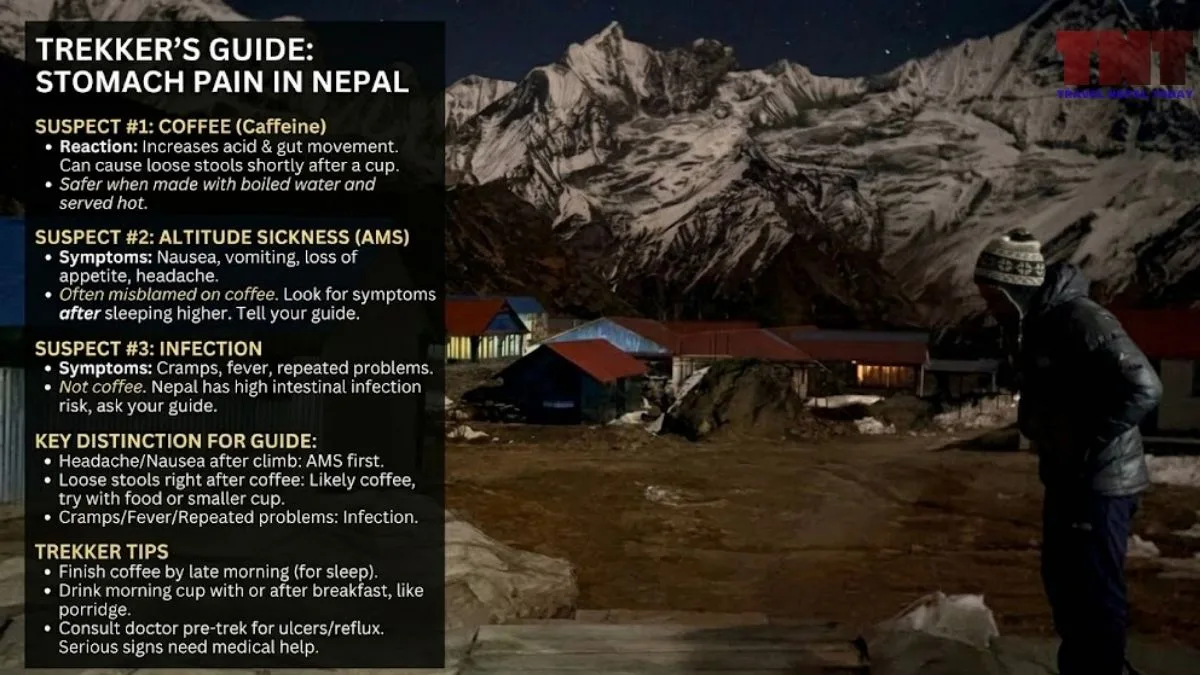
First, altitude. Nausea, vomiting and no appetite are classic signs of altitude sickness. A trekker who feels sick after a steep day may be blaming the coffee for an altitude signal.
Second, infection. The CDC says travelers to Nepal are at high risk of intestinal infections, and the risk of travelers’ diarrhea in the spring season (March to May) is double that of autumn (October and November).
Hot coffee or tea is on the CDC’s list of safer drinks, as long as it is made with boiled water and served hot.
Here is how I would sort it out:
- Headache, nausea and no appetite after you sleep higher: Think altitude first and tell your guide.
- Loose stools soon after coffee, with no fever and no other problem: Coffee is a fair suspect. Try it after food, such as porridge, or switch to tea.
- Cramps, fever, or repeated diarrhea or vomiting: This is not the coffee. Treat it as a possible infection and ask your guide about medical help.
One more tip: I suggest finishing your coffee by late morning. That rule is for your sleep, not your stomach!
Have your morning cup with or after breakfast, such as porridge, not first thing on an empty stomach. If you still get heartburn, try a smaller cup or skip caffeine that day.
If you already have reflux or ulcers, ask your doctor before the trek. Burning pain that keeps coming back, black stools, or repeated vomiting needs medical help, not just a change of drink.
Himalayan Teas: Which Ones Carry Caffeine?
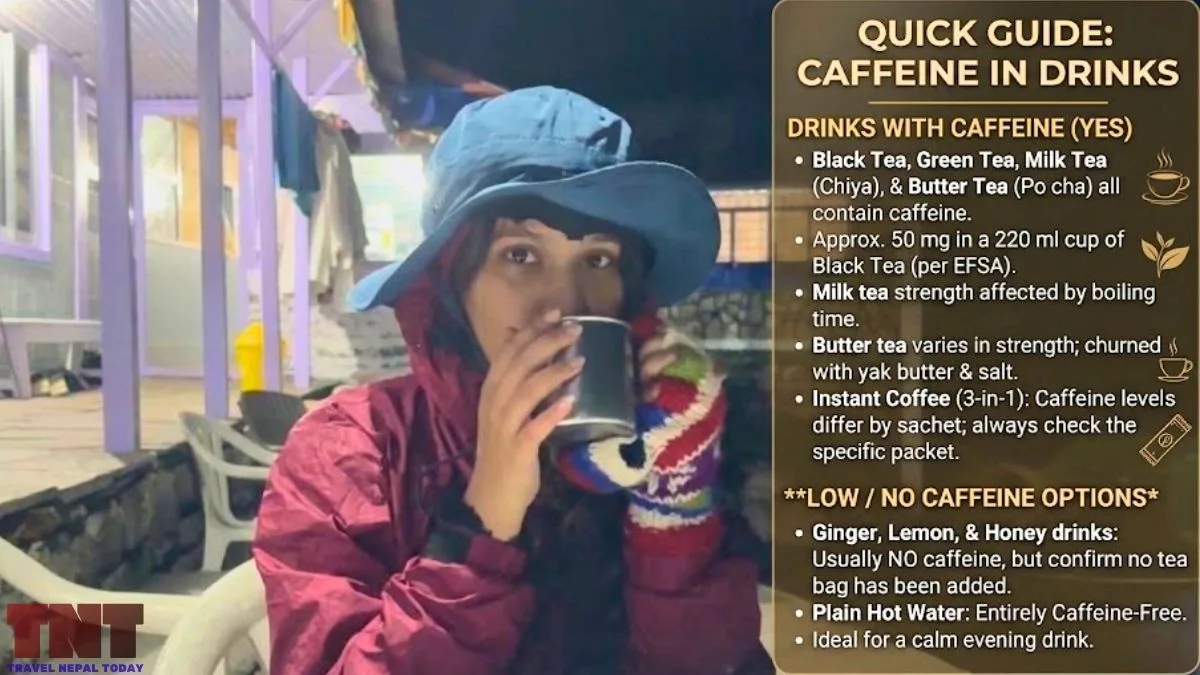
“Himalayan tea” is not one drink. Black, green, milk tea (chiya), and butter tea carry caffeine. Ginger, lemon, and herbal drinks generally do not.
A 2008 lab test of 20 store-bought teas found 14 to 61 mg of caffeine per serving in white, green and black teas, and none in the herbal teas.
It also found that the longer a tea steeps, the more caffeine comes out. On the trail, that means a pot of chiya boiled hard is stronger than a quickly dunked tea bag!
Teahouse Drink Guide
| Drink | Caffeine? | What to Know? |
|---|---|---|
| Black tea | Yes | About 50 mg in a 220 ml cup, per EFSA |
| Milk tea (chiya) | Yes | Made from tea leaves; the longer it boils, the stronger it gets |
| Green tea | Yes | Similar range to black tea |
| Butter tea (po cha) | Yes | Made from compressed tea, churned with yak butter and salt; strength varies |
| Instant coffee (3-in-1 sachet) | Yes | Check the packet, because sachets differ |
| Ginger, lemon and honey drinks | Usually no | Ask whether a tea bag goes in |
| Plain hot water | No | The easiest evening drink |
Two cautions:
- A herbal drink is not automatically harmless just because it is traditional, so ask what is in it!
- And if a host offers you butter tea, I would accept it! It is a drink of hospitality, a few sips is fine, and the calories are welcome at altitude.
Can Caffeinated Soft Drinks Cure Altitude Sickness? The Fizzy Myth Debunked
You’ll often find soft drinks being sold at teahouses, including high-altitude destinations. It’s tempting for the tongue buds and even your ear buds, as you may hear locals claiming phrases like “A Coke or Pepsi can help with altitude sickness!” But is that really true?
Well, NO! Coke does not cure altitude sickness for sure!
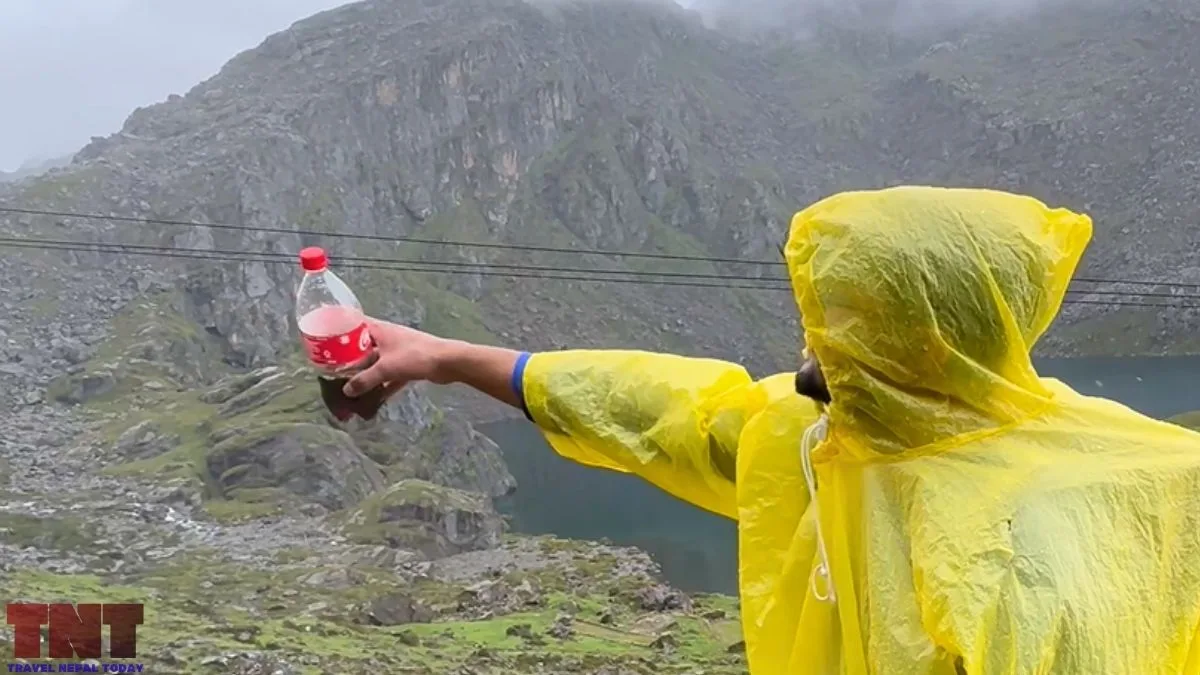
The medical guidance I quoted earlier names slow ascent and medicines such as Diamox for prevention, so cola is not on that list!
But why do so many trekkers swear by it? Well, at altitude your appetite drops and nausea is common, so a plate of dal bhat can feel impossible. A cold, sweet, fizzy drink goes down easily!
Himalayan climbers have long noticed that people who avoid sweets at sea level crave sugar up high. The sugar gives a quick lift, the cold drink feels good, and the drink gets the credit!
Why Coke and Pepsi but not Fanta or Sprite? Coke contains caffeine. Fanta and Sprite are usually sold without it, but check the label.
How much caffeine is in it? Less than you might think! Here are typical amounts from the Australian Institute of Sport’s caffeine table:
| Soft Drink | 375 ml Can | 600 ml Bottle |
|---|---|---|
| Coca-Cola | 36 mg | 58 mg |
| Diet Coke | 48 mg | 77 mg |
| Pepsi | 40 mg | 64 mg |
Notice that Diet Coke has more caffeine than regular Coke. A 600 ml bottle of Diet Coke at dinner has about 77 mg, which is more than a cup of black tea (about 50 mg)!
My verdict: if a cold, sweet drink helps you eat or lifts your mood, enjoy it and count it. But it is not medicine. If you feel sick and have a headache that is getting worse, do not open another bottle! Stop going higher and tell your guide.
Hidden Caffeine: Chocolate, Energy Bars and Other Snacks
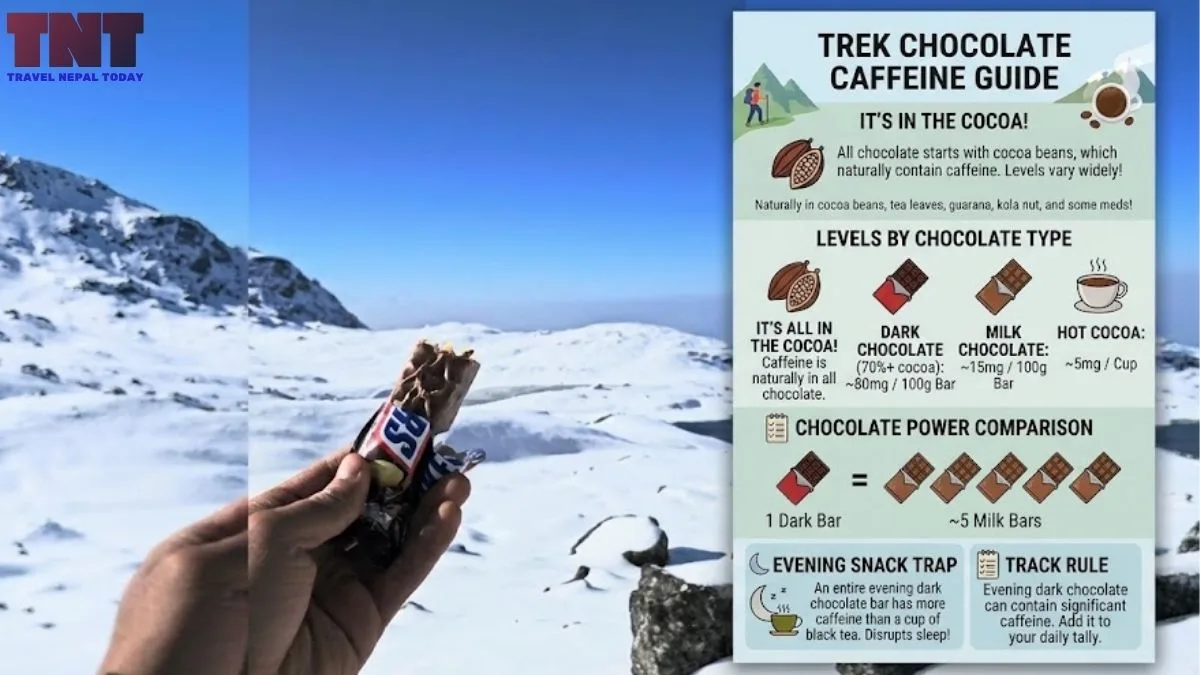
Caffeine hides in more places than your cup! It occurs naturally in coffee and cocoa beans, tea leaves, guarana berries, the kola nut, and that some medicines contain it too!
Here are the ones you will meet on a trek:
- Chocolate: Cocoa carries a little caffeine. Milk chocolate has little, dark chocolate has more, and hot chocolate is low. Bars with caramel or nougat probably have less, because they contain less cocoa, but I would still suggest checking the label.
- Energy bars, gels and chews: Most sports foods have none, but some flavours do. The Australian Institute of Sport says sports gels and bars typically carry 20 to 100 mg per serving. A caffeinated GU gel has 20 or 40 mg, and a Clif Bar in mint flavour has 49 mg. Look for the word “caffeine” on the label, or for guarana, kola nut or green tea extract.
- Tablets: Some headache, cold and “stay awake” tablets contain caffeine. A No-Doz tablet has about 100 mg. Read the label of everything in your first aid kit!
- Powders and supplements: Pre-workout and fat-burner powders are the biggest trap. The same table lists scoops with roughly 90 to nearly 390 mg, and warns that the dose on these products is often unclear. I would honestly suggest leaving them at home!
Let me do some simple math. How many of each snack equal one cup of filter coffee (90 mg)?
| Snack | Caffeine | How Many Equal 1 Cup of Coffee |
|---|---|---|
| Hot chocolate (250 ml cup) | 5 to 10 mg | 9 to 18 cups |
| Milk chocolate (60 g bar) | 5 to 15 mg | 6 to 18 bars |
| Dark chocolate (60 g bar) | 10 to 50 mg | 2 to 9 bars |
| Coca-Cola (375 ml can) | 36 mg | 2.5 cans |
| Caffeinated energy gel | 20 to 40 mg (some have 100 mg) | 2 to 4 gels |
| Energy bar with caffeine (Clif Bar mint, 68 g) | 49 mg | about 2 bars |
| Caffeine tablet (No-Doz, Australia) | 100 mg | 1 tablet |
One square of chocolate means nothing! The problem is the evening.
Imagine you have a Coke (36 mg) with dinner and half a dark chocolate bar afterwards (about 5 to 25 mg). That is roughly 40 to 60 mg close to bedtime, about the same as a cup of black tea, and half of the 100 mg that can affect sleep!
My rule: snacks count too. Put them on the same daily tally as your coffee and chiya!
Does a Hot Drink With Caffeine Really Warm You?
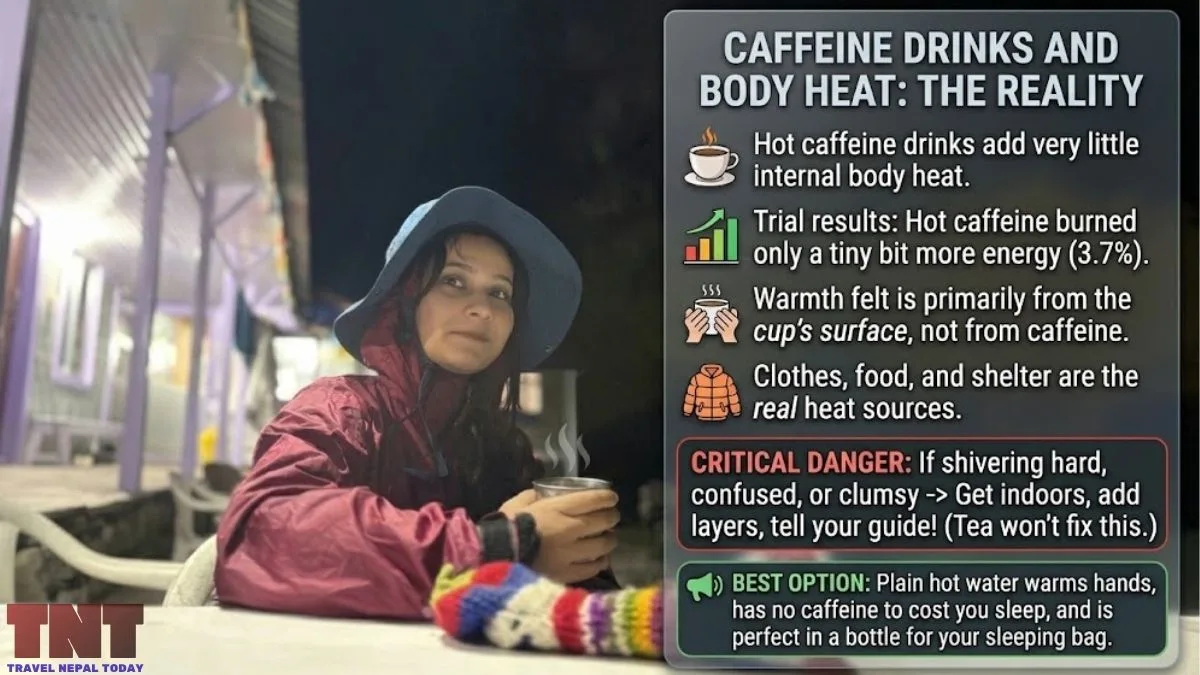
A hot cup warms your hands and lifts your mood in minutes, but caffeine adds very little heat. Clothes, food, and shelter do the real work!
In a 2018 trial, 23 healthy adults drank 500 ml of a caffeinated herbal tea (yerba mate, we call it the “Messi’s drink“), either hot or cold. Over the next 90 minutes, their bodies burned only 3.7% more energy after the hot drink and 8.3% more after the cold one.
So, caffeine does nudge your body’s heat factory, but only a little, and the hot drink did not even win. The warmth you feel is the warmth of the cup.
I am all for those comfortable minutes. But a few percent more energy is small next to a down jacket, dry socks and a warm dining room.
If you are shivering hard, confused or clumsy, that is not a tea problem. Get indoors, add layers and tell your guide!
Tip: Ask the teahouse for hot water, which has no caffeine, and put it in your bottle at night. It warms your sleeping bag and replaces the late cup that would cost you sleep.
The 8 Factors That Decide How Caffeine Treats You
The same cup can help one trekker, do nothing for another, and ruin the night of a third. Eight things explain why:
- Altitude and Sleeping Height: The higher you go, the less your body can do, whatever you drink! Doctors also say the height where you sleep matters more than the highest point you reach in a day. Protect the night most, because overnight is when your body works hardest to adjust to the thin air.
- Total Dose: Count everything! Instant coffee, chiya, cans, Coke and other soft drinks, chocolate, caffeinated energy bars and gels, and any caffeine tablets. A strong brew or a bigger can changes the number.
- Body Weight, Tolerance and Health: A 55 kg trekker reaches the comfortable limit sooner than an 80 kg one. Someone who drinks 3 coffees a day at home reacts differently from someone who rarely has one. If you have a heart or blood pressure problem, ask your doctor first!
- Timing: Use the bedtime table above. A cup before a pre-dawn start is fine. The 3 pm cup is the one that follows you into your sleeping bag.
- How Hard You Are Working: Sitting in a warm dining room and climbing a steep section are very different jobs. The 2025 trial found caffeine made hearts beat faster. If your heart is already pounding on a climb, adding a stimulant is not wise.
- Water, Cold and Food: Cold and altitude already make you pee more, as the earlier study noted. Eat properly, drink when thirsty, and take coffee with food if your stomach is touchy.
- The Drink Itself: A coffee, a chiya, a butter tea, and an energy drink are different products. Tea gets stronger the longer it steeps, and cans differ by brand and country. Stick to steaming-hot drinks made with boiled water.
- Other Symptoms and Medicines: Diamox makes you pee more. Stopping caffeine causes headaches. Altitude sickness also causes headaches, nausea and poor sleep. When these overlap, look at the pattern across the whole day, not just one cup.
Where Trekkers Get Confused: Headaches, Withdrawal and Myths
A daily coffee drinker who stops suddenly can get a headache that looks just like altitude sickness.
Example: you drink 3 coffees a day at home, the teahouse has none, and on day 3 your head pounds. You may think it is altitude when it is really missing caffeine. That is why the CDC guidance quoted earlier tells regular users to keep their usual intake at altitude!
Read that carefully. It says keep your usual, not drink more. Nobody should start caffeine at 4,000 m!
Does caffeine help altitude sickness? The most promising result so far is a 2023 study in which low-dose caffeine eased fluid in the lungs (HAPE) in mice and protected lung cells in a lab dish.
However, note that mice are not trekkers and their bodies may react differently than humans. What really protects you is a slow ascent, a lower sleeping height and, for some people, medicine prescribed by a doctor.
A word on headaches: An ordinary headache after a dry, tiring day may settle with water, food and rest. A headache that comes with nausea, dizziness, unsteady walking or confusion, or that grows as you climb, is altitude sickness until proven otherwise. Do not go higher, tell your guide, and remember that going down is the most important treatment.
Five Myths, Checked
| Myth | What the Evidence Shows |
|---|---|
| Coffee and tea dehydrate you at altitude | The earlier Everest Base Camp research showed that tea drinkers passed no extra urine! |
| Energy drinks are far stronger than coffee | A 250 ml can has 80 mg, less than the same amount of filter coffee; the real issues are extra drinks and blood pressure. |
| Caffeine helps you acclimatize | Acclimatization comes from slow ascent and sleeping lower; caffeine’s one promising altitude result is in mice. |
| Himalayan herbal tea is always caffeine-free | Black, milk, green, and butter tea carry caffeine; ginger and lemon usually do not |
| A hot cup warms you from inside | Caffeine adds only a few percent more heat; most of the warmth is the cup |
What This Means for Your Himalayan Trek?
My rule is simple! Relax on the lower days, tighten up as you climb, and treat caffeine as comfort, not a performance tool, above 4,000 m.
That 4,000 m line is my own judgement, not an official cutoff. The reasoning: altitude sickness risk starts rising above about 2,500 m, and the lab gains for caffeine were seen lower down.
Caffeine Plan by Route
| Route | Where Your Choices Matter Most | My Verdict |
|---|---|---|
| Lower hill treks and early days of most routes | Sleeping below about 3,000 m | Normal coffee and chiya; an earlier cutoff still helps sleep |
| Everest Base Camp trek | Dingboche (about 4,410 m) and higher, where a morning dose shortened sleep | Keep your usual cups, no afternoon coffee, skip the cans |
| Annapurna Circuit | The night before Thorong La, and the pre-dawn pass day (the pass is above 5,000 m) | An early cup is fine; no late caffeine; nothing new |
| Manaslu Circuit | The night before Larkya La, which is also above 4,000 m | Same plan; protect the night before the pass |
| Langtang and similar valley treks | Mostly sleeping under 4,000 m | Normal intake, but watch the afternoon cup! |
And by type of trekker, here are my tips:
- The daily coffee drinker: keep your usual cups, move them earlier, and do not stop suddenly.
- The occasional drinker: do not start now, and skip energy drinks.
- Anyone taking Diamox: expect to pee more, and blame the medicine before the coffee.
- High blood pressure, a heart condition, or diabetes (or you’re pregnant and still doing a trek): ask your doctor!
- Pass day: one cup of what you already drink, never something new.
Your Teahouse Caffeine Plan
When tea cups and energy drinks are part of your daily routine, it helps to keep a few simple boundaries in mind. Keep these practical guidelines handy as you manage your caffeine intake on the trail:
- Keep your usual caffeine, not more: The CDC advice is to continue, not to increase.
- Count every source:Instant coffee, chiya and cans all go on the same tally. Use the table above.
- Stop about 9 hours before lights-out: For a 9 pm bedtime, that is roughly noon.
- Swap the afternoon cup: Choose ginger, lemon or hot water, and ask that no tea bag goes in.
- Drink when thirsty and watch your urine colour: Do not force extra water.
- Take coffee with food if your stomach is touchy: Drink only steaming-hot drinks made with boiled water.
- Check your symptoms first:Headache, nausea, dizziness and poor sleep come before the cup. Do not climb higher if they are getting worse.
- Test everything at home: Never try a new can or a stronger coffee on a pass day, and keep to two cans a day if you use energy drinks.
Bonus rule: snacks count too. Coke, chocolate, caffeinated bars and gels, and headache or “stay awake” tablets all go on the same tally.
Final Words
Trekking advice loves a villain, and for a long time the villain was the cup in your hand. The evidence, a good part of it gathered in Nepal, points somewhere else.
Tea did not dry out the people at Everest Base Camp. A can of energy drink is not the caffeine monster it is painted as, and Nepal’s own numbers say so!
What really costs trekkers something is quieter: the afternoon cup that steals sleep at 4,000 m, the second and third can nobody counts, and the old hope that a stimulant can negotiate with thin air.
Here is my stance, and I will hold it: keep the habit you already have, move it earlier in the day, count every source, and never let caffeine decide whether you go higher. Time, a slow ascent and a lower sleeping height earn the credit for good acclimatization! A cup of coffee earns none of it.
And if your body says stop, no coffee, no tea, and no energy drink outranks it!
About The Author