Key Takeaways:
- September is no longer the best time to trek in Nepal because the monsoon now lasts into October, so the clear autumn weather has shifted later, to mid-October and especially November.
- DHM records show the average monsoon withdrawal moved from around 21 September (1968 to 1997) to around 11 October (2008 to 2025), so September is monsoon from start to finish.
- Dashain moves between 2 and 24 October while the monsoon now leaves around 11 October, so the clear “Dashain weather” we remember was partly a coincidence, and wet, Hile Dashains will be more common.
- About a dozen factors decide a September trek (rain, temperature, wind, views, trails, roads, flights, bridges, high-pass snow, leeches, crowds and politics), and rain, views, trails, roads, flights and bridges carry the highest risk across Annapurna, Everest, Manaslu and Langtang.
- Every year from 2022 to 2026 brought avalanches, floods, stranded trekkers or closures around September, from the 244 deaths in the September 2024 floods to the 2026 Rasuwa flood, the Namrung bridge loss and the Manang stranding.
- A longer monsoon, already soaked slopes and steep terrain explain the pattern, and I believe the bigger cause is climate change, which made the September 2024 rain about 10% heavier and 70% more likely according to World Weather Attribution.
- The safest September options are short treks near Kathmandu (Gosaikunda, Helambu, Panch Pokhari) and rain shadow routes (Upper Mustang, Dolpo, Nar Phu) once the road and weather window check out, while long routes far from Kathmandu and view-focused treks like Poon Hill and Ghandruk are best avoided.
- October beats September, but the best choice is early to mid-November, about a week after Bhai Tika, for clear skies, drier trails and fewer locals, since the monsoon exits around 11 October and storms like Cyclone Montha can still hit in late October.
- Check the road first and the weather window second, follow DHM updates, add 2 to 3 buffer days at each end, book through a trekking agency and pack for wet and cold together.
As I write this on 6 October, DHM (Department of Hydrology and Meteorology) has not yet announced the date the monsoon fully left the country.
Here is the part I find telling. Meteorologists are forecasting rain until the day before Ghatasthapana (10th October), and they are careful to say it is post-monsoon rain brought by weak westerly winds and that Nepal does not need the monsoon to get rain.
I understand the distinction, and it matters to a forecaster. It does not matter to you on a trail!
Rain in the second week of October, with the monsoon still officially in the country, means the same wet boots and the same slippery trail. It tells me that the transition between the monsoon (rainy season) and autumn (the clear, ideal trekking season) in Nepal is no longer distinct or predictable.
So, 2026 is not an unlucky year in an otherwise reliable pattern. By DHM’s own definition the monsoon runs through September, and in most recent years it has stayed well into October.
September in Nepal is not the beginning of the good season. It is the end of the wet one, and the record below shows 2026 is the pattern and not the exception.
I’m writing this blog to make you think twice before deciding to visit Nepal in September 2027. While 88,248 foreign tourists visited here in September 2026, don’t run after just the numbers!
September Is Still Monsoon (And Monsoon Now Ends Even Later!)
DHM’s normal dates for eastern Nepal are 13 June for onset and 2 October for withdrawal, a monsoon of 112 days.
That second date has already moved for 2026! In DHM’s own report on the 2010 monsoon, the normal withdrawal date was 23 September, based on the 1971 to 2000 average. The official normal is now about 9 days later!
And the real dates have moved further than the normal has. I took DHM’s table of onset and withdrawal dates (eastern Nepal, 1968 to 2024) plus the 2025 update and averaged the withdrawal dates by period:
| Period | Years with data | Average withdrawal date |
|---|---|---|
| 1968 to 1997 | 29 | around 21 September |
| 1998 to 2007 | 10 | around 30 September |
| 2008 to 2025 | 18 | around 11 October |
Two more numbers from the same table. Before 1998, only 1 year in 29 had a withdrawal on or after 5 October. From 1998 to 2025, it happened in 17 years out of 28. And since 2008, only one year (2012) finished before 1 October.
These are simple averages I calculated from DHM’s records, but they agree with the research. Gautam and Regmi (2013) found a statistically significant delay in monsoon withdrawal over Nepal, with a shift after 1997, and DHM’s own analysis, reported by Nepal News, says the monsoon period is lengthening, with earlier onsets and later withdrawals.
2025 is the clearest recent example! The monsoon entered eastern Nepal on 29 May, 15 days early, and withdrew on 10 October, 8 days late, which made 135 days, the longest monsoon DHM has recorded.
And 2026 is running late at both ends: onset on 19 June, and a first withdrawal bulletin on 3 October that covers only the west.
This year’s hope is for a drier Dashain, coming after last year’s soggy holidays. That’s because Dashain is also late (but I can’t say the same for 2027).
So, what does this mean for September? It means the idea that late September settles into autumn weather belongs to an older climate.
Recent Septembers are monsoon from the first day to the last, and the Octobers that follow often start wet!
Hile Dashain vs. The Dashain We Remember
I grew up with a picture of Dashain weather in Late September: clear sky, kites, a cool morning. But Dashain follows the lunar calendar, so the main day moves by up to three weeks from year to year, while the monsoon follows its own clock.
| Year | Tika | DHM monsoon withdrawal, eastern Nepal |
|---|---|---|
| 2022 | 5 October | 16 October |
| 2023 | 24 October | 15 October |
| 2024 | 12 October | 12 October |
| 2025 | 2 October | 10 October |
| 2026 | 21 October | Yet to be confirmed |
In 2022, 2024 and 2025, tika came before or on the day the monsoon left eastern Nepal. In 2025, it fell on 2 October, making the holidays soggy.
Even I had to delay my Manaslu Circuit Trek day after day as it was raining continuously for days even after Tika. In fact, when the monsoon withdrew on the 10th, I was already in Namrung (lucky me, the rain had stopped and the weather window was perfect).
Despite the monsoon withdrawal, Cyclone Montha brought unexpected heavy rains even in late October! I wanted to make this all about September, but look, even October rain is making it doubtful to call it the best season…
So, my memory of Dashain weather is partly a memory of years when the lunar calendar and the monsoon happened to line up. The gap between the two is wider now, because the monsoon leaves around 11 October on average, and Dashain can fall anywhere from 2 to 24 October!
Probably Hile Dashain for most upcoming years, thanks to “season creep“!
What Actually Decides a September Trek: The Factors Explained
Rain gets all the attention, but it is only one of about a dozen things that decide whether a September trek goes well.
Here are the quick answers first. Below the tables, I explain each factor with examples from Annapurna, Everest, Manaslu and Langtang.
| Factor | September in one line | Risk |
|---|---|---|
| Rain and clouds | Frequent, can last for days, worst on the south-facing side | High |
| Temperature | Warm and sticky low down, cold nights above 3,500 m, wet gear makes both worse | Medium |
| Wind | Calm mornings, stronger from mid-morning in the big valleys | Medium |
| Mountain views | Best in the early morning, clouds usually close in later | High (you may see nothing) |
| Trail condition | Mud, slippery steps, landslides | High |
| Road access | The weakest link, roads wash out and vehicles get stuck often | High |
| Flights | Lukla and Jomsom flights cancel quickly in cloud | High |
| Rivers and bridges | One night of rain can take a bridge! | High |
| Snow on high passes | Can arrive around late September | Medium |
| Leeches | Common on low, damp forest trails | Medium (a nuisance) |
| Crowds and lodges | Medium (better to book) | Low (a plus) |
| Politics and strikes | Rare, but it can close up to a month (speaking this from the Gen-Z revolution of September 2025!) | Low to medium |
And here is how the four main regions compare:
| Region | Main September problem | What happened in 2026 | My verdict |
|---|---|---|---|
| Annapurna | The Pokhara side is among the wettest in Nepal, and the road along the Marsyangdi can wash out | Hundreds of tourists stranded in Manang, Thorong La turn-backs after snow | Avoid the south side (Poon Hill, Ghandruk). Upper Manang and Mustang only after checking the road and the weather |
| Everest | Lukla flights need clear weather and cancel fast | Outside the Rasuwa flood zone | Possible with spare days, but the flight is the risk |
| Manaslu | Narrow trail, river crossings on suspension bridges, a long road to the start | Two bridges swept away at Namrung on 6 September | Avoid in September |
| Langtang | The only road to Syabrubesi was destroyed on 26 August | Valley cut off, tourists evacuated by helicopter | Avoid this year. Helambu or Panch Pokhari are better short options (trails likely to open up shortly; check updates here) |
Rain and Clouds
Kathmandu gets about 205 mm of rain in September and only 45 mm in October, according to 1991 to 2020 climate normals.
Pokhara, at the foot of the Annapurna range, gets around 3,900 mm in a year, which is why Ghandruk and Poon Hill are so green and so wet.
Behind the big mountains it is a different country! The lowest rainfall occurs in Mustang, Manang, the Everest and the Dolpa region.
So, the same September can mean daily downpours on one trail and dry paths two valleys away. And rain is not the whole story, because clouds hide the mountains even on days when it does not rain.
Temperature
In Kathmandu, September averages about 24°C and feels sticky. Then you climb, and the air cools by roughly 6.5°C for every 1,000 m!
A warm start at Besisahar turns into jacket weather in Manang, and cold nights above 3,500 m!
In September, the cold is not the real problem. A wet jacket, wet socks and a damp sleeping bag at 3,500 m are!
Wind
Every big valley has its own daily wind. Mornings are usually calm, then the sun warms the slopes and the wind starts blowing up the valley.
For example, in the Kali Gandaki, the way to Mustang, observations show the switch around 9 am, and a study in the Rolwaling Himal found the same day and night reversal with a strong seasonal effect.
That is why flights into Jomsom run early, and why it’s recommended to start walking at first light in Mustang. The bigger wind system is the moist flow from the Bay of Bengal and the Arabian Sea, which a paper on the 2024 floods links to several days of rain at a time.
Mountain Views
This is the factor first-time visitors care about most, and the one September handles worst!
When you are high up, above about 4,000 m, you can wake up close to the mountains and get a clear early morning. Below that, once clouds sit in the valley, that is usually the end of the story.
It is why I would not send anyone to Poon Hill or Ghandruk in September. Those destinations are sold on the view and not on the adventure, and the view is exactly what the monsoon takes away.
Trail Condition
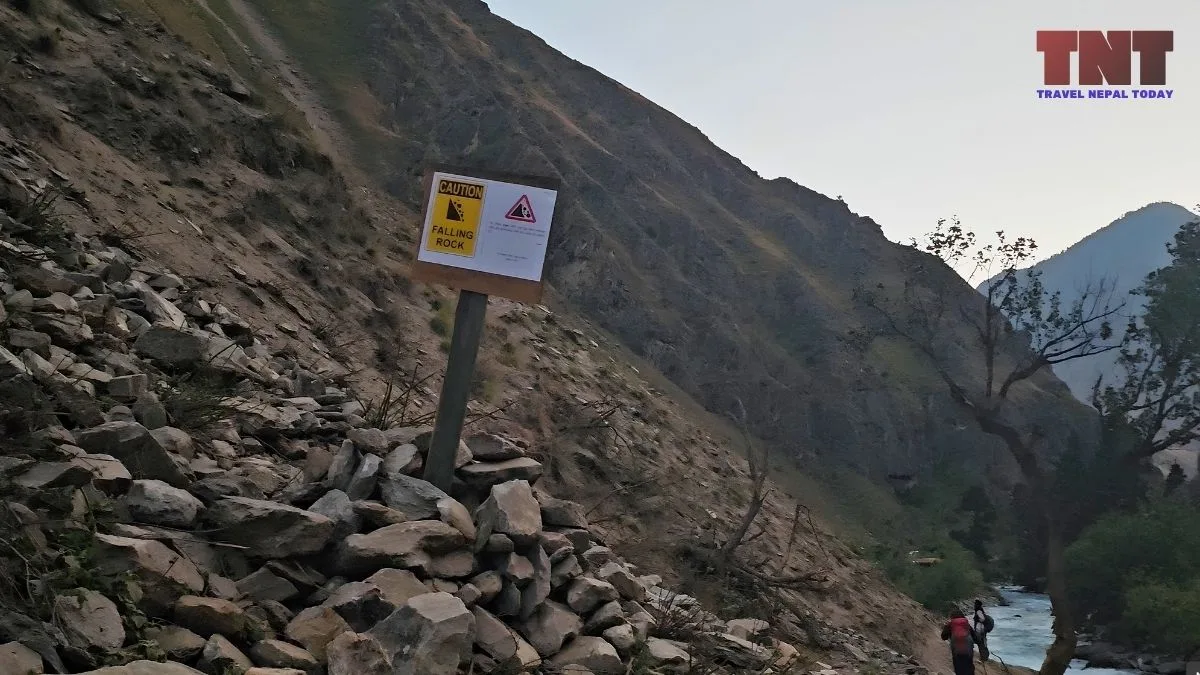
Mud, wet stone steps, small landslides, and waterfalls. None of it is dangerous on its own!
However, it slows you down, and slow days add up. The worst sections are the lower trails cut into steep slopes, like the early days of the Manaslu Circuit, where a landslide in September 2016 killed four people near Tatopani!
Road Access
This one ruins more September trips than the weather does.
You can have a perfect forecast for the mountains and still lose two days to a road. In September 2024, landslides blocked all three highways out of Kathmandu.
Likewise, in late September 2026, the road along the Marsyangdi was washed away and tourists were stuck in Manang.
And Langtang’s only road, to Syabrubesi, was destroyed on 26 August, leaving the valley cut off. When the road goes, walking is the only way. That is fine if you planned days for it, and a disaster if you did not.
Flights
Flights to Lukla or any other mountainous location only run in the morning, and they stop quickly when cloud closes in.
Even in October it can go wrong! In 2022, about 2,000 tourists were stranded in Manthali and 1,500 in Lukla, and in October 2023, more than 200 flights were cancelled over five days.
September is cloudier than both months, so I would expect more of the same. Helicopters help, but not everyone can afford them.
Rivers and Bridges
A trek is a chain, and bridges are the weakest links.
On 6 September 2026, a flood in the Therang Khola at Namrung swept away two bridges on the Manaslu Circuit, and the Gorkha administration had told trekkers to suspend travel.
The local municipality began work on an alternative route the next day, but the point stands. A stream you hop across in April can be impassable after one night of rain in September.
Snow on High Passes
Rain at lower heights falls as snow up high. In late September 2026, more than 150 trekkers who had crossed or tried to cross Thorong La had to turn back to Manang after heavy snowfall.
On 27 September, an avalanche hit Himlung Himal base camp in Nar Phu and killed 15 Nepali workers and guides who were preparing for the expedition season.
No foreign climbers had arrived yet. Two different problems with the same message: the high mountains start winter early!
Leeches
Leeches love warm, wet forest. In September, treat any low, damp trail as leech country.
Gaiters, treated socks, and a check of your boots at every rest stop usually keep them away.
They are more disgusting than dangerous, but for a first time visitor they can ruin the mood of a day!
Crowds and Lodges
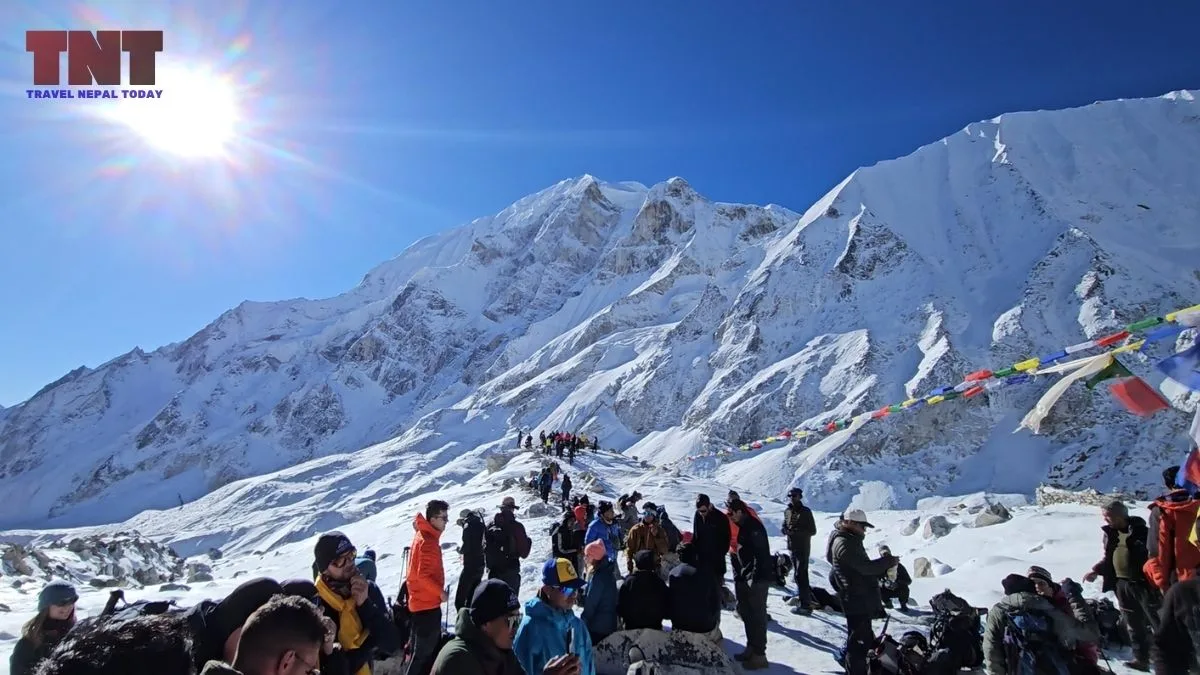
This is the plus compared to October. Trails are comparatively quieter, rooms are easier to find, and the hills are at their greenest. Still, since September is promoted as a peak season, pre-booking is essential.
I understand the temptation. 88,248 foreign tourists arrived in September 2026, 12.1 percent more than last year, but the growth came from India, China and Sri Lanka.
Arrivals from Europe fell 8.7 percent, and arrivals from the United States dropped from 9,679 to 8,299. My reading is that fewer of the visitors who fill October’s trails came in September!
Politics and Strikes
Weather is not the only thing that can close a month. On 8 and 9 September 2025, deadly protests in Kathmandu shut the airport for hours, and September arrivals fell 18.3 percent from a year earlier!
That is not a monsoon story, but it is the same lesson. The best time to trek is not only about the season, it is about conditions on the day or month.
What Has Gone Wrong in Recent Septembers?
I went back through five years of September and early autumn news. I am not doing this to scare you. I am doing it because the pattern is easy to miss when every year gets its own headline.
- 2022: On 26 September, an avalanche between Camps 3 and 4 on Manaslu killed Nepali guide Anup Rai and injured 12 other climbers, on a mountain with heavy snowfall and a lingering monsoon. That is mountaineering and not trekking, but the same weather sits over the Manaslu Circuit below it. A few days later, the Himalayan Times described scores of trekkers stranded in Dolpa and Manaslu after rain and snow damaged the trails.
- 2023: A quieter year in the headlines, but not in the numbers. The national disaster authority counted 92 deaths, 30 missing and 459 landslides, even though the season had less rain than usual. Then Lukla flights stalled for five days in October!
- 2024: From 26 to 28 September, extreme rain hit Kathmandu and eastern Nepal. World Weather Attribution reported 244 deaths! All three highways out of Kathmandu were blocked, and a landslide buried at least three buses about 16 km from the city, killing about three dozen people. One weekend killed far more people than the whole 2023 monsoon season.
- 2025: On 8 and 9 September, the GenZ protests closed Kathmandu’s airport. Then came the heavy rain from 3 to 6 October killed at least 47 people in two days, and a group of 16 Nepali trekkers who set out for Langtang despite rain warnings had to be rescued by the army. Four were swept away and bodies still not found! On the Tibetan side of Everest, about 350 trekkers were guided out of a blizzard.
- 2026: The Rasuwa flood on 26 August is the news perhaps the whole world knows. The Manaslu flood on 6 September was another. Then from 24 to 28 September, 27 people dead and 4 missing, and the national disaster authority recorded over 100 mm of rain at 106 stations while about 9,000 foreign tourists and trekkers were in the country. At the Dharapani checkpoint, 590 foreign tourists registered between 22 and 28 September, and 146 had to turn back.
Why This Keeps Happening and Why It’s Worrying?
Three reasons come up again and again:
- First, the wet season is longer, so the end of the monsoon now overlaps the start of the trekking season.
- Second, the ground is already full. World Weather Attribution found the 2024 rain fell on soil saturated by months of monsoon, and a peer-reviewed study of the Kathmandu Valley floods says earlier floods in July and August had already left the catchments saturated.
- Third, the terrain itself: steep, young mountains, roads cut into unstable slopes, and, as experts quoted after the October 2025 floods put it, limited forecasting and a weak post-disaster response.
The bigger cause, I believe, is “climate change“.
A monsoon that arrives late, runs long and drops its heaviest rain on slopes that are already soaked is the kind of year I would expect a warming climate to produce.
World Weather Attribution found that climate change made the September 2024 rain about 10 percent heavier and about 70 percent more likely.
Scientists have not yet said climate change caused the Rasuwa collapse itself, and I will respect that. But ICIMOD figures quoted by the Kathmandu Post say Hindu Kush Himalaya glaciers lost about 12 percent of their area and 9 percent of their ice between 1990 and 2020.
Warmer, looser mountains plus heavier late rain is a bad mix for any trail!
Which Treks Are Safe in September, and Which Are Not?
The honest answer depends on the factors above: the weather window, the trail, the road and the distance from Kathmandu.
Let me say what I mean by safe. I do not mean nothing can happen. I mean that if something goes wrong, you can get out. That is why distance from Kathmandu matters so much in September. The further you are from a road, the less that definition holds!
Short Treks Near Kathmandu: My Best Bet
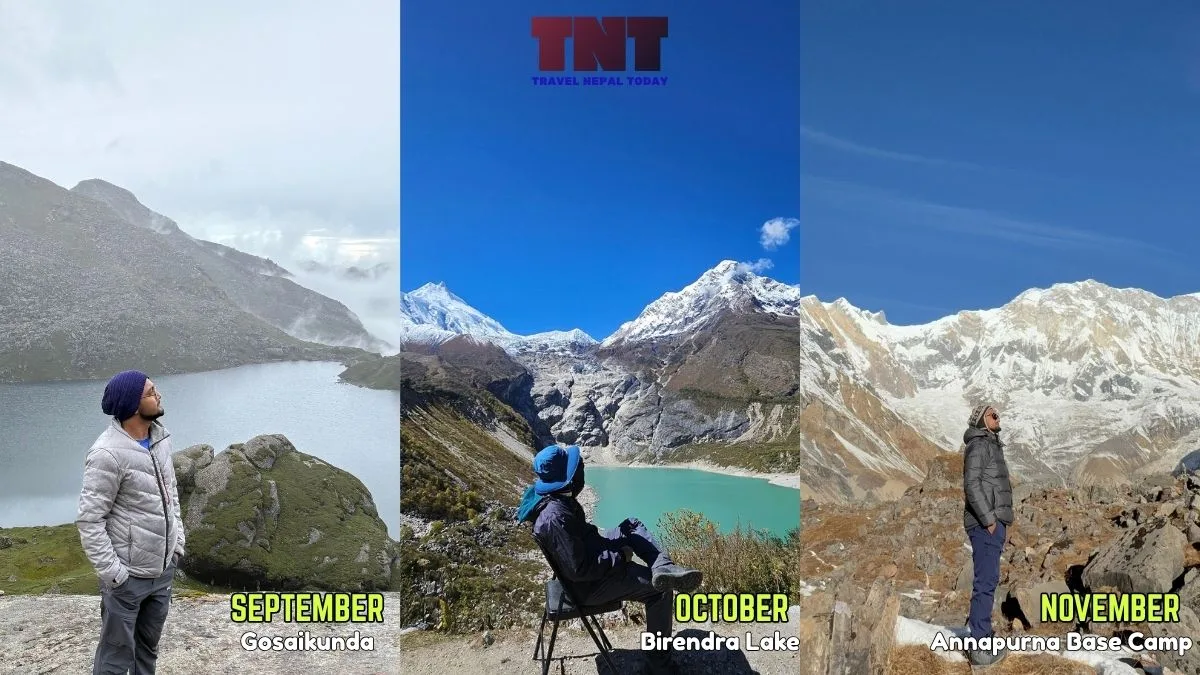
The monsoon-friendly short treks are the ones I would look at first: Gosain Kunda, Panch Pokhari and Helambu region.
They are close to the capital, and in September, they are green, quiet, and, for Gosaikunda, busy with pilgrims around Janai Purnima (usually it’s August).
If the weather turns, you are back in Kathmandu in a day or two. One warning for 2026: Gosaikunda is usually reached through Dhunche, and the Rasuwa road corridor is damaged.
However, alternative routes are opening up, and the same road is also under renovation, so expect the normal route via Gosaikunda to be open soon! If that happens, even the Langtang Valley Trek becomes possible via Dhunche-to-Thulo-Syaprhu trail.
The longer walk from Sundarijal over Helambu, crossing the Laurebina Pass (where Suryakunda Lake is located), is a popular alternative, so check the current road status before you plan your trek!
Rain Shadow Treks: Great If You Can Plan the Weather Window!
Upper Mustang, Dolpo and Nar Phu sit behind the big mountains, where the monsoon arrives weakened.
They can be superb in September, with dry trails, huge landscapes and almost no crowds. But the challenge is the road to reach there!
Some years the road is blocked, and walking is the only way. In late September 2026, the Marsyangdi road was washed away, and a landslide at Thasang in Mustang partly blocked the Kali Gandaki.
Likewise, in dry seasons, even buses now reach Dunai, Dolpa. But during monsoon, you might require changing multiple vehicles (mostly jeeps) in the rural sections past Tallu Bagar.
So, my order of checking is simple: assess the road first, then check the weather window, and only then decide.
Avoid Long Routes Far From Kathmandu
Everest Base Camp, the Manaslu Circuit, the Annapurna Circuit and Kanchenjunga are not what I would recommend in September. You spend days away from the road, and the weather can turn at any time!
In 2026 alone, Manaslu lost two bridges on 6 September, and three weeks later hundreds of trekkers were stuck in Manang. Everest was outside the Rasuwa flood zone, but the Lukla flight remains the weak link.
View-Focused Treks: The Ones I Would Avoid
Poon Hill, Kokhe Danda, Mohare Danda, or even a short trip to Ghandruk are the clearest examples!
They are famous for panoramic views and not for adventure. Cloud cover below about 4,000 m can erase the only reason you came!
If you are choosing a trek for the mountains, September is the wrong month for these. I did the Kokhe-Mohare-Poon-Hill approach at the peak of Spring (in April) and ended up with zero visibility. So, reaching there in September for open skies: you have to be very, very lucky.
If You Already Know Nepal
I am not saying do not come here in September. Trekking in every season in Nepal is great. But most of you reading this are probably on your first or second visit, and I do not want a bad decision to ruin the trip you saved up for!
If you already know Nepal, then even August can be the best season for you. The trails are greener, quieter and more beautiful than ever. Just accept the challenges and the leeches!
And remember the mountains are not the only reason to come. The culture you see in the monsoon villages, in the festivals and on the pilgrim trails, is very different from what October or November shows you!
So, Should You Choose September or October?
I have already said a lot about October, so here is the short comparison, with mid-November added because that is where my research ended up:
| Factors | September | October | Mid November |
|---|---|---|---|
| Rain | Frequent, often for days | Less, but mid-month rain and cyclones are possible | Least, drier trails |
| Mountain views | Mostly early mornings | Clear skies, in a limited window | The clearest views |
| Crowds | Quiet | Heavy, with bookings full | Fewer than October, after Tihar |
| Cold | Mild low down, wet and cold up high | Good, cold above 4,000 m late in the month | Cold, with snow unlikely |
| Main risk | Roads, bridges, landslides | Cyclone storms, flight delays, crowds | Cold nights |
The average monsoon exit from 2008 to 2025 is 11 October, so I would plan anything that is not a rain shadow trek for after that date.
After the rain ends there is a weather window, but do not expect no rainfall and no heavy snowfall at all.
Autumn 2025 showed that! The monsoon withdrew on 10 October, then Cyclone Montha stranded trekkers in late October, and on 3 November an avalanche at Yalung Ri base camp killed 7 climbers.
October is known for clear skies, and you do get them, but in a limited window (arguable today, but if you read this article five years later, you’ll get me). It is also heavy with crowds!
Some of the groups who postponed from September pile into October. Its prime window still has the best advantages: less wet trails and good temperatures, with cold above 4,000 m that you can handle in proper layers, especially in late October. But a cyclone like the one in 2025 can happen, so do not treat any October date as a promise!
Personally, I would choose October over September because of all that. But after this research, and with season creep in mind, my suggestion for the best time to trek in Nepal would be early to mid-November.
Much better if you look up the dates of Bhai Tika and plan at least a week latter. That way, you get fewer locals on the trails, clear skies with very little chance of rain, and drier trails.
Snow is unlikely, which may disappoint a few of you, but if it snowed in late October, that snow remains up high.
Even late November to early December is great. I did Annapurna Base Camp then. No snow was a disappointment, but the clear blue skies and the clear views of the mountains right in front of me made it one of the best I have had for views!
So, if you want to see mountains, November it is. October’s temperatures can’t be matched in November (especially after mid-Nov), so expect cold without snow.
Tips to Plan Trekking in September
If you are still set on trekking in September, you do not have to cancel your plans. Just change how you approach them.
Here is how to plan smartly and stay safe when the weather gets unpredictable:
- Do not marry September or October. Sometimes August, or even July, opens up a good weather window, and for a short trek that can be perfect. For longer routes, it is the opposite. You will spend days out there and the weather changes often, so careful planning is essential!
- Around September, go short, or reach the drier trails before the rainy spells. Gosaikunda, Helambu and Panch Pokhari for short trips, and Mustang or Dolpo only after you have checked the road.
- Check the road first, then the weather window. A clear forecast means little if the bridge before the trailhead is gone.
- Follow the official news. DHM’s bulletins and its monsoon withdrawal announcement are the best source. A weather tool is useful for a rough idea, and most give figures for up to 10 days, but treat them as an idea and not a promise!
- Add buffer days, always. 2 to 3 spare days at each end, and no international flight on the day after your trek ends.
- Go through a trekking agency. Operators know what to do even when something goes wrong, from rerouting around a washed out bridge to arranging a helicopter. Also, check that your insurance covers helicopter evacuation at your trek’s highest point.
- Pack for wet and cold at the same time. A proper waterproof shell, a warm layer for camps above 3,500 m, gaiters for leeches, and zip-lock bags for everything that must stay dry.
Final Words
Let me say it plainly. September is no longer the best season to trek in Nepal, however many agency pages still sell it as the start of autumn.
The monsoon now leaves around 11 October on average. In 2026, it started leaving on 3 October, a flood had already taken Langtang’s road, two bridges had gone at Namrung, and hundreds of trekkers were stuck in Manang. A season that behaves like that cannot be called the best one!
But I will not tell you not to trek if you love adventure. Nepal is great at any time of the year, and the challenges are part of it, as long as you accept these: leeches, a closed road, a long detour, a day lost to cloud.
If you are ready for that, go, and enjoy trails that are quiet and green. If this is your first or second trip and you have one chance at the views, wait for at least October (much better – Early November).
In short, it is climate change, and the season is shifting. The clear weather I remember in late September now arrives around mid October, and the ultimate best views now come in November.
Expecting October to behave like September used to is the mistake, and planning for it should be the new normal. Treat October the way we used to treat September: the season is only just starting, and the clear days come later in the month.
Treat the calendar as a starting point, check the road and the weather window, and give yourself spare days.
And if you trekked in September in a recent year, tell me the route, the dates, and what the weather and the trail were like in the comments. Specific details help me, and all our readers, far more than a general opinion.
Happy travelling!
About The Author