
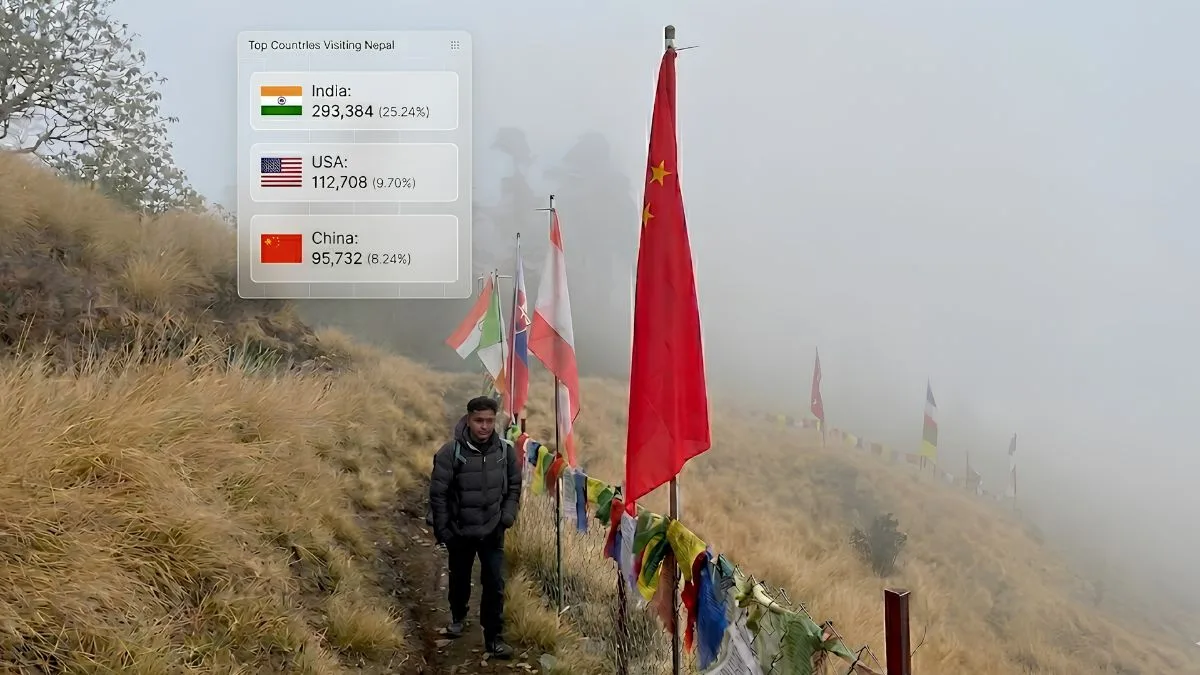
Nepal welcomed visitors from well over 100 countries in 2025, highlighting the broad international appeal of its tourism sector. Data from official Nepal Tourism Statistics reveals significant shifts in visitor patterns, including Bangladesh’s rise into the top five, Myanmar’s rapid growth, China’s slowing recovery, and continued changes in Nepal’s dependence on the Indian market.
What This Top Countries Visiting Nepal Article Covers:
- A complete table of all 18 officially tracked nationalities, including 2024 and 2025 arrival figures and percentage changes
- India’s continued position as Nepal’s largest source market and why its overall share of arrivals is gradually declining
- Bangladesh’s entry into Nepal’s top five source countries for the first time
- China’s tourism recovery losing momentum in 2025 following strong growth during 2024
- Myanmar’s remarkable 71% increase in visitor arrivals, the highest growth rate among all individually tracked countries
- Sri Lanka’s steady rise to become Nepal’s seventh-largest source market
- South Korea’s notable 12.75% decline and what it signals about changing travel trends
- An analysis of the combined data showing where Nepal’s international visitors are actually coming from
- Key regional trends across South Asia, East Asia, Europe, North America, and other emerging source markets
For a broader analysis of Nepal’s tourism sector, including total arrivals, tourism revenue, trekking activity, mountaineering statistics, and average length of stay, see the Nepal Tourism Data 2025 overview.
Nepal attracted visitors from well over 100 countries in 2025. The total was 1,162,365 tourists across the year, a 1.29% increase on 2024. Among those, 18 nationalities are tracked individually in the government’s annual report and together they account for about 80.93% of all arrivals.
But which countries came in what numbers, and what changed compared to the year before?
I went through the full nationality breakdown in the Nepal Tourism Statistics 2025 report so here is everything, country by country!
Nepal Tourist Arrivals by Nationality 2025: Complete Table
Here are all 18 nationalities tracked by the Department of Immigration, ranked by total 2025 arrivals, with their share and year-on-year change from 2024.
| Rank | Country | 2025 Arrivals | Share | 2024 Arrivals | Change |
|---|---|---|---|---|---|
| 1 | India | 293,384 | 25.24% | 317,781 | -7.67% |
| 2 | USA | 112,708 | 9.70% | 111,217 | +1.34% |
| 3 | China | 95,732 | 8.24% | 101,874 | -6.03% |
| 4 | UK | 58,935 | 5.07% | 54,765 | +7.61% |
| 5 | Bangladesh | 57,885 | 4.98% | 48,849 | +18.49% |
| 6 | Australia | 49,564 | 4.26% | 43,978 | +12.70% |
| 7 | Sri Lanka | 37,678 | 3.24% | 30,227 | +24.65% |
| 8 | Thailand | 30,361 | 2.61% | 30,746 | -1.25% |
| 9 | Germany | 30,320 | 2.61% | 29,799 | +1.75% |
| 10 | Japan | 24,859 | 2.14% | 22,854 | +8.78% |
| 11 | France | 24,590 | 2.12% | 25,118 | -2.10% |
| 12 | South Korea | 23,615 | 2.03% | 27,068 | -12.75% |
| 13 | Malaysia | 22,591 | 1.94% | 20,973 | +7.72% |
| 14 | Myanmar | 22,085 | 1.90% | 12,910 | +71.07% |
| 15 | Canada | 17,008 | 1.46% | 16,073 | +5.82% |
| 16 | Italy | 14,905 | 1.28% | 14,472 | +2.99% |
| 17 | Spain | 13,143 | 1.13% | 13,968 | -5.91% |
| 18 | Netherlands | 11,314 | 0.97% | 11,391 | -0.68% |
| – | Others | 221,688 | 19.07% | 213,505 | +3.83% |
| Total | 1,162,365 | 100% | 1,147,548 | +1.29% |
The “Others” category covers every country not individually tracked and represents nearly a fifth of all arrivals. In 2025, it grew by 3.83% from 2024, which signals continued diversification of Nepal’s source markets.
Now, let me walk you through the most important parts of this list.
India Remains Nepal’s Largest Source Market
India sent 293,384 tourists to Nepal in 2025, which works out to 25.24% of total arrivals. Roughly one in four visitors to Nepal comes from India, and that has been the case for years.
The reasons are well-known:
- Shared culture and history
- Land border connectivity
- Strong religious ties with sites like Pashupatinath, Muktinath, Lumbini, and Janakpur
- No visa requirement for Indian nationals
The land entry data confirms this: Belahiya (Bhairahawa) alone handled 104,088 land arrivals in 2025, and the majority of those are Indian visitors.
But the data also shows India’s numbers declined by 7.67% in 2025 (from 317,781 to 293,384), and its share of total arrivals dropped from 27.69% to 25.24%.
Some context helps here. India’s numbers had surged unusually in 2023 (319,936 visitors, 31.52% of all arrivals) and stayed elevated through 2024.
The 2025 figure is actually closer to what India was sending pre-pandemic: 254,150 in 2019 at 21.2% of total. The decline from 2024 looks like a return to baseline rather than a genuine drop in interest.
India has been Nepal’s largest source market for as long as the data goes back, and that is not changing.
USA: Holding Steady at #2
The United States of America sent 112,708 tourists to Nepal in 2025, a 1.34% increase from 111,217 in 2024. Its share held essentially flat at 9.70% versus 9.69% the previous year.
American visitors tend to cluster in trekking and mountaineering, which is why Nepal consistently appears on lists of top long-haul adventure destinations for US travelers.
Cultural tourism in Kathmandu and Lumbini pilgrimage are also strong draws. Peak months for US visitors were October and March, which aligns with the standard spring and autumn trekking seasons.
Looking at the longer arc, USA arrivals grew from 93,241 in 2019 to 112,708 in 2025, a 20.9% increase over six years. The US market has not only fully recovered post-pandemic but pushed meaningfully above its previous peak!
China: Recovery Has Stalled
China sent 95,732 tourists to Nepal in 2025, a 6.03% decline from 101,874 in 2024. Its share of total arrivals dropped from 8.88% to 8.24%.
This is the most significant trend to watch in Nepal’s nationality data right now. China was Nepal’s second-largest source market before the pandemic.
In 2019, 169,543 Chinese tourists visited Nepal, accounting for 14.2% of all arrivals. Then COVID and border closures reduced that to near nothing (6,198 in 2021).
The recovery from 2023 to 2024 was strong: 60,878 to 101,874, a 67.4% jump. But 2025 reversed part of that with a 6% dip to 95,732.
In practical terms, China’s 2025 arrivals represent 56.5% of its 2019 peak. That gap is substantial.
Whether the stalled recovery reflects ongoing flight connectivity issues, broader China outbound travel trends, diplomatic dynamics between the two countries, or something else entirely is not something the statistics report itself can answer. But the direction in 2025 was not encouraging.
UK: Solid Growth, Back Near Pre-Pandemic Levels
The United Kingdom sent 58,935 visitors to Nepal in 2025, a 7.61% increase from 54,765 in 2024. The UK is Nepal’s fourth-largest source country at 5.07% of total arrivals.
Before COVID, the UK was sending 61,144 visitors per year to Nepal (2019). In 2025, UK arrivals reached 58,935, essentially back at that level and continuing to grow. Among long-haul Western markets, the UK has one of the more complete recovery stories.
British visitors concentrate in the trekking and mountaineering segment. October, March, and April are the peak months, consistent with Everest Base Camp, Annapurna, and other classic routes.
Bangladesh’s Rapid Rise: A New Top 5 Country
Bangladesh sent 57,885 tourists to Nepal in 2025, an 18.49% increase from 48,849 in 2024. That moved it from #6 to #5, displacing Australia, and into Nepal’s top five source countries for the first time.
This has been building steadily. Bangladesh arrivals have grown from 25,849 in 2019 to 36,483 in 2023 to 48,849 in 2024 to 57,885 in 2025. That is more than doubling over six years!
The drivers are fairly clear:
- Bangladesh has a growing middle class with increasing disposable income and a strong appetite for regional travel.
- Nepal is geographically close (Dhaka to Kathmandu is a short direct flight).
- There is deep cultural familiarity.
- The Lumbini pilgrimage connection also matters, as Bangladesh has a significant Buddhist population and religious tourism to Lumbini from South Asia is growing broadly.
At 4.98%, Bangladesh is now very close to the UK at 5.07%. The gap is less than 1,000 visitors. If current growth continues, Bangladesh reaching #4 in 2026 is a real possibility!
Australia: Above Pre-Pandemic Levels and Growing
Australia sent 49,564 tourists to Nepal in 2025, a 12.70% increase from 43,978 in 2024. Despite falling to #6 after Bangladesh passed it, Australia’s own trajectory is strong.
Pre-pandemic, Australian arrivals peaked at 38,972 in 2019. In 2025, Australia reached 49,564, which is 27.2% above its 2019 peak. That makes Australia one of the few major source markets that has fully recovered and meaningfully exceeded pre-COVID levels.
Australian trekkers are a consistent presence on Himalayan routes, particularly on Everest Base Camp and Annapurna region. There is also a growing Nepali diaspora in Australia that contributes to VFR (visiting friends and relatives) travel.
Sri Lanka: Fastest-Growing Major Market in 2025
Sri Lanka sent 37,678 tourists to Nepal in 2025, up 24.65% from 30,227 in 2024. That makes Sri Lanka Nepal’s seventh-largest source country and the fastest-growing among the top 10.
Much of this growth is driven by religious tourism. Sri Lanka sent 32,287 visitors to Lumbini in 2025, making it the single largest third-country national group at the birthplace of the Buddha.
For Sri Lanka, a Buddhist-majority country, the Lumbini pilgrimage has become a significant travel motivator and the numbers reflect that clearly.
Sri Lanka’s recovery from the pandemic has been volatile: 56,316 in 2019, down to 463 in 2021 and 4,606 in 2022, recovering to 21,851 in 2023 and 30,227 in 2024. The 2025 figure of 37,678 keeps that trajectory moving, though it is still below the 2019 level.
European Markets: Germany Stable, France and Spain Slight Declines
Among European source markets, 2025 was a mixed year with no dramatic movements in either direction.
- Germany sent 30,320 tourists to Nepal, a 1.75% increase from 29,799 in 2024. Germany is Nepal’s ninth-largest source market. German adventure travelers are a well-established presence on Himalayan trekking routes and the numbers have been fairly stable for several years.
- France declined slightly to 24,590 visitors (down 2.10% from 25,118 in 2024).
- The Netherlands dropped marginally to 11,314 (down 0.68%).
- Spain pulled back to 13,143 (down 5.91%).
- Italy grew to 14,905 (up 2.99%).
None of these represent significant directional shifts. Western European markets collectively remain important for Nepal’s long-haul trekking segment but are not showing rapid growth.
Japan: Recovering Well, South Korea: A Concerning Dip
Japan sent 24,859 tourists to Nepal in 2025, an 8.78% increase from 22,854 in 2024. Japan has been on a steady recovery path: 5,714 in 2022, 16,463 in 2023, 22,854 in 2024, 24,859 in 2025.
The 2025 figure is still below pre-pandemic levels (30,534 in 2019), but the direction is positive and the gap is narrowing.
South Korea went the other way. Korean arrivals dropped 12.75%, from 27,068 in 2024 to 23,615 in 2025. Before COVID, South Korea was sending 31,108 to 37,218 visitors to Nepal each year. The 2024 recovery to 27,068 had looked promising. The 2025 dip back to 23,615 is a setback.
The reasons behind South Korea’s decline are not evident in the data. It is worth monitoring in 2026 to see whether this is a one-year pullback or a longer trend.
Thailand and Malaysia: Regional Markets Holding Steady
Thailand sent 30,361 tourists to Nepal in 2025, a very small decline of 1.25% from 30,746 in 2024. Thailand’s Buddhist community has a strong Lumbini pilgrimage tradition, and the monthly data shows Thai visitor spikes in February, March, and November that align with Buddhist festival calendars.
Malaysia grew to 22,591 visitors, up 7.72% from 20,973 in 2024. Malaysian arrivals have grown steadily from 21,329 in 2019 and are now above pre-pandemic levels.
Myanmar: The Most Dramatic Shift in the 2025 Nationality Data
A 71.07% increase in a single year deserves more than a sentence. Myanmar sent 22,085 tourists to Nepal in 2025. In 2024, that number was 12,910. In 2023, it was essentially the same: 12,929. So the 2025 figure nearly doubled in a year.
For context, Myanmar was a major source market before the pandemic. In 2018, Nepal received 41,402 visitors from Myanmar, which was 3.53% of total arrivals.
The COVID period combined with Myanmar’s internal political situation from 2021 onward collapsed that figure to near zero (344 visitors in 2021) and kept recovery sluggish through 2022 to 2024.
The 2025 jump to 22,085 is the biggest single-year percentage gain among all 18 tracked nationalities. But it is still only 60.9% of Myanmar’s 2018 peak. So this is recovery from exceptional lows, not a new high.
Whether 2025 represents a genuine trend change or a catch-up year after stagnation is something the 2026 data will clarify.
Canada: Slow and Steady
Canada sent 17,008 tourists to Nepal in 2025, a 5.82% increase from 16,073 in 2024. Canada holds 1.46% of total arrivals and has grown consistently from 17,102 in 2019 through the pandemic recovery.
It has a strong trekking tradition and a growing Nepali diaspora that contributes to consistent VFR travel.
What the Nationality Data Reveals About Nepal Tourism in 2025
A few things stand out when you look at the full picture.
Nepal’s tourism is becoming more geographically diverse. India’s share fell from 27.69% to 25.24%. The Others category grew to 19.07%. Bangladesh broke into the top 5. These are signs of a source market spread that is healthier and less dependent on one or two countries.
The South Asian corridor is strengthening. India (25.24%), Bangladesh (4.98%), and Sri Lanka (3.24%) together account for 33.46% of all arrivals. Add Myanmar (1.90%), Thailand (2.61%), and Malaysia (1.94%) and you are looking at South and Southeast Asian markets collectively driving close to 40% of Nepal’s international arrivals.
China is the market to watch most closely. It remains Nepal’s third-largest source country with 95,732 visitors, but it is still well below its 2019 peak of 169,543 and it went backward in 2025 after a strong recovery in 2024. If China returns to 2019 levels, that alone would add roughly 74,000 additional annual visitors to Nepal’s total, a significant boost.
And Myanmar’s 71% surge, dramatic as it is, should be understood as a recovery from pandemic-era lows rather than a new breakout. The real test is whether it sustains into 2026!
About The Author