Key Takeaways:
- Annapurna Base Camp snow is most likely from January to March, but there is no fixed date.
- April and May are calmer, June to August brings rain rather than snow at ABC, and late October can still deliver a snowstorm.
- Light snow can begin from around 3,000 m in a winter storm, so Ghandruk and Chhomrong are mostly rain stops, while Hinku Cave to Deurali, MBC (3,700 m) and ABC (4,130 m) are the real snow sections.
- Early December was clear and very cold on my trip; late December is when westerly storms start appearing in DHM bulletins, and the monsoon months bring rain and road washouts.
- 3 of the 4 recorded severe avalanche incidents I confirmed on the ABC trail fell in March or late October, two months many trekking agencies call the “best”.
- A light dusting, piled-up snow, route-closing snow, and avalanche conditions are four different problems, and avalanche trouble has been documented near Hinku Cave/Hinku River and Deurali.
- To check if it will snow, read the DHM bulletin for Gandaki Province, use a forecast pinned to ABC’s elevation, and recheck every evening because the trek takes 5 to 7 days.
- Fresh snow reflects up to 80% of UV radiation, so UV-blocking glasses belong in your pack in every season. Also, add gaiters and microspikes that help on packed ice, but full crampons are rarely needed except after heavy snow.
Annapurna Base Camp was a dream for me from the time I was in 10th grade, when I had just learned what mountains were and how wonderful trekking could be. In every picture I had seen, it was all white!
While I couldn’t get what I had imagined during my own trek in late November/early December, what I got was clear blue skies and views that felt like an October from the past. On top of that, a cold that crept in hard during the early mornings and late evenings.
For snow, I had picked the wrong time, and I knew it. But since my Mardi Himal Trek had surprised me with a light snow a year early in 2024, I was expecting something of that sort.
No snow, but not no ice. Melt from the earlier snowfall had left slippery, icy patches on the upper sections. However, for views, I had hand-picked one of the best times!
Yet, it left me with a question the usual pages could not answer: when is the right time to experience Annapurna Base Camp snow?
So, I went through dated news reports, DHM (Department of Hydrology and Meteorology) bulletins, and research papers. Here is what I found: there is no fixed date for snow at Annapurna Base Camp.
There is a window, and inside that window snow and ice come in different kinds, from the light dusting you picture to the black ice that tripped us up and the avalanche weather that has killed trekkers on this exact trail.
Well, ABC is a short trek, and anyone with basic fitness can do it (although those stairs and uphills are a real challenge!).
Snow changes that. And this is why this article gives you more than a list of months. It tells you which snow to hope for, which to avoid, and how to check before you commit your 5 to 7 days.
The Quick Answer: Snow at ABC Month by Month
Snow at ABC is most likely from January to March, and the dated record shows that March and late October carry surprises! Here is the whole year in one table:
| Period | Chance of snow at ABC | What it usually looks like? | Bottom Line |
|---|---|---|---|
| Early December | Low | Clear skies, very cold mornings and evenings (sharing my experience) | Good for views, poor for snow |
| Late December to February | High | Winter storms (westerly systems) leave snow on the upper trail | Real snow, real risk, allow extra days |
| March | High, strongest in the first half | Storms still arrive, and an avalanche killed a trekker on March 24, 2025 | Beautiful but not safe by default (proper planning is essential despite being a peak month) |
| April | Moderate to low | Old snow above Deurali, occasional fresh snow | Calmer than March |
| May | Low | Mostly rain and cloud building toward monsoon | Rarely a snow month |
| June to August | Very low at ABC | Monsoon rain, landslides, washed-out roads | Plan for rain |
| September to mid-October | Unpredictable | Rain, landslides, and a late storm is possible | Weather window matters more than the month |
| Late October to November | Low, with shock events | Heavy snow closed the trail from October 28 to 31, 2025 | Usually calm, occasionally not |
Note: Treat the above table as a rough picture built from several years, not a promise. A snowy March last year does not mean this March will be snowy. It means March is a month where you should expect to check. One exception to the table is that black ice can sit on the upper trail in most months, with or without fresh snowfall.
Which Sections of the ABC Trail Receive Snowfall?
Light snow can begin from around 3,000 m in a winter storm. So, on the standard route, the real snow sections are Hinku Cave to Deurali, Machhapuchhre Base Camp (MBC), and ABC, while Ghandruk and Chhomrong are mostly rain stops.
| Section | Snow chance in a winter storm |
|---|---|
| Ghandruk | Very low, rain in most storms |
| Chhomrong to Sinuwa | Low, a brief dusting only in the coldest storms |
| Bamboo to Dovan | Low to moderate, sleet or light snow that does not last |
| Himalaya | Moderate, patchy snow on the trail |
| Hinku Cave to Deurali | High, snow lies and the avalanche stretch becomes active |
| MBC | High, snow lies for days |
| ABC | Highest, and it stays longest |
Below 2,000 m, almost all winter precipitation falls as rain, and snow becomes a real share of it above 3,000 m.
Ghandruk sits right at that rain-only edge, so treat it as a rain stop! A snowy morning there would be a short, rare event, not something to plan around.
Chhomrong is only slightly higher, at about 2,170 m, and the same logic applies. In the coldest storms, you may wake to a thin dusting, and it will be gone by midday.
The village is a good place to read the sky and ask the lodge owners what fell above, since the ACAP check post is there too! The same is with Sinuwa (both Lower and Upper).
From Bamboo into the Modi River gorge, the chance climbs with every few hundred metres. Between Dovan and Himalaya Hotel you can meet sleet and light snow on a cold storm day.
Snow that actually lies on the stairs starts to become normal near Hinku Cave and Deurali, which is also where the avalanche trouble in the log sits. MBC and ABC receive snow first and keep it longest!
The snow line is not fixed. In late October 2025, snow was reported from MBC (3,700 m) upward, because autumn air is warmer.
Winter storms push it lower. The January 2020 avalanche hit at Hinku Cave, about 3,200 m, and rescue teams later found snow 12 m deep in places!
Here is the part that changes how you walk. The trail runs through a narrow gorge, so snow sliding off the slopes above can reach the path even on a day when no snow is falling on the path itself. The snow you meet on the trail may have fallen far above you!
Annapurna Base Camp Snow Month by Month Analysis
Weather patterns in the Annapurna Sanctuary do not follow a simple calendar. Because the trail climbs rapidly from subtropical forest into an alpine zone, atmospheric shifts play out hour by hour rather than month by month.
Here is how the snow profile actually evolves across the year:
January to March: The Snow Season
January to March is the window with the highest chance and the heaviest snow, and it is also the window with the deadliest ABC avalanche on record in recent years!
The winter-storm research above describes this period, DHM bulletins keep showing it (a westerly system with snow in the mountains of Gandaki Province was forecast in mid March 2026), and the dated incidents land here too!
Deep snow also slows you down! The trek normally takes about a week, but with deep winter snow it may take 8-9 days. So, plan for that; don’t stick with any outline itinerary!
April and May
April and May are the calmer months. Old snow lingers on the upper trail above Deurali early in spring, fresh storms can happen in early April, but by May, you are far more likely to meet rain and cloud than snow!
In the dated reports I collected, none of the ABC snow closures fall in April or May. That does not make snow impossible at 4,130 m, so keep a warm layer ready, but it tells you these are the months to pick if you want views over drama.
June to August
Plan for rain, not snow! DHM monsoon bulletins do still mention light to moderate snow for the high hills and mountains (a July 15 bulletin is one example), so I will not say “never.”
But the trouble in these months is on the way to ABC. On July 13, 2026, a flood on the Modi River washed away a section of the Nayapul to Ghandruk road and stranded about 300 domestic tourists!
September to Mid-October
This stretch is unpredictable, and it is risky for reasons that have little to do with snow: rain, landslides, wet clothes and crowds once October starts.
I have already explained in another article why September is no longer the best month to trek in Nepal. If you still go, snow is possible anytime in the window, so weather planning matters more than the calendar!
Late October and November
Late October is usually fine, but not always, and that is the biggest correction to the old rule of thumb. Heavy snow closed the ABC trail from October 28 to 31, 2025, and I will unpack that event in the log below.
November is generally calmer. Mine, at the very end of the month and into early December, had the clearest blue sky with no snow at all!
I have written before that October can be unpredictable, and that a lucky trekker might get beautiful snow in it. The 2025 storm is the other side of that luck!
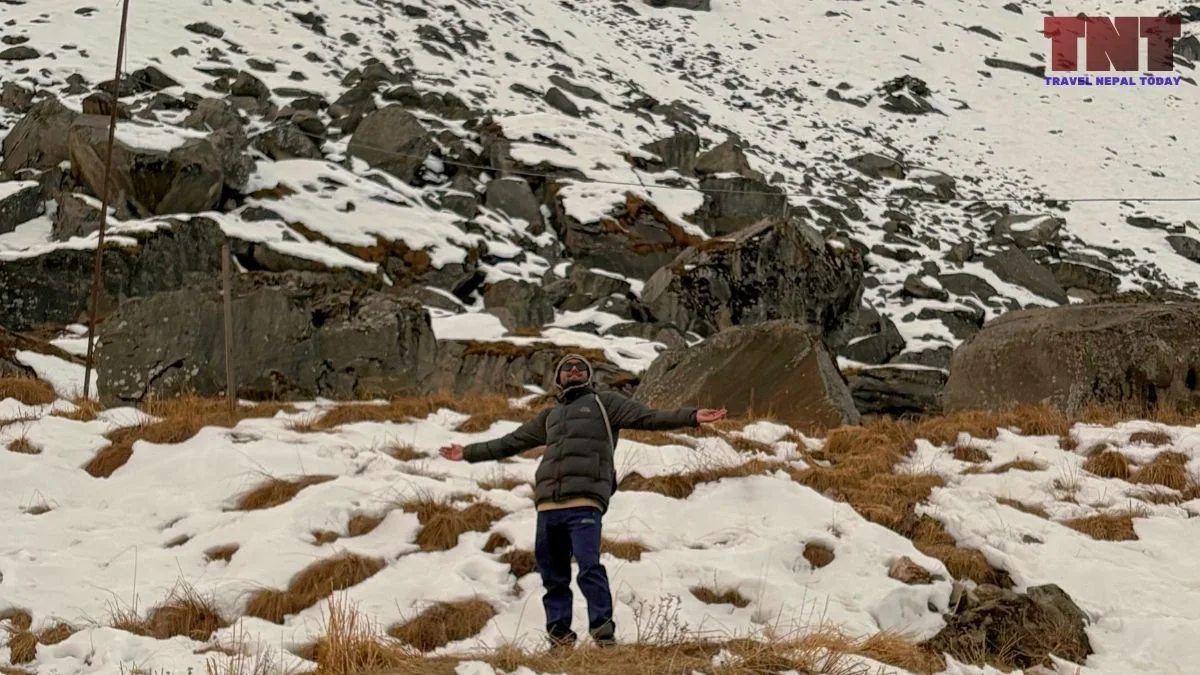
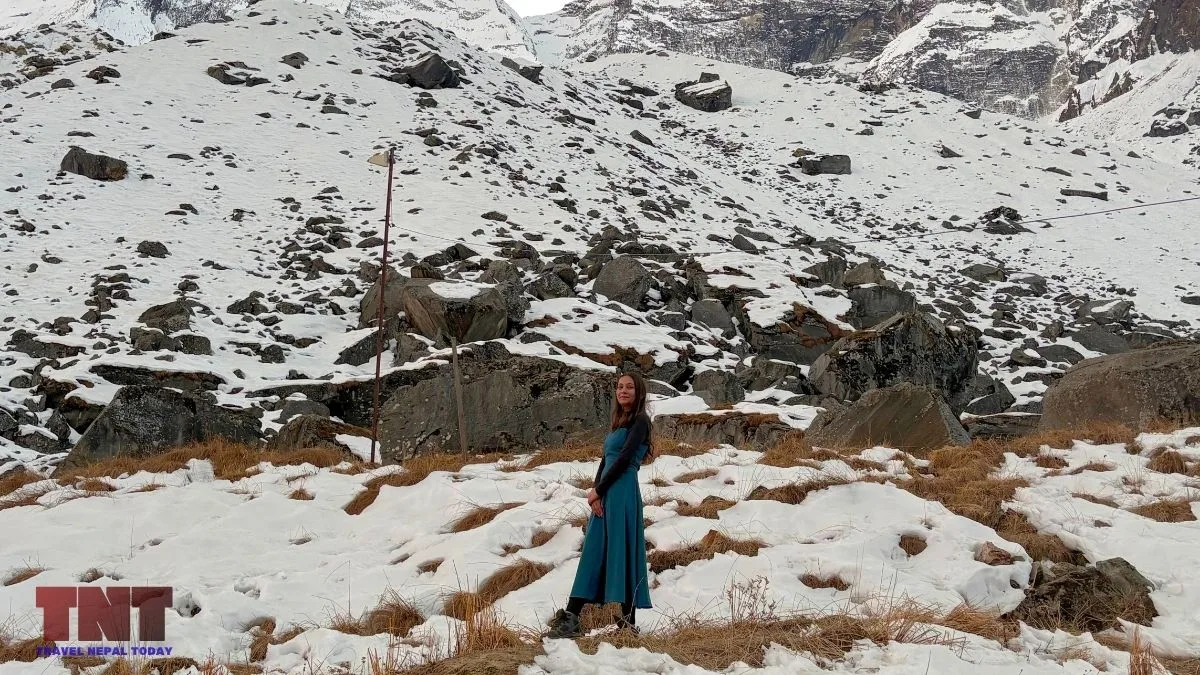
December
Early December can be clear and very cold (it was for me). Late December is when westerly storms start to show up in the bulletins.
The DHM issued a special winter precipitation bulletin on December 26, 2025, and the forecast for December 27 listed light rain or snowfall at one or two high places in Gandaki Province. Let’s see what happens in 2026…
The Snow Log: Serious News From the Past
The dated record shows that 3 of the 4 major avalanche incidents on the ABC trail fell in March or late October, the two months many operators rank among the best!
| Date | What happened |
|---|---|
| March 3, 2002 | An avalanche at Bagar, a day’s trek from ABC, killed 3 German trekkers, and their guide was presumed dead. |
| January 17, 2020 | An avalanche at Hinku Cave swept away 4 Korean trekkers and 3 Nepali staff, and at least 90 stranded people were flown out. |
| March 24, 2025 | An avalanche near Deurali on the way back from ABC killed a 28-year-old Chinese trekker, found on April 5. |
| Snow from the night of October 27, 2025 | Heavy snow from about 3,700 m upward; ABC (4,130 m) was blanketed, the Kaski side of the trail was closed by Annapurna Rural Municipality, and most trekkers had already begun descending. From the north side (the North ABC Trek), 72 people (17 foreigners) were rescued. |
Read that table carefully. Part of this pattern is plain crowding, since March and late October are when most trekkers are on the trail, so a bad snow day finds more people. But that is exactly the point!
The busiest months are the ones where snow does the most damage, and they are the ones sold to you as the “safe” months. This is a log of events that made the news, not a probability table, and I would not turn it into one.
Based on the evidence above, two popular assumptions deserve a reality check as we head toward 2027:
- “March and October are the safe shoulders.” Well, the log says otherwise. Both months carry documented hits, and both are peak trekking months.
- “Avalanche risk belongs to deep winter.” Of the 3 avalanches in the log, 2 happened in March, not January or February!
5 Kinds of Snow: Light Dusting to Avalanche Weather
I’m categorizing snow at ABC into five different types, and the one you dream about is only the first!
Light Snowfall: The Picture in Your Head!
A light dusting turns the sanctuary white without stopping you.
It can still make the stairs slippery and cut visibility, but this is the snow I went looking for and did not find.
If you want it, you are hoping for a storm that arrives and clears fast!
Black Ice: The Quiet One
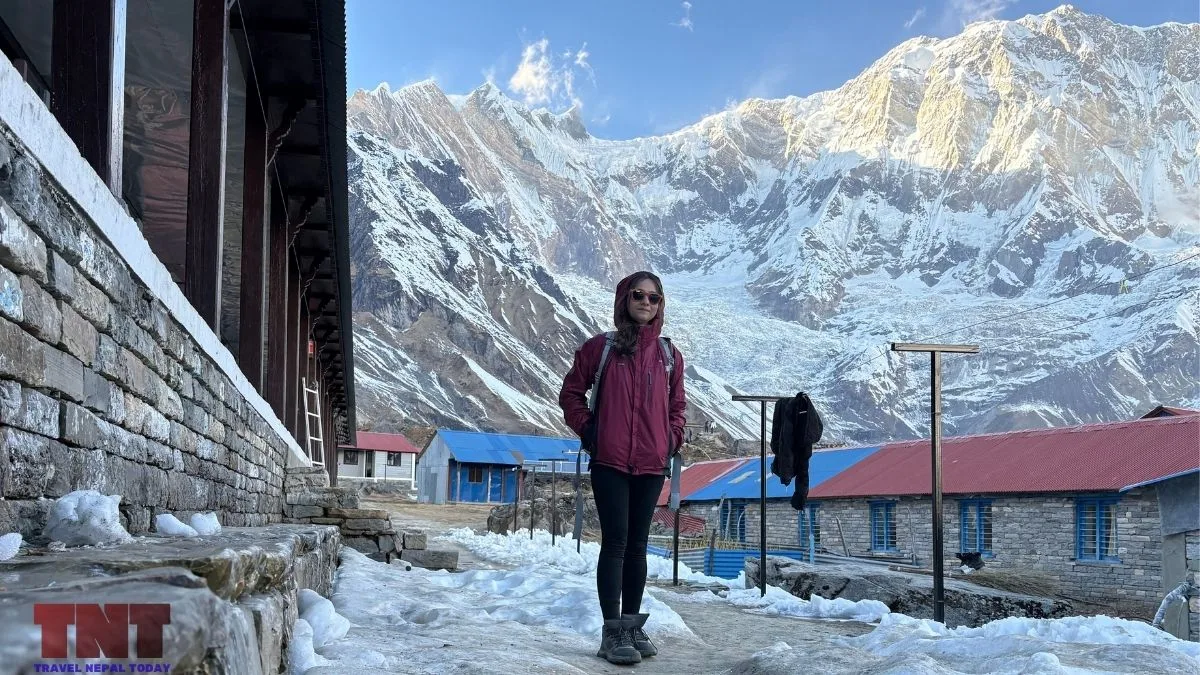
Black ice is the problem you are most likely to meet, because it needs no storm.
It is a thin, clear layer of ice that looks like wet stone, and it forms when snow or meltwater refreezes on shaded steps and trail, mostly in the cold hours of the morning and evening.
Even I met it at the end of November and the start of December 2025. The last snowfall I can date at ABC before my trip was the late October storm, about 4 weeks earlier, and its leftovers had melted by day and frozen again on the upper sections, mostly well above the villages.
The sky was clear, nothing was falling, and the stairs were still slippery. Sneha slipped and went down while I laughed, saying, “Machha Maryo!a Nepali slang: used when a person slips, trips, or takes a clumsy tumble (literal meaning: caught a fish!)“, and she stayed angry for the rest of the trail (sorry!). It looks funny for about a second, but a fall on these steps is a real risk!
Walk shaded sections slowly, test a wet-looking step before you trust it, and wear your microspikes.
Piled-up Snow: When the Trek Slows
Snow hides steps and trail marks and makes the descent harder than the climb.
As I said earlier, deep winter snow stretches a one-week trek to at least 8-9 days. So, starting early and carrying the days to spare is essential!
Heavy Snow: When The Trail Closes
Heavy snow is the kind that stops the trek instead of slowing it. In late October 2025, snow began falling on ABC on Monday night, and Annapurna Rural Municipality in Kaski closed the trail until October 31.
The snow had reached MBC as well, and ACAP confirmed that most trekkers who got to ABC had already started walking down before it grew heavier!
The timing made it harder. The snow began just as post-Tihar visitors were arriving, mostly domestic tourists. So, the trail was at its busiest right when it shut!
You see, a closure notice does not wait for your itinerary!
Avalanche Conditions: A Different Level of Risk
The documented avalanche stretch runs between Dovan and Deurali, at Hinku Cave and Hinku River (perhaps an alternative name given to “Modi Khola” in this section, as the water flows right beneath the cave).
In fact, there’s a huge board as you approach Deurali mentioning the risk of avalanches and floods. Check it out for yourself:
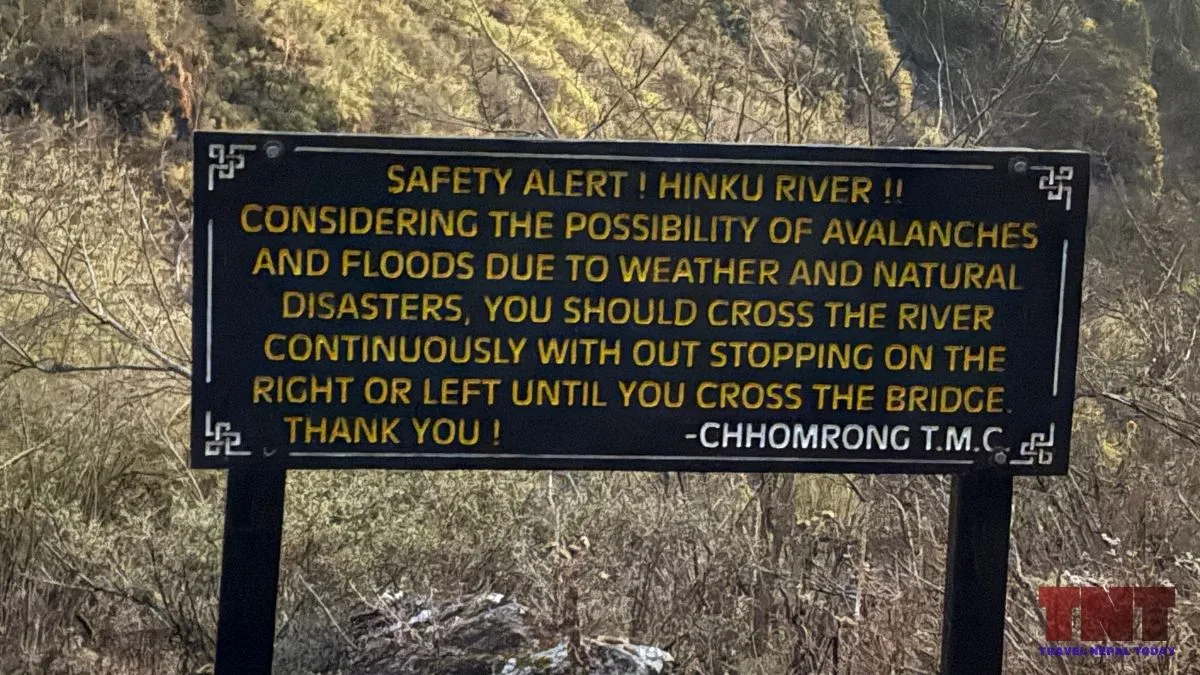
The reason is the shape of the ground. These few spots near Deurali are exposed to avalanches off the flanks of Hiunchuli and Annapurna South, which funnel snow and ice blocks onto the trail.
Heavy snowfall is what loads those slopes! The January 2020 slide was triggered by heavy snowfall, and the head of the ACAP (Annapurna Conservation Area Project) Chhomrong check post said they had warned tourists not to go above Chhomrong before it hit!
I am not an avalanche professional, but here is only the plain rule: after fresh heavy snowfall, do not cross Hinku Cave to Deurali. Wait at the lodge until local people tell you the slopes have settled, cross early in the day, and follow your guide!
How to Check If It Will Snow During Your Trek?
Spotting a winter storm before it traps you on the trail takes more than a glance at your phone screen. Here is how to read the actual weather signs for Annapurna Base Camp instead of guessing:
- Read the DHM bulletin: The Department of Hydrology and Meteorology writes in plain phrases. “Westerly wind” and “snowfall in the high hilly and mountainous areas of Gandaki Province” mean pay attention. Examples are the December 26 to 27, 2025 bulletins and the mid-March 2026 bulletins I mentioned above.
- Look backward as well as forward: Snow that fell last week still sits on those slopes.
- Treat Pokhara rain as a hint: If a westerly system is soaking Pokhara and the hills for a day or two, expect snow above Deurali. If it is dry, learn nothing from it.
- Use a forecast for ABC, not Pokhara: Look at the amount of precipitation and the temperature at about 4,000 m. A percentage chance of precipitation is not a chance of snow, because the same system can fall as rain or snow. More on this below!
- Ask every evening: The lodge owners at Chhomrong, Bamboo, Deurali and Machhapuchhre Base Camp (MBC) know what fell last night. So, seek their suggestion.
- Watch for district notices. In October 2025, Annapurna Rural Municipality closed the ABC trail until October 31, so ask your lodge, the municipality, or your agency before you start each day.
- Carry the days: Weather decisions need time! A trek with no buffer turns every forecast into a gamble.
Checking Pokhara Weather to Predict Snow in ABC?
ABC gets snow when moist air is forced up the mountains and the air is cold enough all the way down to the ground, and because ABC sits at 4,130 m, it can be snowing there while Pokhara is dry or soaked in rain!
Three things have to line up: moisture (water vapour carried by the wind), cold (the whole column of air, not just the temperature where you stand), and lift (the mountains push air upward, and it cools as it rises).
The best measurements come from a research network on the eastern slopes of the Annapurna range. The Lang and Barros study (2004) of central Himalayan winter storms found that:
- Below 2,000 m, nearly all precipitation falls as rain even in winter.
- Above 3,000 m up to 40% of annual precipitation can fall as winter snow.
That is the science behind “winter is snow season.” But it also explains the surprise of late October 2025.
The DHM said a westerly wind had combined with a low-pressure system over the Arabian Sea, producing moderate to heavy snowfall over the mountains of Manang and Mustang.
In the same 24 hours, Radio Nepal reported 64.4 mm of rain at Chame and 51.2 mm at Jomsom. Rain in the valley, snow above, on the same day. Snow was reported from Machhapuchhre Base Camp (3,700 m) upward.
So, here is my honest take on the “check Pokhara” idea. If a westerly system is soaking Pokhara and the hills, expect snow in the Annapurna Sanctuary.
But a dry day in Pokhara tells you nothing about what is falling at 4,130 m. Use it as a hint, never as a forecast!
Spring Snow vs Autumn Snow: Which is Riskier to Your Eyes?
Wear UV-blocking glasses whenever snow is on the ground, in any season, because the damage comes from ultraviolet (UV) radiation, not from brightness.
Snow blindness is photokeratitis, a sunburn of the eye’s surface. The World Health Organization notes that fresh snow can reflect as much as 80% of UV radiation, that UV levels rise 10% to 12% with every 1,000 m of altitude, and that clouds do not make you safe because scattered UV still reaches you.
At 4,130 m with snow underfoot, you are getting it from above as well as from below!.
I had heard that spring snow is harder on the eyes than autumn snow. The part that holds is the sun’s angle. The Cancer Council notes that UV is strongest when the sun is high and lower in winter.
So, April or May snow carries more UV than January snow, and October is in between.
But the practical rule does not change with the calendar: any clear day over snow is a day for proper glasses. A pair that is only dark is not enough, so look for 100% UV protection.
What to Pack for a Snowy ABC Trek?
Gaiters and UV glasses are the basics for snow, microspikes help on packed ice, and full crampons are rarely needed except after heavy snow.
Here are the absolute essentials:
| Item | When you need it? | Note |
|---|---|---|
| Gaiters (covers that seal the gap between boot and trouser) | Whenever snow is deeper than your ankle | Keeps snow out of your boots, gives no grip. |
| UV-blocking sunglasses | Any day snow is on the ground | Look for 100% UV protection. |
| Microspikes (small spiked chains that stretch over your boots) | Packed snow, black ice and icy steps | There are places that rent them, so ask in case you forgot to carry it. |
| Full crampons | After heavy snow or on hard ice | I do not see the need for them on the standard route in normal conditions, and your guide should decide. |
| Warm layers, waterproof shell, gloves | Always in the snow season | Cold and wet clothing is a risk even when no snow falls |
| Sleeping bag | Winter nights | Pick it by the lowest forecast night temperature, not by the month. |
As for the cold, even without snow, late November was already severe for me in the early mornings and late evenings. A night after fresh snow will be colder, so take the cold seriously before you take the gear list seriously.
Which Snow Should You Choose?
First-timers should aim for clear windows like late November to early December or April; experienced winter trekkers can aim for late January to mid-March too, and nobody should plan a trip when weather warnings say heavy snowfall is approaching.
| If you are… | Aim for | Why | Watch out for |
|---|---|---|---|
| A first-timer who wants views | Late November to early December, or April | In the dated log, none of the incidents fall in these windows | Very cold mornings and evenings, as I met in 2025 |
| An experienced walker who wants real snow | Late January to mid March | This is where the winter-storm research and the incident log point | Allow more days, do not cross Hinku Cave to Deurali after fresh snow |
| Hoping for a lucky October snowfall | Do not plan it | The late October 2025 storm blanketed ABC and halted all trekking (such things can happen any time) | An overcrowded time; news of possible heavy snowfall in the Annapurna region |
Final Words
I did not get my snow at ABC. I still want it, and nothing in this research changed that. What changed is what I am willing to ask of the mountain!
The honest answer to Annapurna Base Camp snow is that it happens in a window, January to March, with surprises on both edges and a late October storm that no best-month list had room for.
The harder answer is when to go for snow, because the snow that makes the photograph and the snow that closes the trail come out of the same weather system!
Here is where I land. If you are new to trekking, go when the odds of snow are low and the skies are clear, like the late November to early December window I walked, or April. You will still get the mountains, and you will still earn them on those stairs.
If you are an experienced walker who wants snow, choose late January to mid March, give yourself at least 8-10 days, and treat the stretch between Dovan and Deurali with respect. Do not cross it after fresh heavy snow, however close the sanctuary feels!
And do not plan a trip around time like the late October 2025 snow. Take it if a storm hands it to you, with a guide who knows when to say no!
March and September are the crowded months, and the dated record says crowds and snow do not mix. While March could be great, September’s risk is too high!
When I do the ABC trek again (this time for the snow), I will read the bulletin every evening and carry spare days, because the Annapurna Sanctuary will still be there next week.
Happy travelling to Kaski!
About The Author