Key Takeaways:
- Annapurna I is the 10th highest mountain in the world at 8,091 m. It is the only 8,000 m peak in the Annapurna massif.
- Climbers also call it the “Killer Mountain“, while “Annapurna” is a Sanskrit name, which means “full of food” and points to the Hindu goddess of nourishment.
- Maurice Herzog and Louis Lachenal made the first ascent on June 3, 1950. It was the first 8,000 m peak ever climbed.
- Trekkers and climbers see two different mountains. The south face is above Annapurna Base Camp. The normal climbing route is on the north side and you get to see its north face if you’re doing the North ABC Trek.
- On the classic ABC trek, the big peak in front of you is usually Annapurna South (7,219 m), not Annapurna I.
- The fatality rate is 13.42% (75 deaths, 559 ascents, as of early 2025).
- For foreign climbers, the royalty is US$ 3,000 in spring, US$ 1,500 in autumn and US$ 750 in winter and summer. A US$ 3,000 garbage deposit applies per team.
Climbers also know Annapurna I by a darker name, the “Killer Mountain“. For decades, it killed roughly one climber for every three who reached the top!
In Nepal, people see it differently, as the home of the goddess of food and harvest, which is why you will also read “Goddess of the Harvests” next to its name.
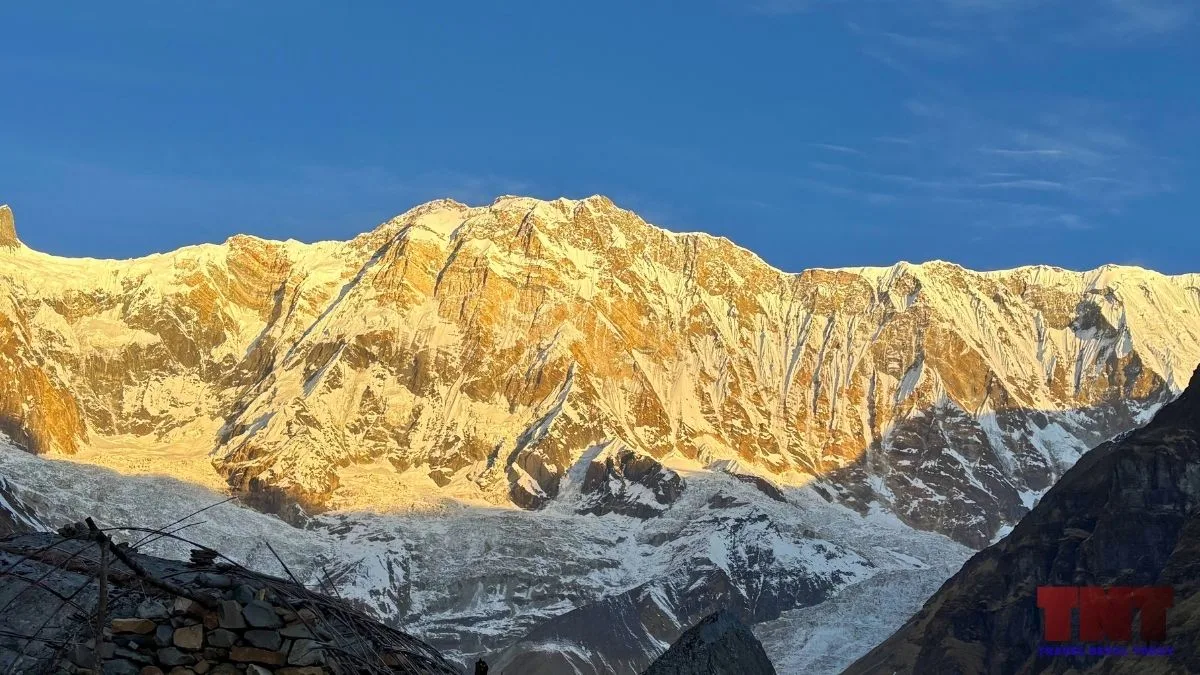
The south side is a huge wall above the Annapurna Sanctuary. The north side is where climbers go. And the closer, lower peaks hide the summit from most viewpoints!
This article is about the mountain itself, not the whole range. It explains how it was measured, what each face looks like, and where each one can be seen from.
It also covers the glaciers, the climate and hazard story, the climbing history and what Nepal currently charges for an expedition. Let’s start!
Key Facts About Annapurna I
| Elevation | 8,091 m (26,545 ft) |
| Location | Annapurna Rural Municipalities of Kaski and Myagdi Districts, Gandaki Province |
| Coordinates | 28°35′46″N 83°49′13″E |
| First Ascent | June 3, 1950, Herzog and Lachenal, no supplementary oxygen |
| First Winter Ascent | February 3, 1987, Jerzy Kukuczka and Artur Hajzer |
| First ascent by women | October 15, 1978 (Vera Komarkova and Irene Miller) |
| First Nepali women’s ascent | April 16, 2021 (six women) |
| Protected Area | Annapurna Conservation Area |
| Fatality Rate | 13.42% (75 deaths, 559 ascents, early 2025) |
| Main Glaciers | North Annapurna Glacier, Annapurna South Glacier |
| Rank | 10th highest mountain in the world |
| Other Names | Annapurna Main, Annapurna First, “Killer Mountain” |
| Name Meaning | “Full of food”, usually translated as Goddess of the Harvests |
| Lower Summits | Annapurna I Central (8,051 m) and Annapurna I East (8,010 m) |
| Climbing Seasons | Spring (March to May) and a short autumn window in October |
Annapurna I and the Peaks Around It
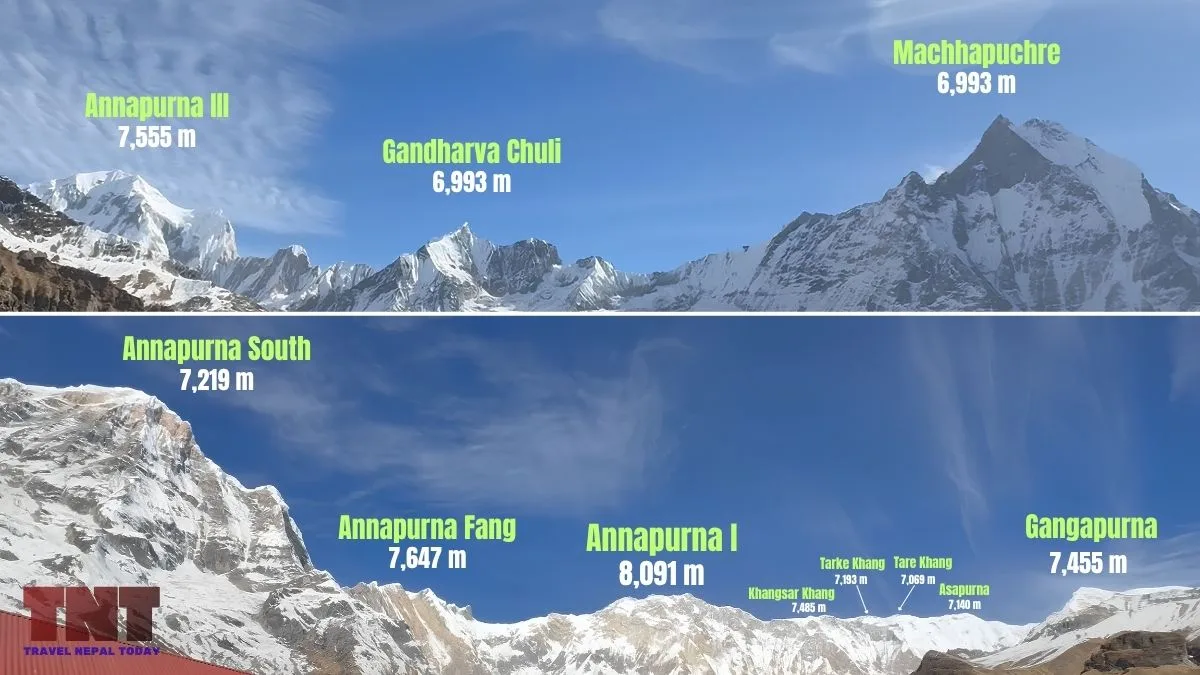
“Annapurna” can mean the whole range or its highest peak. Annapurna II, III and IV are separate mountains, and this article does not cover them.
Here are the peaks that matter for understanding Annapurna I:
| Peak | Height | Relation to Annapurna I |
|---|---|---|
| Annapurna South | 7,219 m | In front of it from the south. Often mistaken for it by trekkers doing the Annapurna Base Camp Trek. |
| Hiunchuli | 6,441 m | Extension of Annapurna South |
| Annapurna Fang (Varaha Shikhar) | 7,647 m | On the ridge to the west |
| Khangsar Khang (Roc Noir) | 7,485 m | On the east ridge |
| Machhapuchare | 6,993 m | East side of the Sanctuary entrance |
Note: Annapurna I also has two lower summits on its east ridge, called Annapurna I East and Annapurna I Central. Both lower summits stay above 8,000 m, but most records treat them as part of Annapurna I rather than as separate 8,000 m peaks.
What Does Annapurna Mean?
People search for “Annapurna 1”, “Annapurna First” and “Annapurna Main”, but they all mean the same mountain. The Roman numeral is the standard form.
The name is Sanskrit. Anna means food and purna means filled. It is usually translated as “full of food” or “goddess of abundance”, after the Hindu goddess of nourishment.
In August 2026, Annapurna Rural Municipality proposed adding the name of the late climber Nirmal Purja to the mountain.
Here is what happened: on 30 July 2026, Nirmal Purja (Nimsdai) died with nine other climbers in an avalanche on Broad Peak in Pakistan.
He was born in the Annapurna region, and Annapurna was the first mountain of his 2019 “Project Possible” campaign, which he began on 23 April 2019.
On 18 August, Annapurna Rural Municipality approved a museum and a life-size statue in his memory. It also proposed the name “Nimsdai Annapurna” for the mountain and “Nimsdai Maurice Herzog Trail” for the north-side trek.
Both name changes need federal approval, and the municipality head said they would consult Herzog’s family first.
While the mountaineer’s legacy is deeply respected, altering Annapurna’s iconic name risks diminishing its historical significance. This proposal has already sparked widespread debate, and our TNT team hopes it will not be implemented. The trail name being changed to “Nimsdai Maurice Herzog Trail” could be interesting, though.
How Tall Is Annapurna I? The Survey Story
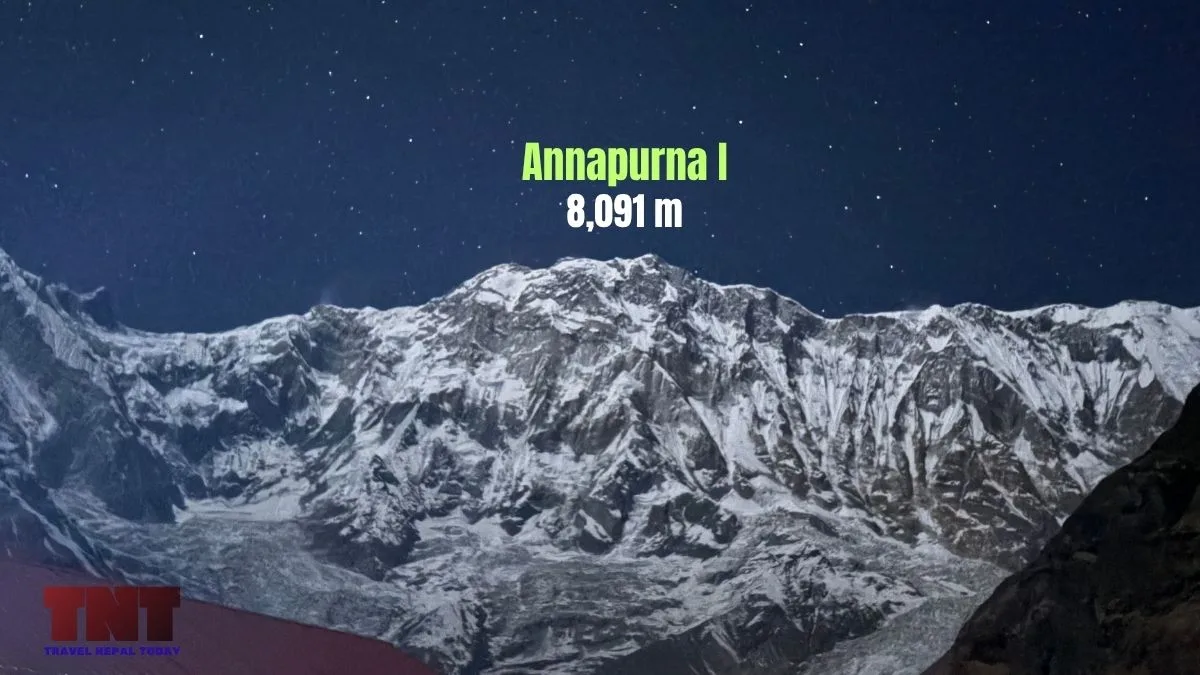
Annapurna I was measured long before anyone climbed it. A 2025 paper from Nepal’s Survey Department explains how.
Surveyors of the Great Trigonometrical Survey recorded it as “Peak XXXIX” from stations far away. The paper gives an early value of 26,492 ft (8,075 m). The 1929 Survey of India map showed 8,078 m, and a 1963 map showed 26,545 ft, which is 8,091 m.
However, Nepal’s Survey Department has not made direct field observations to measure the height of any high mountain except Everest. So, 8,091 m is the accepted figure, but it is a legacy value, not a modern summit measurement.
Annapurna I vs Annapurna South: The Most Common Mix-Up
Many people believe the huge peak they see from the ABC trail is Annapurna I. However, most of the time, they are mistaken – it is Annapurna South.
Annapurna South (7,219 m) is the mountain that fills the view from Chhomrong, Ghandruk, and the upper Sanctuary trail.
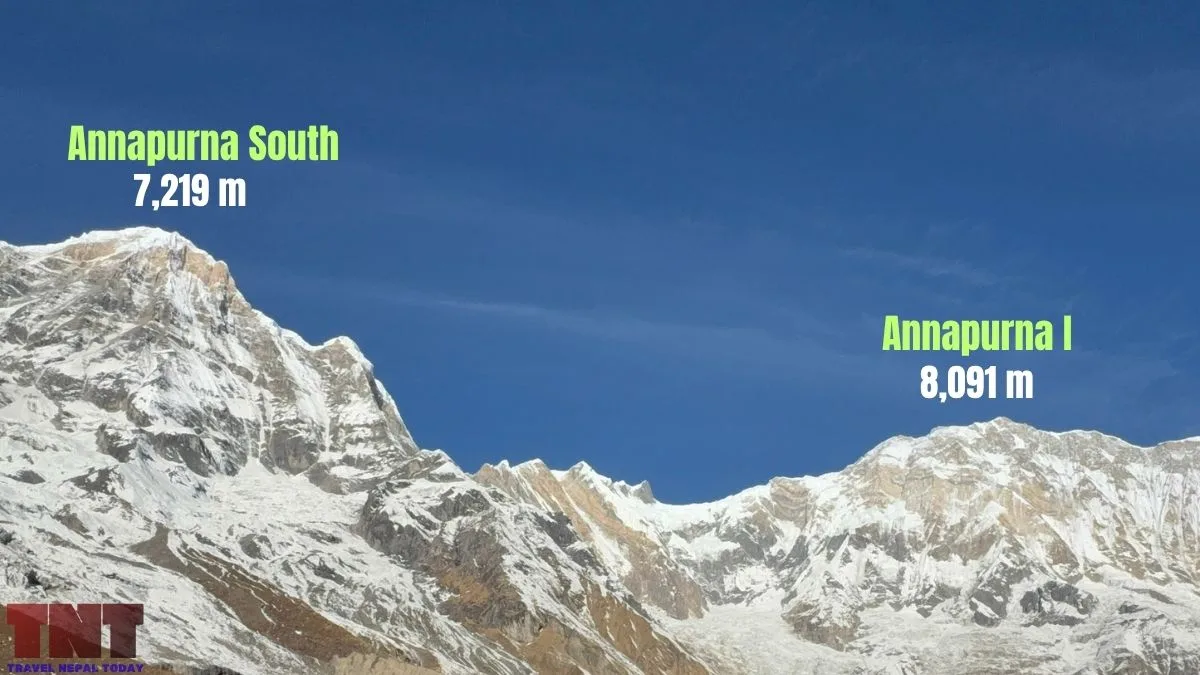
Its parent peak is Annapurna I Main. Hiun Chuli, the lower peak next to it, is its extension. Together with Machhapuchare, they stand as the “gates” of the Annapurna Sanctuary, leading to the south face of Annapurna I.
In simple terms, yes, you stand right in front of Annapurna I, but only after you start approaching the base camp (the peak is visible from MBC). Don’t confuse it with Annapurna South!
Here is how to tell them apart:
- From Chhomrong and most parts of the trail: the big pyramid in front of you is Annapurna South. Annapurna I is farther back and often partly hidden.
- At Annapurna Base Camp: Annapurna I is to the north-west while Annapurna South is to the south-west.
- Height: Annapurna South is closer to the trail and sits right behind the giant board, so many often overlook it in favour of the real giant sitting to the right!
The Faces and Routes of Annapurna I
Mountaineering records do not describe Annapurna I with four neat faces. They describe a north face, a south face, an east ridge, and a west or southwest side.
The 1950 French team did not plan to climb Annapurna. They first searched for a route on Dhaulagiri, decided it was too hard, and switched to Annapurna with the monsoon close.
Herzog later wrote a book about the expedition that sold widely and shaped how the public saw Himalayan climbing.
| Face or ridge | Seen from | Main climbing history |
|---|---|---|
| North face | North Annapurna Base Camp (aka Annapurna First Base Camp), Miristi Khola valley | 1950 French route, Dutch Rib (1977), northwest spur (1996) |
| South face | Annapurna Base Camp (Sanctuary) | Bonington route (1970), Polish routes, Béghin-Lafaille line |
| East ridge | Distant views from the north and the Manang side | Spanish route (1974), Lafaille and Inurrategi traverse (2002) |
| West and southwest | Lete in the Kali Gandaki valley (northwest face) | 1997 Boukreev attempt. No clear complete ascent found |
North Face
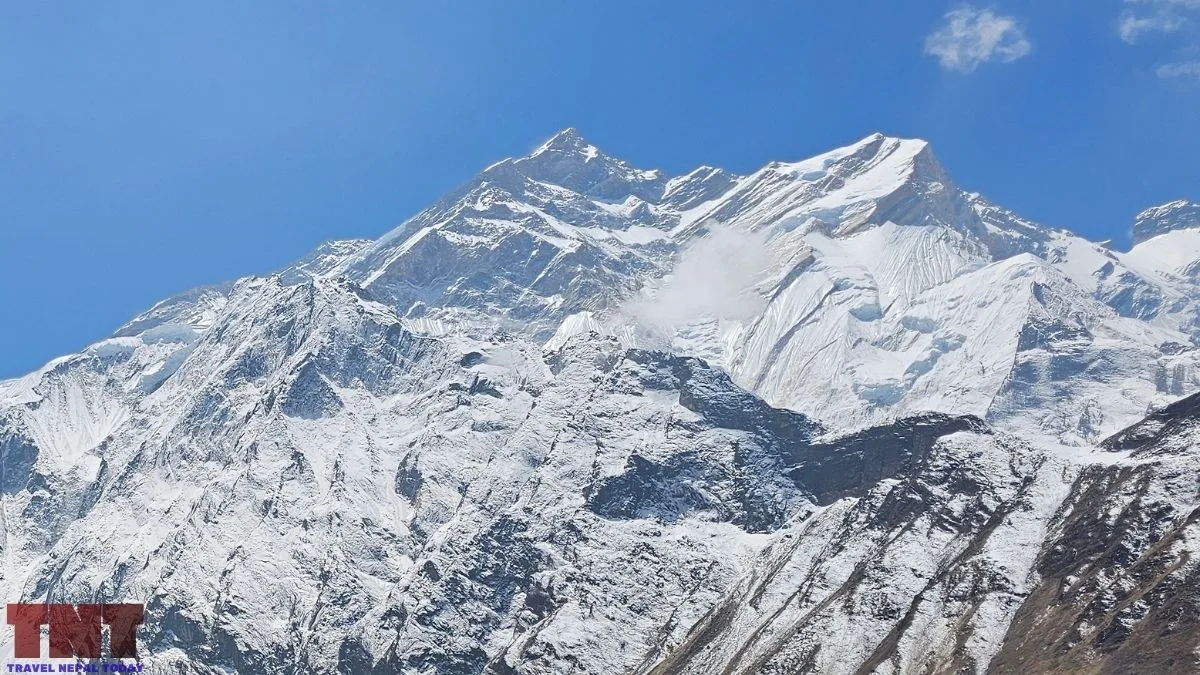
This is the side where the mountain was first climbed by Maurice Herzog and Louis Lachenal!
The 1950 route climbs the North Annapurna Glacier, passes an ice cliff the French called the “Sickle”, and goes up through it to the snowfields above. The slope angle is lower than the south face, but avalanche risk is very high.
Three routes matter here:
- The French route: The 1950 line.
- The Dutch Rib: The Royal Netherlands Alpine Club opened it in 1977. Mathieu van Rijswick and Sherpa Sonam summited on October 13, 1977. It is the line most commercial teams use today.
- The northwest spur. A Polish team first climbed it in 1996.
The most dangerous stretch lies between Camp II (5,460 m) and Camp III (6,400 m). At around 5,900 m, a recurring avalanche hazard at this point accounts for the majority of deaths.
South Face
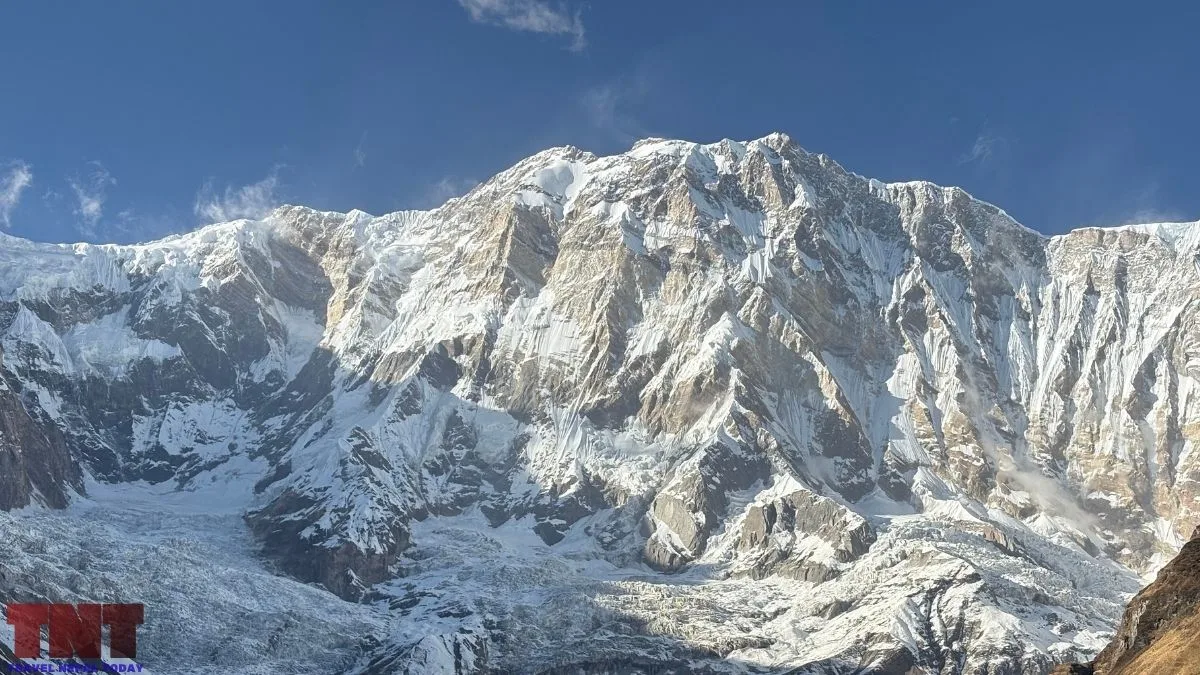
The south face is a wall of about 3,000 m above the Annapurna Sanctuary:
- 1970: The British expedition led by Chris Bonington made the first serious route on an 8,000 m face. Don Whillans and Dougal Haston reached the summit. Ian Clough died in a serac fall.
- 1981: Polish climbers Maciej Berbeka and Bogusław Probulski climbed a new route to Annapurna I Central.
- 1992: Pierre Béghin died while attempting a line on the right side with Jean-Christophe Lafaille. It is now known as the Béghin-Lafaille route.
- 2007: Tomaž Humar made a solo attempt on a new line!
- 2013: Ueli Steck claimed a 28-hour solo of the Béghin-Lafaille line. The claim is disputed, though. The American Alpine Journal noted that there is no summit photo, and analyst Rodolphe Popier argued against it. The Piolets d’Or jury honoured it anyway!
East Ridge
The east ridge links the main summit to Annapurna I Central and East, and on to Roc Noir.
In 2002, Jean-Christophe Lafaille and Mikel Inurrategi traversed it from east to west, because descending either face was too dangerous.
West and Southwest Side
The west and southwest side runs toward Annapurna Fang.
In December 1997, Anatoli Boukreev, Dmitri Sobolev and Simone Moro attempted the east face of Fang and Annapurna’s southwest ridge.
A cornice from the western wall set off an avalanche on December 25. Boukreev and Sobolev were killed, but Moro survived.
Where to See Annapurna I From?
While Annapurna I is one of the most formidable peaks on Earth, catching a glimpse of its actual summit can be surprisingly tricky due to the surrounding lower ranges.
Depending on whether you are looking for the south face from the deep river basin or the north route from afar, here are the best viewpoints to spot the true giant.
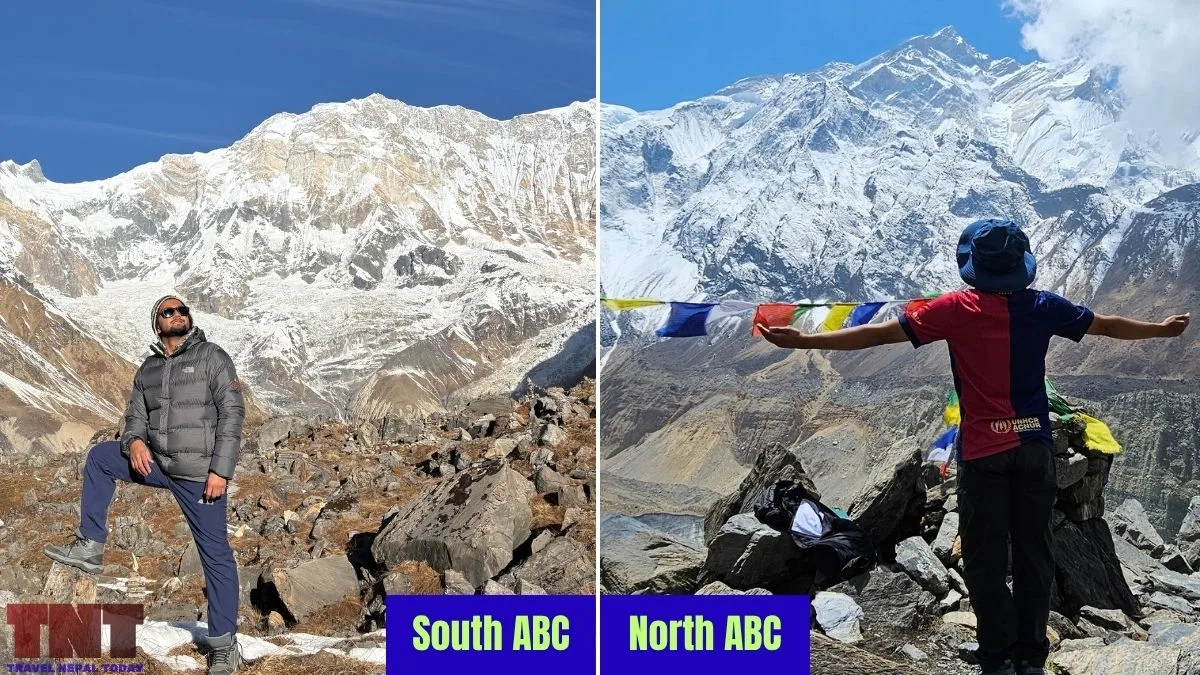
The Two Base Camps for Trekkers
| Factors | Annapurna Base Camp (South ABC) | North Annapurna Base Camp |
|---|---|---|
| Altitude | 4,130 m | 4,190 m |
| Side of the mountain | South | North |
| Face you see | The south face rising above the glacier | The north face and the 1950 route |
| Approach | Through the Annapurna Sanctuary | Up the Miristi Khola, from Narchyang |
| Trail name | Annapurna Base Camp Trail | Maurice Herzog Trail |
Annapurna Base Camp sits inside the Annapurna Sanctuary, the high basin on the south side. This is the base camp for the south face, and the one most trekkers visit!
North Annapurna Base Camp is the base of the normal climbing route and has been a trending destination among the locals. It is only about two days’ walk from Narchyang starting Hum Khola (2,883 m). Reportedly, the trail was identified in 2011 and officially mapped in 2020.
Other Viewpoints
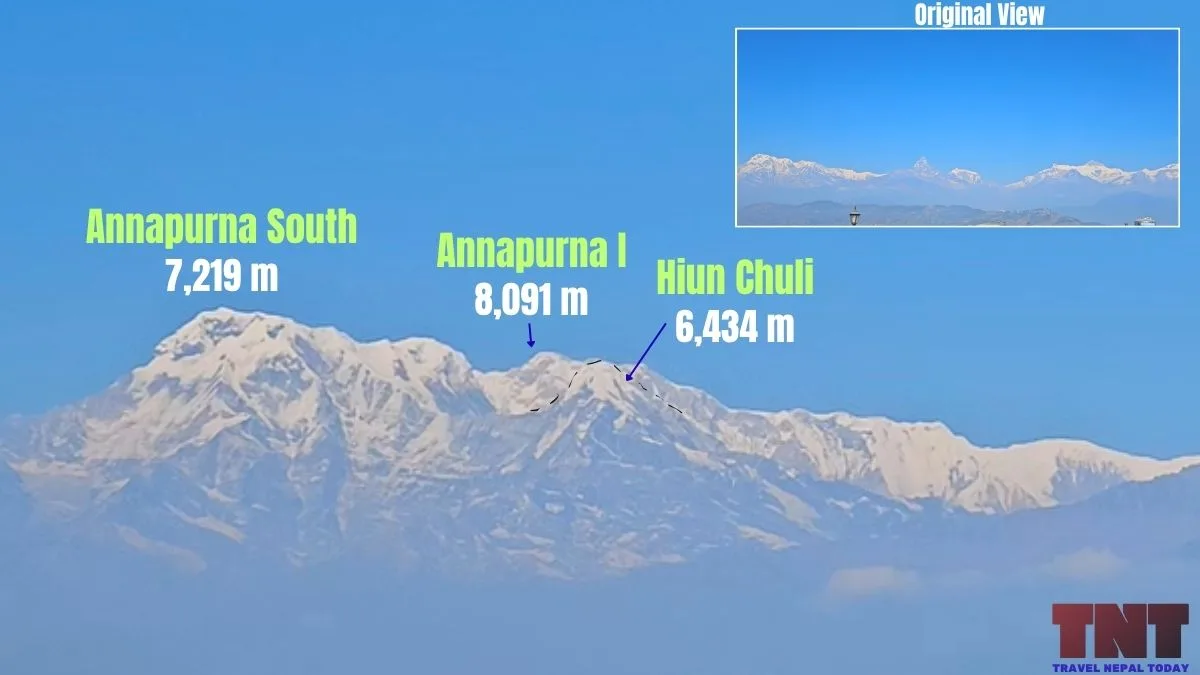
If you are looking to admire the giant peak from afar, here are the best alternative spots to catch a view:
- Poon Hill (3,210 m). Annapurna I is among the peaks visible with Dhaulagiri, Annapurna South, Hiunchuli, Machapuchare and Nilgiri. Annapurna South is nearer and looks bigger, so as mentioned earlier, don’t confuse it!
- Pokhara (822 m). Machapuchare, Hiunchuli, and Annapurna South dominate the view. However, on clear days, you can indeed see the peak of Annapurna I from viewpoints like Pumdikot. So yes, it can be seen from the Pokhara area, but only as a distant, partly screened summit. Do not expect it to stand out!
- Lete (Kali Gandaki valley). One of the few places on the Annapurna Circuit trail with a clear view of the Annapurna northwest face.
The Glaciers of Annapurna I
Annapurna I is made of the Tethyan Himalayan Sequence, a stack of early Paleozoic sedimentary rocks.
The summit is formed by the Nilgiri Formation, which includes Ordovician limestone and dolomite. Below it are the Cambrian Annapurna Yellow Formation and the Sanctuary Formation.
These rocks were laid down on the northern shelf of the Indian plate. They were folded and lifted when the Indian plate collided with the Eurasian plate.
The two main glaciers of Annapurna I are listed below.
Annapurna South Glacier
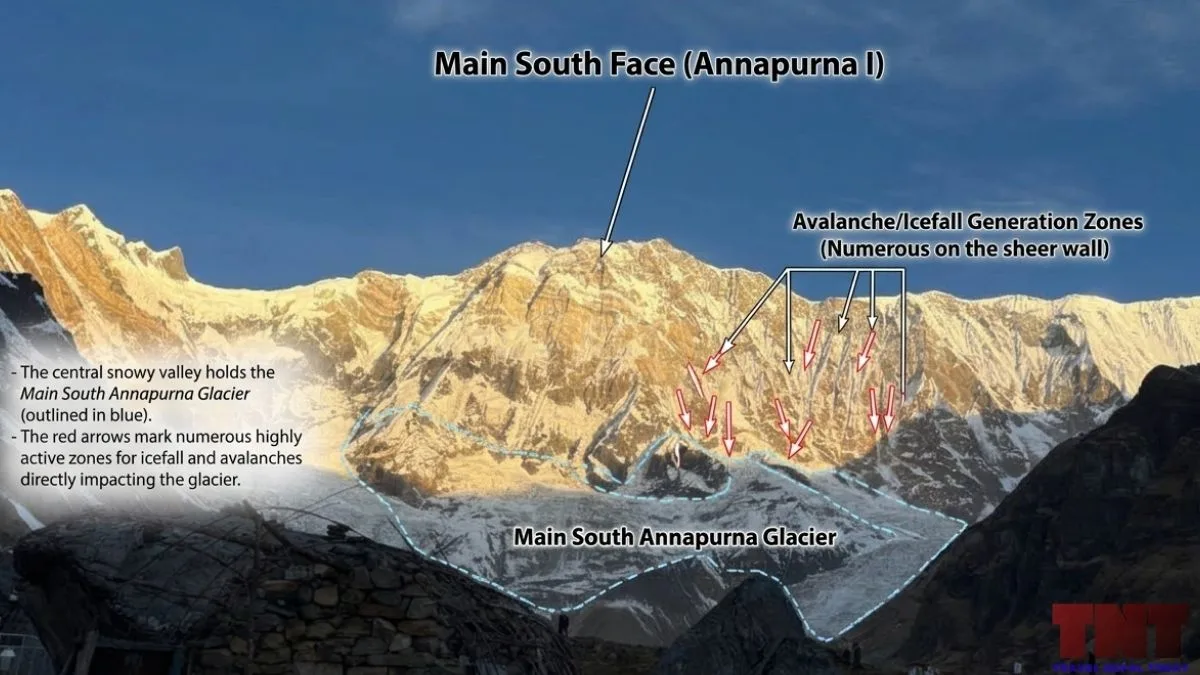
Annapurna South Glacier lies at the foot of Annapurna I.
Newcastle University researchers studied it in the field in 2016 and 2017. It has a debris-covered tongue about 5 km long, cut off from its high-elevation accumulation areas. Radar measurements found ice up to about 200 m thick!
Satellite studies by Lovell, Carr and Stokes (2019) show clear surface lowering on its ablation zone, the part where melting exceeds snowfall. Velocities on its lower tongue were 0 to 21 m a⁻¹ in 2016.
North Annapurna Glacier
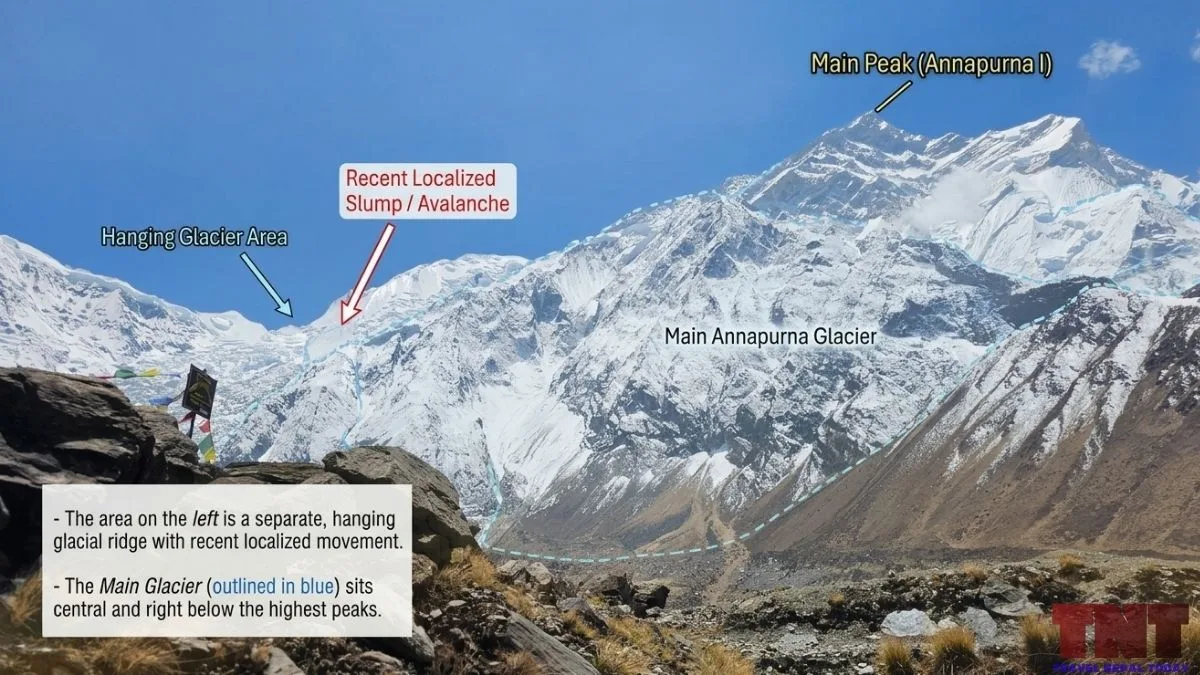
This is the glacier under the north face. The 1950 expedition set Camp I on it.
Moreover, a 1978 American team described it as “broken chaos” in its route notes.
Climate Change and Hazards on Annapurna I
Annapurna I has no glacier study of its own, so scientists use the wider Annapurna region to understand what is happening.
Climate change shows up in the ice, in the lakes below it, and in the way the mountain behaves for climbers.
Glaciers Are Shrinking, But Not At the Same Speed
A Newcastle University team mapped 162 glaciers in the Annapurna Conservation Area. Total glacier area fell 8.5% between 2000 and 2014/15, and the Annapurna Himal subregion lost 6.07%, less than the northern subregions.
This is due to larger glaciers that respond more slowly, and they warn that local factors make future changes hard to predict!
Global data points the same way. The World Glacier Monitoring Service reported that glaciers outside the ice sheets lost 408 gigatonnes of mass in 2025, the second-highest annual loss on record, with High Mountain Asia among the biggest contributors.
The North Annapurna Glacier and Panchakunda Lake
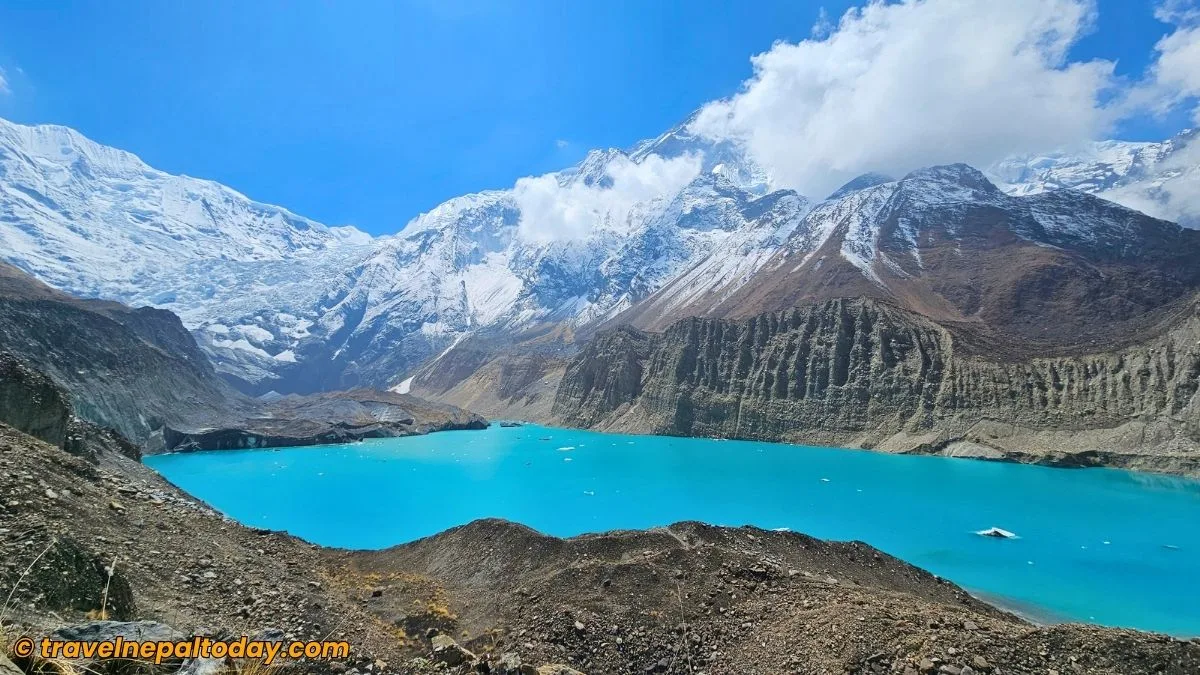
The best local example sits below the north face. Glaciologist Mauri Pelto compared satellite images and found that the North Annapurna Glacier retreated about 600 m between 1988 and 2022.
A lake called Diki Cho (locally famous as Panchadham or Panchakunda Lake) formed at the end of the glacier and reached 0.27 km² after the warm summer of 2022.
North Annapurna Base Camp sits near this terminus, so the shoreline has changed under climbers’ feet.
Meanwhile, the Annapurna South Glacier is thinning. Its debris-covered tongue is about 5 km long and shows clear surface lowering, as covered above!
Avalanches and Seracs: The Hazard That Shapes Every Season
Avalanches matter more than altitude on this mountain! As of writing this article, 39 of the 75 deaths came from avalanches, and 20 of the 75 victims were Sherpas.
The worst zone is the Great Couloir between Camp 2 and Camp 3, where seracs (huge blocks of glacier ice) break off without warning.
Recent seasons show how this plays out:
- Winter 2023/24: Alex Txikon‘s team lost a cache of 2,000 m of rope, anchors, and tents at Camp 3 (6,400 m) into a crevasse and gave up. He said he would not go through the Great Couloir again.
- Spring 2025: A dry mountain and warm weather made serac falls more frequent, according to Brazilian guide Moeses Fiamoncini. On 8 April, an avalanche just above Camp 2 killed Rima Sherpa and Ngima Tashi Sherpa. Rescuers found them with Recco reflectors sewn into their clothing.
No study yet ties a specific Annapurna avalanche to warming. Still, the pattern of drier, warmer pre-monsoon conditions makes the route less predictable, and that is why teams move fast and avoid long stays at Camp 2 and Camp 3!
The Climbing History of Annapurna I
As the first 8,000 m peak ever climbed, Annapurna I holds a legendary place in mountaineering. The timeline below runs from 1950 to October 2026:
| Year | Event |
|---|---|
| 1950 | First ascent, June 3, by Herzog and Lachenal. First 8,000 m peak climbed. |
| 1970 | British south face expedition. Whillans and Haston summit. |
| 1977 | Dutch Rib opened, October 13. |
| 1978 | First American and first women’s ascent, October 15. |
| 1981 | Polish route to Annapurna I Central. |
| 1987 | First winter ascent, February 3. |
| 1992 | Béghin killed on the south face. |
| 1996 | Northwest spur climbed. |
| 1997 | Boukreev and Sobolev killed, December 25. |
| 2002 | Lafaille and Inurrategi east ridge traverse. |
| 2013 | Steck‘s disputed south face solo. |
| 2015 | Samuli Mansikka of Finland dies in a fall after his summit, March 24. |
| 2016 | 32 climbers summit on May 1, a record at the time. |
| 2019 | Nirmal Purja summits on April 23, the first peak of Project Possible. Rescue of Wui Kin Chin. Maurice Herzog Trail named! |
| 2021 | Six Nepali women summit on April 16 in a record day of about 67 to 69 summits. |
| 2022 | About 30 summit on April 28. Kristin Harila starts her 14-peak project here. |
| 2023 | Noel Hanna dies after summiting. Anurag Maloo survives a crevasse fall. |
| 2024 | One of the shortest spring seasons ever. Txikon‘s winter attempt ends in January |
| 2025 | Record 66 permits. Two Sherpas die in an avalanche on April 8. Txikon‘s second winter attempt ends. |
| 2026 | Annapurna I becomes the first 8,000-meter peak scaled in the spring season on April 18. Multiple teams summit successfully within a tight weather window. |
The 1950 Ascent
Herzog and Lachenal reached the summit around 2 pm on June 3, 1950 without supplementary oxygen.
The descent was a near disaster! Both were badly frostbitten, and the rest of the team, including Lionel Terray and Gaston Rébuffat, helped bring them down.
1978 and 1987: Historic Years in the Books of Annapurna First
In 1978, an American women’s expedition reached the summit on October 15 with Vera Komarkova, Irene Miller and Sherpas Mingma Tsering and Chewang Ringjing.
Two other team members, Alison Chadwick-Onyszkiewicz and Vera Watson, died on a later summit attempt.
On February 3, 1987, Jerzy Kukuczka and Artur Hajzer made the first winter ascent!
Annapurna I Since 2013
The decade following 2013 marked a dramatic chapter for Annapurna I, a period defined by groundbreaking solo attempts, fierce commercial expeditions, tragic losses, and record-breaking summits that forever transformed how mountaineers approach the world’s deadliest 8,000-meter peak:
- 2013 to 2016: After Steck‘s disputed solo in 2013, the mountain went through quieter years in the record books. On 24 March 2015, Finnish mountaineer Samuli Mansikka reached the summit with a large commercial team and then died in a fall during the descent. On 1 May 2016, 32 climbers stood on top in a single day!
- 2019: a record campaign and a rescue: Nirmal Purja summited Annapurna on 23 April 2019 as the first step of his 14-peak campaign. Two days later, he helped rescue Malaysian doctor Wui Kin Chin, who had spent about two nights near the summit without oxygen, food or water. Rescuers reached him near 7,500 m, but Chin died in a Singapore hospital on 2 May. Purja and Seven Summit Treks said a faster insurance response might have helped!
- 2021, the Nepali women’s ascent: On 16 April 2021, Purnima Shrestha, Maya Sherpa, Dawa Yangzum Sherpa, Pasang Lhamu Sherpa, Dabuti Sherpa and Sharmila Tamang became the first Nepali women to reach the summit. About 67 to 69 people summited that day, which was a record at the time! Priyanka Mohite became the first Indian woman to summit, and Sirbaz Khan and Muhammad Abdul became the first Pakistanis. Three Russian climbers went missing after leaving Camp 4 but were found alive.
- 2022, the crowd arrives: On 28 April 2022, about 30 people summited in one weather window. That day also started Kristin Harila‘s bid to climb all fourteen 8,000 m peaks. The Himalayan Database counted 97 summits in the two years 2021 and 2022, and only 11 climbers skipped bottled oxygen.
- 2023, a deadly spring: Irish climber Noel Hanna, 56, a 10-time Everest summiter, died at Camp 4 on 17 April after summiting. The same day, Indian climber Anurag Maloo, 34, fell into a crevasse while descending between Camps 3 and 2. A team including Polish climber Adam Bielecki lifted him out after about 4 hours on 20 April, and a doctor in Pokhara revived him with 3 hours of CPR. Reports differ on the crevasse depth, from 70 m to 300 m.
- 2024, helicopter taxis: Spring 2024 may have been the shortest Annapurna season ever. After ropes reached Camp 3, one weather window opened, climbers summited, and every outfitter left. Nima Rinji Sherpa summited at age 17, and Annapurna was his 11th 8,000 m peak.
- 2025, a record permit year: The Department of Tourism issued 66 permits across six teams, the most ever for Annapurna I. Imagine Nepal’s rope-fixing team summited first on 6 April, and later, 45 summits for the spring was registered, 22 of them by Nepali staff. Two days after the first summits, the 8 April avalanche killed Rima Sherpa and Ngima Tashi Sherpa.
Deaths, Statistics and Recent News
Behind the breathtaking summits and record-breaking seasons lies a sobering reality.
Understanding Annapurna I requires looking closely at its hard numbers, evolving safety trends, and the recent events that continue to shape its formidable legacy.
Annapurna I Fatality Rate
The records of deaths in Annapurna I are 75 from 557 summits, a ratio of 13.46%!
The rate has fallen from about 38% at the end of 2009 (157 summits and 60 deaths) to about 18% in spring 2022 (395 summits and 72 deaths) and about 13.4% today!
Most of the drop comes from more summits, not fewer deaths. Deaths rose by only 3 between 2022 and 2026, while summits grew by more than 150!
Fewer Climbers Go Without Oxygen
Between 2001 and 2010, 74 climbers summited and 69 did not use bottled oxygen.
Between 2011 and 2020, 115 summited and 44 skipped it! And in 2021 and 2022, only 11 of 97 summiters skipped it.
Fixed ropes, Sherpa support and oxygen explain the safer numbers, but they also mean that more climbers now reach the summit with less experience!
Is Annapurna I Deadlier Than Everest?
Per summit, yes!
Annapurna’s ratio is 13.46%, while Everest sits near 2.54% (344 deaths against 13,550 summit records).
Everest has far more deaths overall because far more people climb it.
Annapurna I Climbing Permit, Royalty and Garbage Rules
According to Nepal’s Department of Tourism, effective September 1, 2025, Annapurna I falls under “other mountains more than 8,000 m (except Everest and Manaslu)“.
Mandatory Royalty (Per Person)
| Season | Foreign climber | Nepali climber |
|---|---|---|
| Spring (March to May) | USD 3,000 | NPR 50,000 |
| Autumn (September to November) | USD 1,500 | NPR 25,000 |
| Winter and summer | USD 750 | NPR 12,500 |
Note on Garbage Deposit: Schedule 9 of the regulation (Rule 26) sets a deposit of USD 3,000 per expedition team for peaks above 8,001 m other than Everest in the Khumbu and Annapurna ranges. It is per team, not per climber!
Other Mandatory Rules
Beyond the royalty and garbage deposit fee, here are other things to keep in mind before proceeding to book your Annapurna I summit with an agency:
- No solo expeditions: The 2025 amendments require one guide or high-altitude worker per two climbers on any 8,000 m peak.
- Registered agency: Foreign climbers must go through a registered Nepali trekking/expedition agency.
- Liaison officer: The team pays for the government liaison officer.
- Travel Insurance: Insurance rules for Nepali staff changed in 2025! What this means is not only the climber but also guides, porters, and the liaison officer must have insurance. This is usually taken care of by the agency, so confirm this with whoever you’re planning to book with.
- Conservation Area Permit: You need to get the Annapurna Conservation Area permit that costs NPR 3,000 for foreign nationals (NPR 1,000 for SAARC nationals) because Annapurna I is inside the Annapurna Conservation Area.
Mandatory Fees vs. Commercial Costs
| Government and mandatory | Commercial, set by the operator |
|---|---|
| Royalty per climber | Sherpa and guide support |
| Garbage deposit (per team) | Oxygen and fixed ropes |
| Liaison officer and staff insurance | Base camp services, food and gear |
| Conservation area permit | Helicopter transfers, agency margin |
Final Thoughts
Annapurna I opened the age of 8,000 m climbing, and it is still among the most dangerous peaks!
Most of what trekkers know about it comes from the south side, but note that climbers actually use the north trail (i.e., the Maurice Herzog trail).
If you are planning to see Mt. Annapurna I, we are ready to help you with your visit to either Annapurna Base Camp for the south face, or the North Annapurna Base Camp that’s recently getting popular for trekking!
About The Author