Nagdaha Dhapakhel is one of the few remaining natural water bodies in the Kathmandu Valley. Located in the Lalitpur district, this spot is perfect for a short getaway, especially on weekends.
In fact, it can easily be included as a side trip when visiting popular destinations like Hattiban, Gadowari, Marble Danda, Phulchowki Hill, Lakuri Bhanjyang, or others.
My trip was short but, as always, meaningful. Through this blog, I aim to provide you with as much information as possible about Nagdaha. From its history and religious beliefs to things to do and useful tips along the way!
Key Facts About Nagdaha
| Location | Dhapakhel, Lalitpur, Bagmati Province |
| Mode of Transportation | Private or Public Vehicle + Short Walk |
| Distance (from Satdobato) | 4.5 km |
| Distance (from Taudaha) | 10.8 km approx. |
| Time to Reach | 15 to 20 minutes approx. |
| Best Time to Visit | Naag Panchami (July/August) |
Mythological Stories Tied with Nagdaha
There are plenty of myths associated with the lake of Nagdaha, and to understand them, we have to travel back in time.
The Story of Serpents

Long ago, Kathmandu was still a massive lake. When Manjushree cut through the hills of Chobar, the water drained, and the valley we know today appeared.
But the lake wasn’t empty. Shree Karkotak Nagaraja and his serpent family were living there. They were disappointed by the changes and expressed their sadness to Manjushree. To comfort them, he granted them a home at Taudaha Lake.
However, some legends say that a few (Baski Nags) stayed at Nagdaha. The name itself was inherited from the time when Kathmandu was a lake full of serpents.
During the rainy season, it is said that a male serpent from Taudaha would meet a female serpent in Nagdaha. This meeting was believed to bring rain, fertility, and prosperity to the land! (source)
Story of Lord Shiva and Goddess Bajrabarahi

Another story involves Lord Shiva. Local folklore tells that he visited Nagdaha long ago (source).
But this worried Goddess Bajrabarahi, as she feared that nobody would worship the lake. Using her divine powers, she transformed herself into a pig, making Mahadev feel that the lake was unclean.
Reportedly, after this, Lord Shiva returned to Gosaikunda Lake, where he had previously struck a mountain to drink water, which accidentally filled the area and formed a pond.
How to Reach Nagdaha in Dhapakhel, Lalitpur?
Reaching Nagdaha in Dhapakhel, Lalitpur, is pretty easy. You can get there by both private and public vehicles. And the road up to the pond is also fully paved!
Your first step is to reach Satdobato, Ring Road, and then take the turn that leads toward the Hattiban-Gadowari route. From here, take a right turn to continue onward to Dhapakhel.
Note that there are other routes as well, and you can easily use Google Maps to navigate.
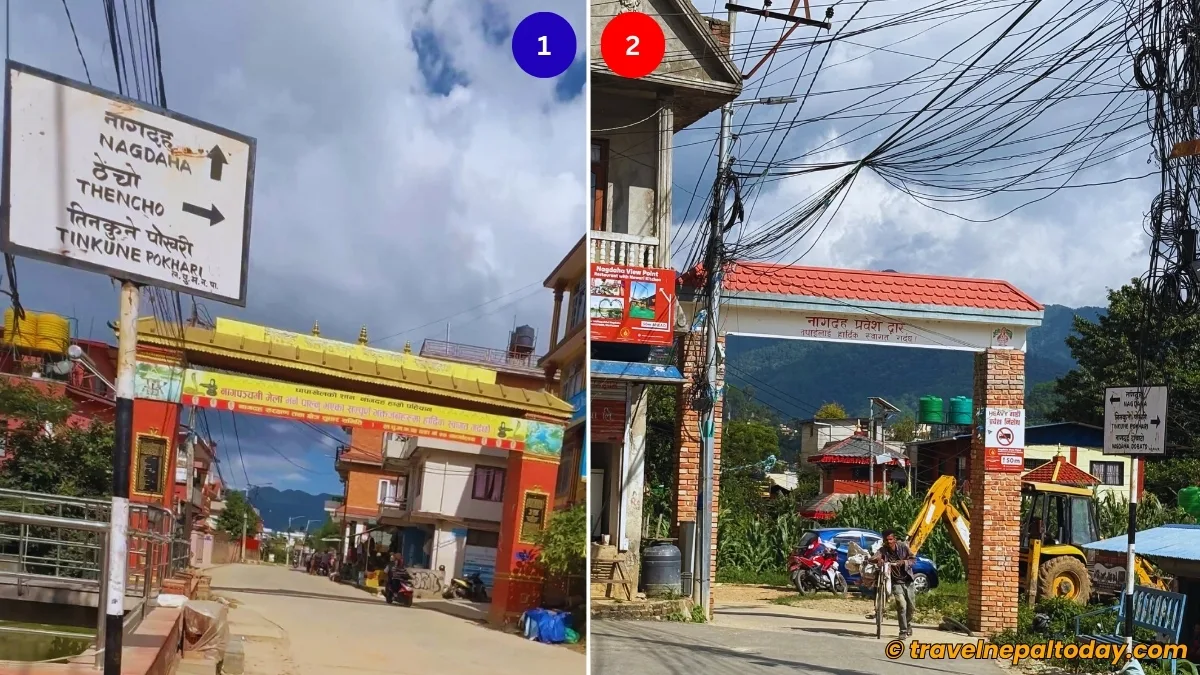
You’ll come across the ‘Nagdaha Santaneshwor Bajrabarahi Prabesh Dwar’ gate on your right. From this diversion, continue straight for about 700 meters to reach Nagdaha.
There’s one fight diversion with another gate, indicating that you have reached the destination.
Parking is flexible. You can stop anywhere you feel comfortable because this is a hidden gem, and there won’t be much crowd, even on Saturdays. Unless, of course, this post goes viral…
Regarding public vehicles, they can be found in the Satdobato and Lagankhel areas (the ones going to Thecho via Dhapakhel). Once you reach the gate, you just have to walk about 15 minutes to reach the lake.
6 Things to Do in Nagdaha
Since Dhapakhel’s Nagdaha is a small pond, you can easily go around it. That’s exactly what you’ll want to do after visiting here, which I fondly remember calling ‘Lalitpur’s Kamal Pokhari’.
Here’s what you can do:
Offer Prayers at Nag Temple
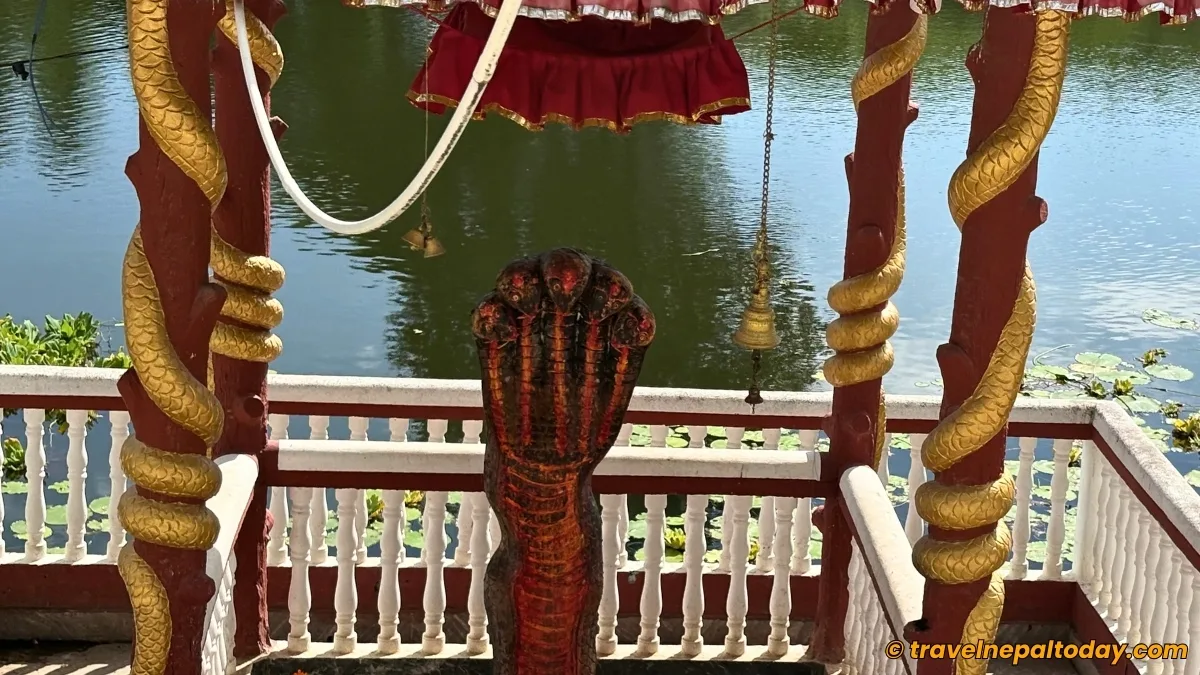
As mentioned earlier, as soon as you reach Nagdaha, you’ll be welcomed by a Nag Temple. There’s also a Ganesh Temple nearby if you’d like to offer prayers there too.
I parked my motorcycle near the edge and noticed a stairway leading down. While we didn’t go inside the temple itself, we offered our blessings from a little distance.
During Nag Panchami, this place gets crowded with locals. So, if you’re planning to experience the festival, Nagdaha in Dhapakhel should definitely be on your bucket list.
Tip: Take milk, sweets, flowers, and incense to offer at the Nag Temple.
Visit the Saptarishi Temple
Continue forward and you’ll reach a small temple (it was locked during our visit). Inside, there are seven statues depicting each Saptarishi. These are basically the seven sages of Hindu mythology.
You’ve probably heard of ‘Gotra’, haven’t you? Well, if you’re a Hindu, you’re a descendant of one of these Saptarishis: Atri, Bharadvaja, Gautama Maharishi, Jamadagni, Kashyapa, Vasistha, and Vishvamitra.
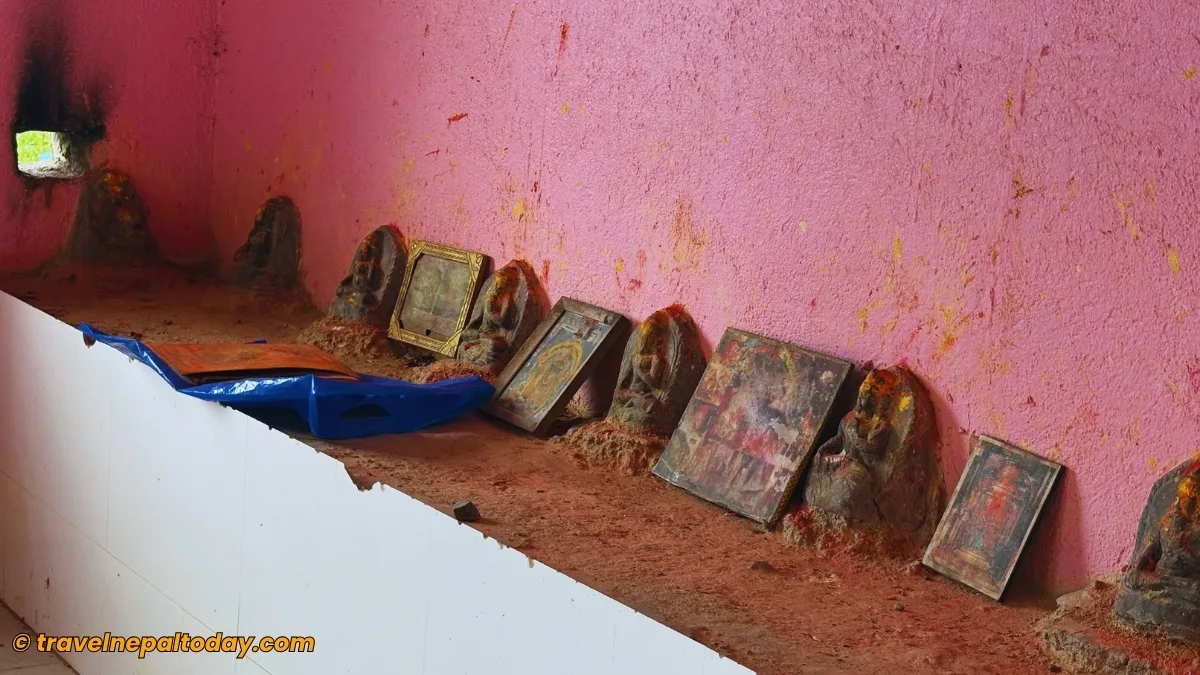
And in case your gotra is something like ‘Kaudinya’ (that’s mine), you’re a descendant of Rishi Vasistha. Some exceptions are there, but in some way, you’re connected!
This can be a bit complex, so if you’re willing to learn more, feel free to drop a comment and I’ll create a detailed guide on ‘gotras’ for sure here on TNT.
During Teej, the temple gets crowded with local women. If you want to witness that, plan your visit during this festival!
Note: There’s also Gaukhureshwar Temple on the northwest shore, which we couldn’t visit. But you should definitely add it to your plans.
Observe Local Life and Daily Rituals
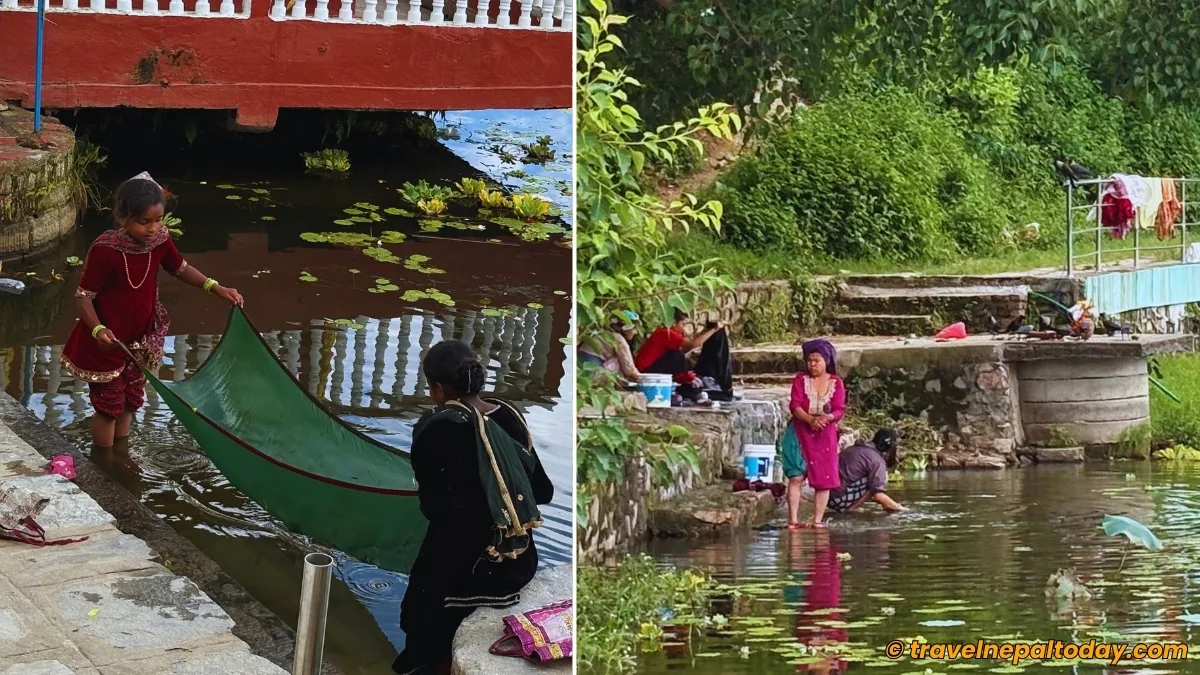
As we were taking some snaps, my eyes fell upon the interesting culture of the locals at Nagdaha.
Some were taking rounds just like us, while others on the opposite side of the Nag Mandir were relaxing on the benches.
A few were even catching fish, although there was a board clearly stating, ‘Swimming and fishing aren’t allowed.’ Perhaps the locals are allowed? I’m not sure.
Not to forget, this sacred pond even served as a place for local women to wash clothes. I have mixed feelings about this, as it could be one of the reasons the water has started to become polluted.
Birdwatching & Exploring the Lake’s Algal Flora
With that previous statement, I’d like to continue here.
Locals in the past used to believe that the thick and bulky roots of the lotus flowers in Nagdaha could naturally purify the water. In fact, around 50–60 years ago, people would drink straight from the pond without hesitation.
But as time passed, the water turned murky and polluted. So much so that even those miraculous roots aren’t able to cleanse it anymore!
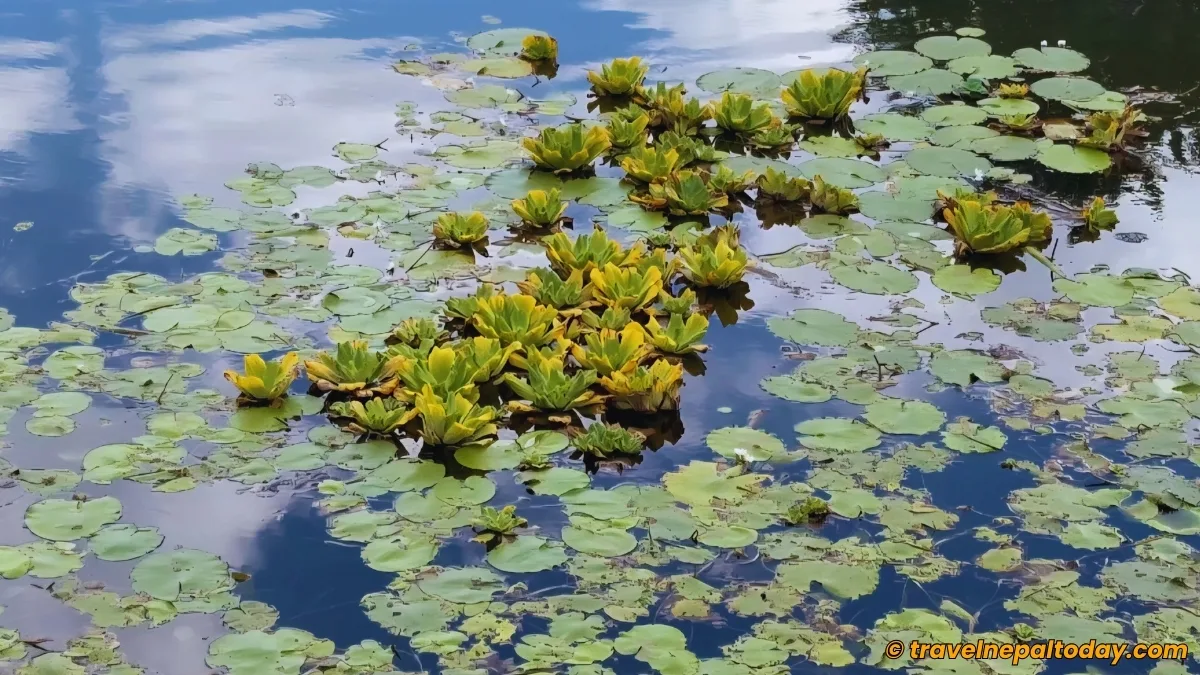
You’ll get a glimpse of those lotuses here. On top of that, you’ll even notice various algal flora present in the water.
As per a study, 25 algal taxa belonging to 16 different families have been observed in the lake. You can check the entire list here.
Lastly, Nagdaha serves as one of the best destinations for birdwatching too. Countless birds have been observed here, including black kite, black drongo, cattle egret, Oriental magpie robin, and migratory species like cuckoos, white-breasted waterhen, common moorhen, little grebe, etc.
Even a rare winter migratory bird, the Baikal teal, was very recently seen. These birds are usually found in Russia (Siberia), Mongolia, and northeastern China. Their presence in Nagdaha clearly highlights how rich the biodiversity of the lake is.
Relax at a Nearby Restaurant
Of course, this is what most youngsters love to do. Luckily, there are plenty of restaurants around. In fact, one right in the center that you pass by while taking a round of the lake.
Since I didn’t get a chance to stop here, I’m unable to share my suggestions on which restaurants or cafés to visit. It was a funny incident, as my partner’s sandal tore and we had to make a quick return.
Next time I visit Nagdaha, I’ll be sure to check out each restaurant and update this article. So, stay tuned!
Feed the Fishes
During our visit to Nagdaha, we didn’t get to see many fish. All we saw were people trying to catch them.
Since our trip ended quite hurriedly, as mentioned above, we weren’t able to fully enjoy this short visit that we had combined with Marble Danda.
However, we’ve come to know that this spot is great for spending time with the local fishes. Bring some fish food and sit by the lake for hours with your friends or loved ones, feeding them whilst enjoying the serene surroundings.
Final Words
‘Najik ko tirtha hela’ is an idiom that perfectly suits Nagdaha. It’s so close to us, has rich mythological and religious connections, and yet very few people know about it.
I’m glad you landed on this page and learned something new about what is actually one of the best hidden gems of the Kathmandu Valley.
It hasn’t received the recognition it deserves, but hopefully, it will in the future. I sincerely hope its biodiversity and cultural heritage are preserved over time.
Happy travelling to Lalitpur!
About The Author