My recent pilgrimage visit to Janaki Temple (locally, Janaki Mandir) in Janakpurdham came with both heart-warming moments and a few unpleasant experiences.
Overall, it was a good trip to Janakpur, thanks to the beauty of Janaki Temple. But if the sanitation here had been better, it would have been a hundred times more enjoyable.
Janaki Temple is the heart of Janakpur and is located almost in the center of the city. A temple dedicated to Ram and Sita, it holds deep religious significance and reflects the rich heritage of Mithila culture. It’s truly one to keep on your travel bucket list!
Today, I won’t just share my experience but also guide you through Janaki Temple’s facts, history, current condition, its possibility of getting recognized as a UNESCO World Heritage Site, and more!
Let’s dive right in…
Key Facts About Janaki Temple
| Location | Janakpur Dham, Janakpur, Dhanusa, Madhesh Province |
| Altitude | 78 m |
| Mode of Transportation | Private / Public |
| Distance (from Kathmandu) | 246 km |
| Distance (from Biratnagar) | 193 km |
| Distance (from Hetauda) | 164 km |
| Distance (from Birgunj) | 158 km |
| Distance (from Bardibas) | 45 km |
| Distance (from Ram Temple, Ayodhya, India) | 445 km |
| Opening Time | 4 AM to 8:30 PM (summer), 6 AM to 7 PM (winter) |
| Best Time to Visit | All seasons (mornings and evenings), overcrowded in Ram Nawami, Vivaha Panchami, Dashain, and Tihar |
Historical Timestamp of Janakpur and Janaki Temple
Before anything else, let’s understand how Janaki Temple came into existence, its historical and religious significance, mythology, and more!
Most of us are already aware that Janakpur was the home to the Hindu Goddess, Sita. And more particularly, well-known for the old Mithila Kingdom, when King Janak used to rule.
Every part of this story is a part of Ramayana, and to understand everything fully, you have to go and read this epic yourself.
Still, you’re here to learn about Janaki Temple cum the entire Janakpur, right? So, I’m going to start from the absolute scratch. After careful research, I’m able to create this historical timestamp that lets you understand the origin of Janaki Mandir to its present state:
Where It All Began: Ancient & Mythological Era
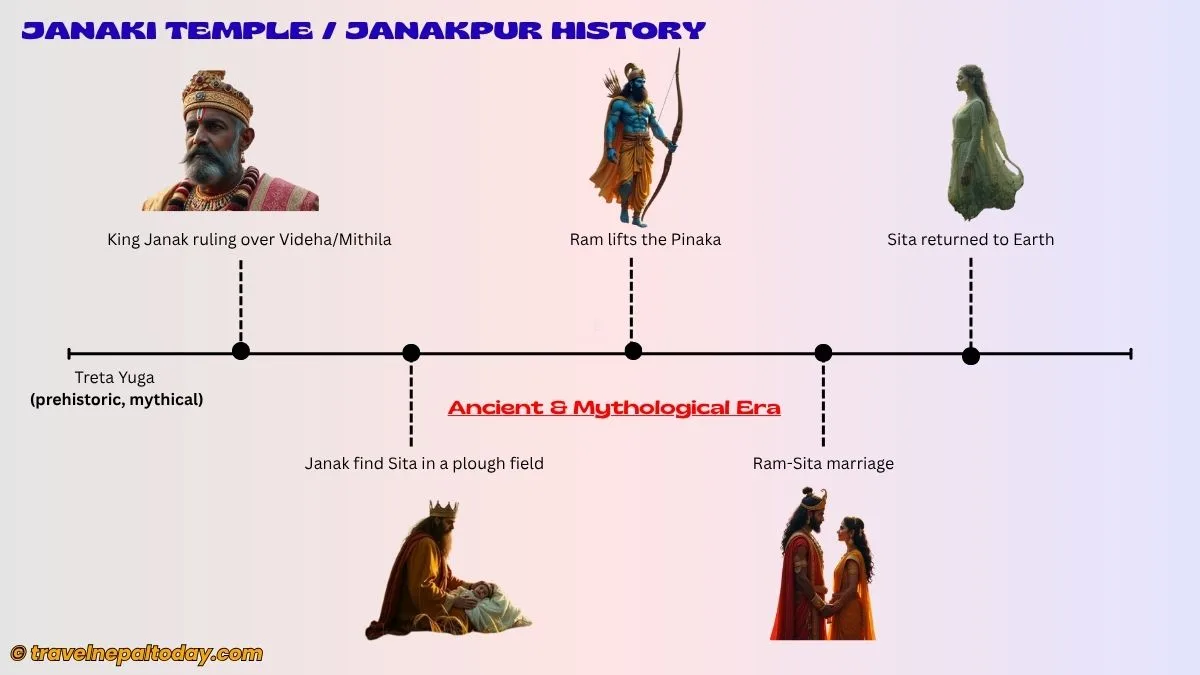
- King Janak of Videha ruled from a capital called Mithila (later claimed as Janakpur).
- King Janak (originally named Seeradhwaj) found infant Sita in a ploughed field and raised her as his daughter.
- In the famous swayamvara (contest), Sita (originally called Janaki) chose Lord Ram as her husband, as he was the only one who could lift and string Shiva’s bow (called Pinaka). The bow broke into three pieces that reached Dhanus Sagar, Dhanusadham, and one in Rameswaram, India.
- This led to Ram-Sita’s marriage at Janakpur (commemorated at the current Vivah Mandap Temple)
- Sita returned to Earth (the way she was born), which marked her sacrifice of life.
Note: There has not been found any archaeological proof that modern Janakpur was the actual ancient capital of Videha.
Forgotten Kingdom to Pilgrimage Revival [Middle Ages to 1600s]
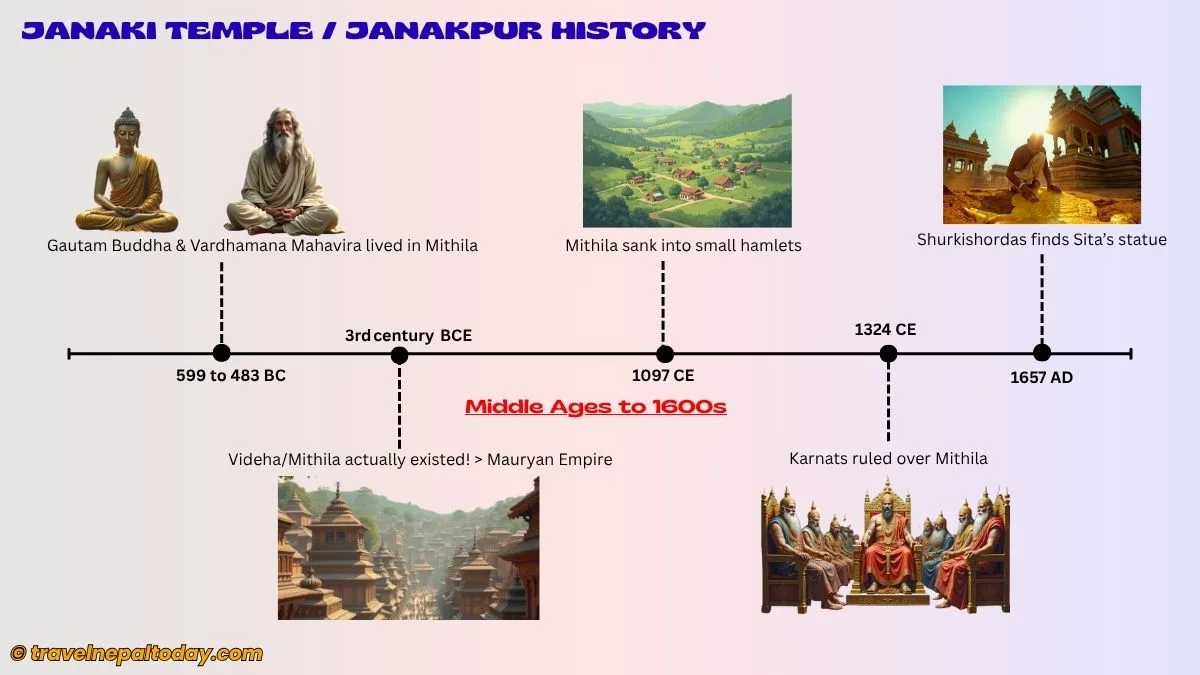
- Both Gautam Buddha and Vardhamana Mahavira (an enlightened sage of the Jain religion) are said to have lived in Mithila/Janakpur.
- Videha/Mithila was actually a real kingdom (flourishing between 10th and 3rd century BCE) and was later absorbed into the Mauryan Empire!
- Later, Janakpur sank to small hamlets, inhabited by farmers, artisans, and temple workers.
- There have been historical references that claim the Janakpur region being featured in medieval Mithila as a regional center under Karnat rulers.
- In 1657, a saint named Shurkishordas found a golden statue of Sita in the present-day Janaki Temple, which is considered the exact place of her birth.
- He promoted Sita’s devotion and is regarded as the “founder” of modern Janakpur.
The Colonial Era [1700s—1900s]
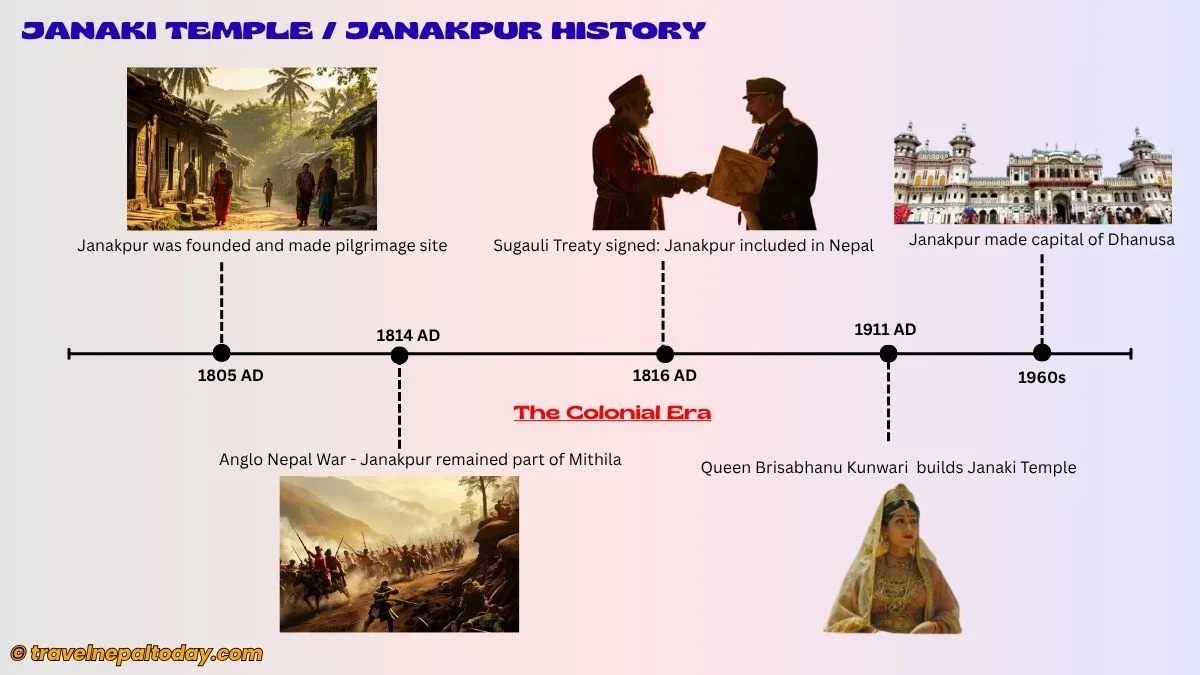
- Janakpur was already founded by the early 18th century and was a pilgrimage site by 1805.
- Janakpur remained a part of the greater Mithila region until the Anglo-Nepal War was fought between 1814-16.
- After the Sugauli Treaty was signed in 1816, Janakpur, along with the entire northern part of ancient Mithila state, officially became a part of Nepal.
- In 1911, Queen Brisabhanu Kunwari constructed the Naulakha Mandir (now called Janaki Temple). The name was given because of the white marble/stone, combined with Rajput, Mughal, and Koiri styles, cost about nine lakh silver coins.
- Janakpur was recognized as a municipality in 1962 and was also regarded as the capital city of Dhanusa District in the 1960s itself.
The Rise of Modern Janakpur [2000s—Present]
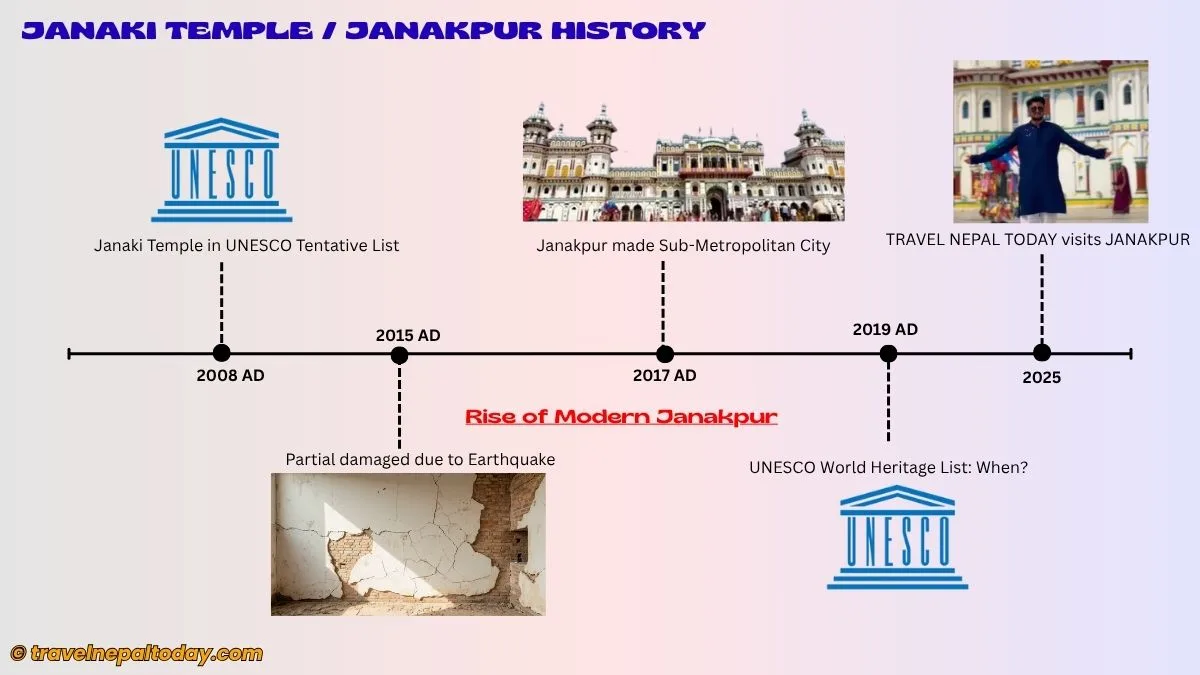
- In 2008, Janaki Temple was recognized in Nepal’s UNESCO tentative list.
- The earthquake of 2015 partially damaged the Janaki Temple, but it’s already in a good condition at present.
- In 2017, Janakpur was recognized as a Sub Metropolitan City.
- Nepal has been actively trying to list Janaki Temple in the UNESCO World Heritage list since 2019.
- Travel Nepal Today visits Janaki Temple in July 2025 (a historic achievement for TNT :p)!
Major Attractions in Janaki Mandir
A trip to Janakpur is definitely on every Nepali’s bucket list. I had heard tons regarding how dirty Janakpur is, and certainly, it was.
But the beauty of Janaki Mandir is what made the trip worth it! Let me share what we did with some tips along the way…
First Impressions of Janakpur: The Harsh Reality
Our hotel stay was a disaster, even with an AC room. The only good part? It was right beside the Janaki Temple, and well, the AC worked, thankfully.
The staff were not very nice, the service was a joke, and they didn’t even provide tissues and first aid when asked. Also, the handwash in the bathroom? Watered-down and reused.
Even outside the temple premises, we saw spits all around. In fact, there was a rusty nail right outside the temple that pierced my partner’s foot. Yup, a tetanus shot had to be taken!
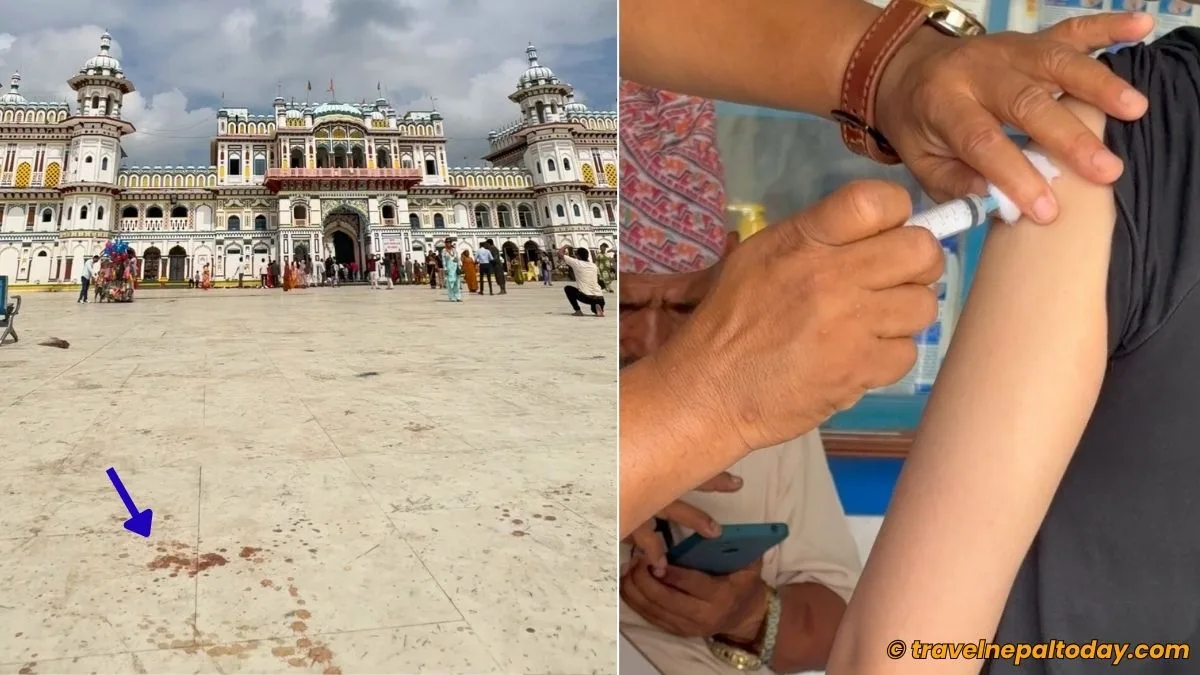
If I start jotting down the bad things, I might write a book on it. This is something the Janakpurdham Sub-Metropolitan City has to take seriously. If this is the case, then I don’t see it being listed as a UNESCO World Heritage Site. Sorry, but that’s the truth.
But if we focus solely on Janaki Temple, it’s truly an architectural masterpiece.
If every citizen in Janakpur appreciates their place and grows it into a better stop, then I can assure you this is going to be one of the best places to visit in Nepal.
However, we are still far from that! And hopefully, people in Madhesh Province understand why this is important. The new generation can bring in hope, and soon enough, we might see this area as one of the pilgrimage hubs for Ram devotees, just like Pashupatinath is for Shiva.
But Then…The Architecture of Janaki Temple Redeems It All!
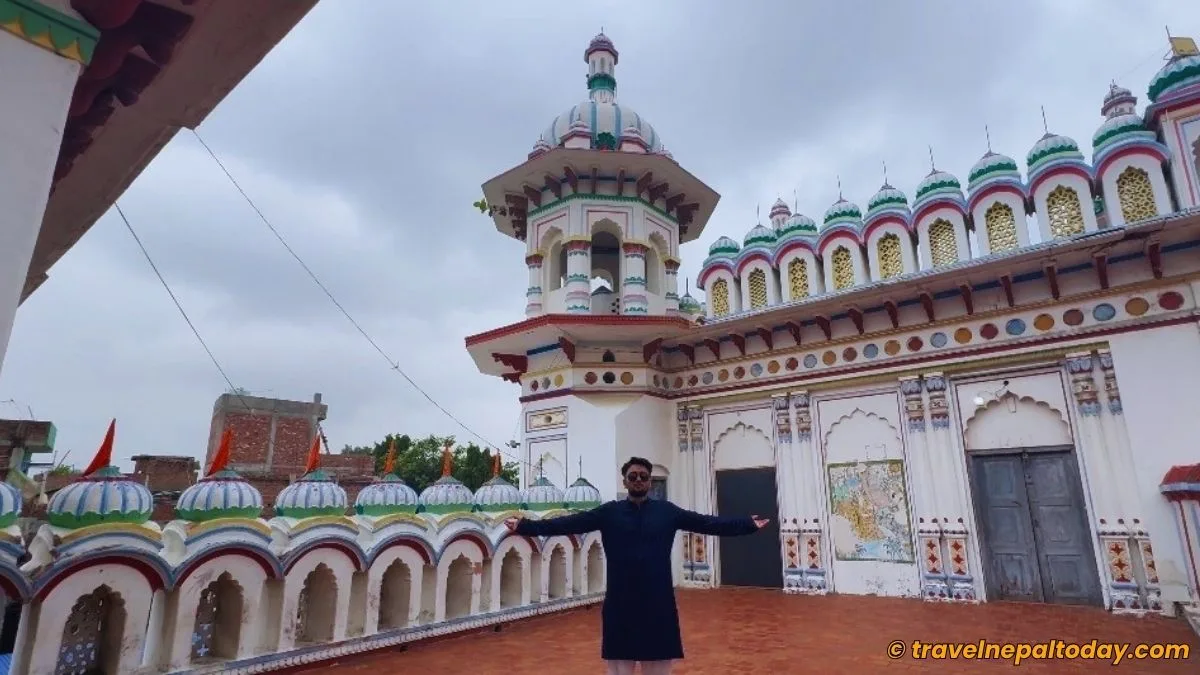
As soon as you take your first glimpse of the Janaki Temple, you’ll be taken to the time of the Mughals (or perhaps let’s say the old Mithila Kingdom). The intricate design from top to bottom is absolutely breathtaking.
The main gate, along with all the tall pillars, and even the inside of the building…every part is well-crafted.
Reportedly, Its architecture is referred to as Koiri Hindu, and it’s a three-storied structure made entirely of stone and marble. It’s been constructed across 1,480 square metres and was commissioned by Queen Vrisha Bhanu of Tikamgarh (just like I mentioned earlier).
And yes, the temple section has been kept neat and clean. Of course, it has to be, right?
Marvellous Night View of Janaki Temple
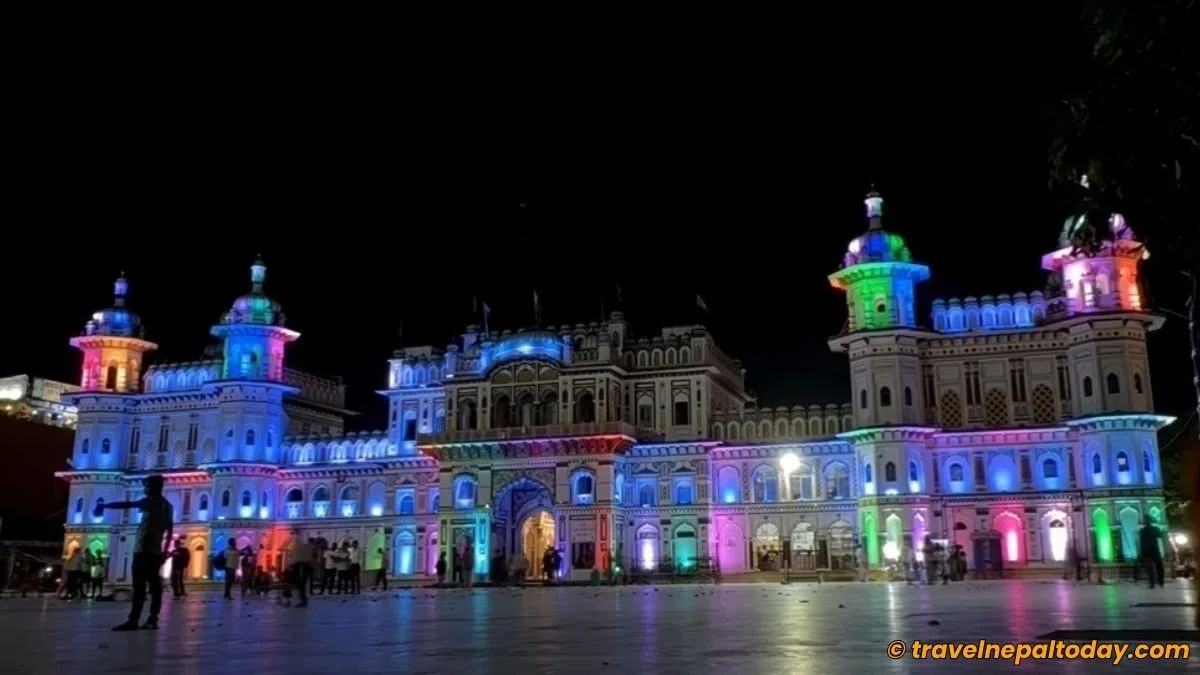
The night view of Janaki Temple is exactly why we went there! And the image above speaks for itself.
After visiting multiple places on our Janakpur ride, we only reached here at around 8 PM. Turns out the light goes out by 8:30, and we were perfectly on time to get a glimpse of the illuminated Janaki Temple.
I was told by one of the hotel staff that this depends on the season. Since summer has longer days, we got to witness it until 8:30 PM. Otherwise, the temple also closes by 7, and so does the lights.
This is one thing you need to keep in mind, and I’d suggest reaching there early.
Ram-Sita Darshan: Jay Shree Ram!
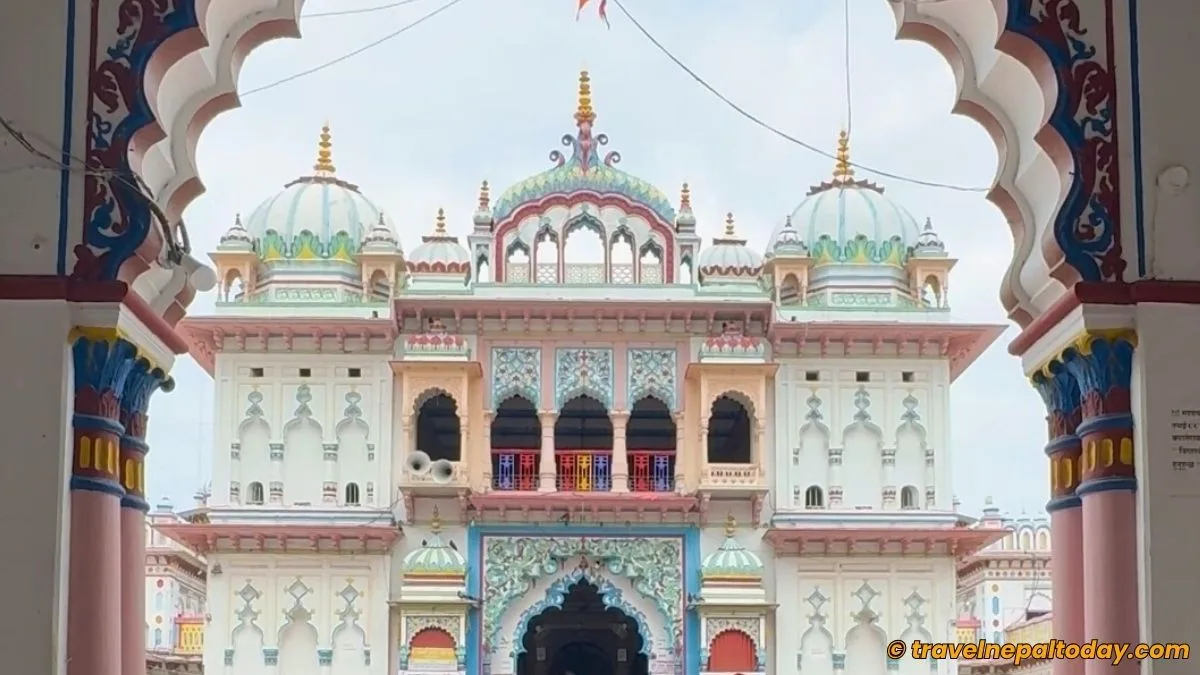
Inside the Janaki Temple is the statue of Ram and Sita. And it’s best that you visit here in the morning, as that’s the ideal time to visit every temple.
You can find street vendors selling fulpati (flowers, prasad, silk clothes, sindoor). Remember: they might overcharge, so bargain a bit!
There’s also a shrine of Hanuman right opposite the statue. So, be sure not to forget lighting at least an incense stick here.
Reportedly, there are different artis conducted here on a daily basis. Since we were here at around 8 AM, we couldn’t experience any. But if you’re willing to witness at least one, here’s what it looks like:
- Mangala Aarti (early morning before sunrise)
- Shringar Aarti (decoration)
- Rajbhog Aarti (midday offerings)
- Sandhya Aarti (evening)
- Shayan Aarti (before temple closes)
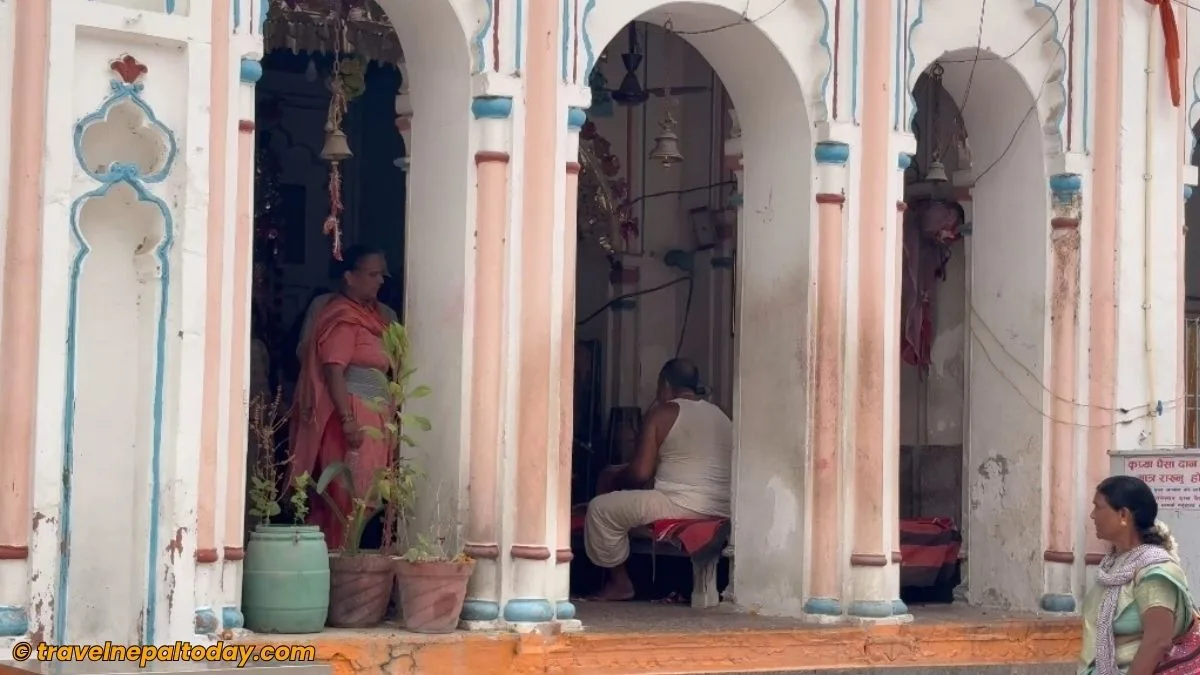
And inside the main temple premises, there’s a 24-hour bhajan that never stops. The people here work in shifts so they can continue it.
Since at night the hymn is kept low so that people nearby won’t get disturbed. Yet, the hymn will still wake you up early in the morning, after 4 AM for sure, if you’re staying in a hotel near the temple. That’s what happened with us!
Do Visit to Janaki Mandir Historical Museum And Janaki Animation
Right behind the main temple is where the museum is located. This is an interesting concept that showcases the history of Mithila.
You get to see the live puppets of King Janak, how Sita was born, the marriage of Ram and Sita, and basically, the mythology we discussed earlier.
It’s like a cinema, and the puppets act automatically. This is something that I watched for the first time and had seriously not expected to find here in Janakpurdham.
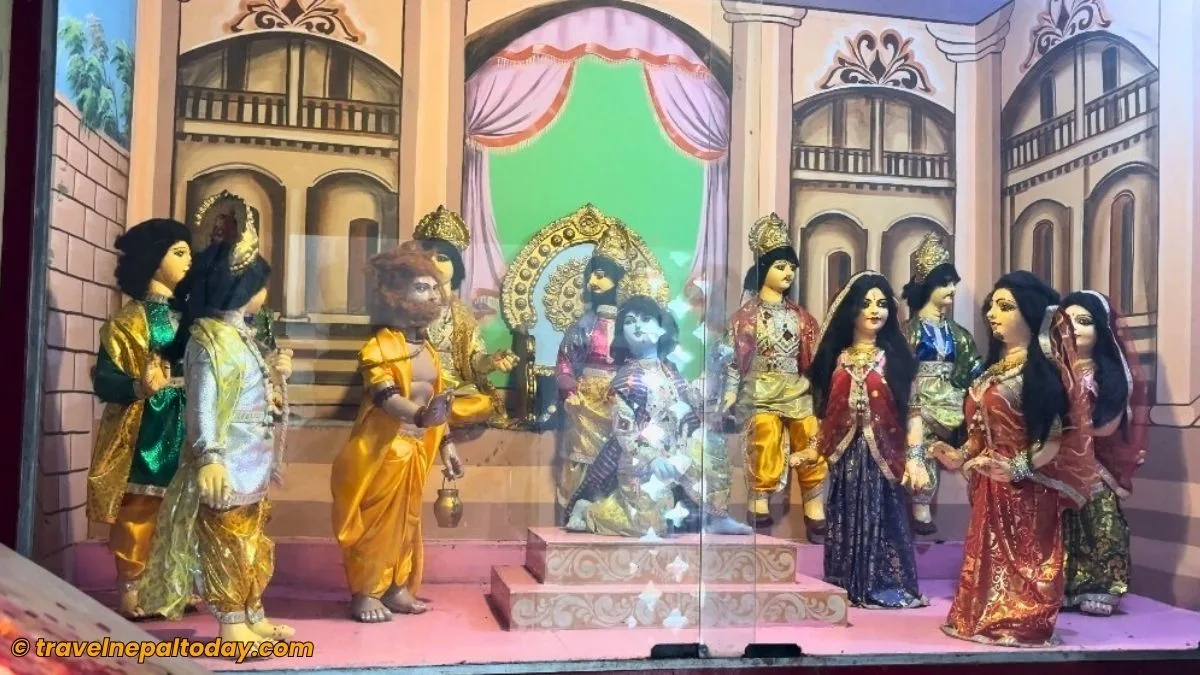
Inside, you can also buy photos of Hindu gods, religious books, and more. And you’re totally allowed to click pictures and videos (I personally asked the staff).
But when you go underground for further exploration, you’ll find real culture preserved from long time back. These are the items Mithila people used for daily life activities, the clothes they used to wear, and more! Here, you’re not allowed to take snaps.
And note that you need to purchase the ticket, which costs just NPR 15 per person. For Indians, it’s INR 10. Both currencies work here!
A Temple Dedicated to Ram’s Brother, Lakshman
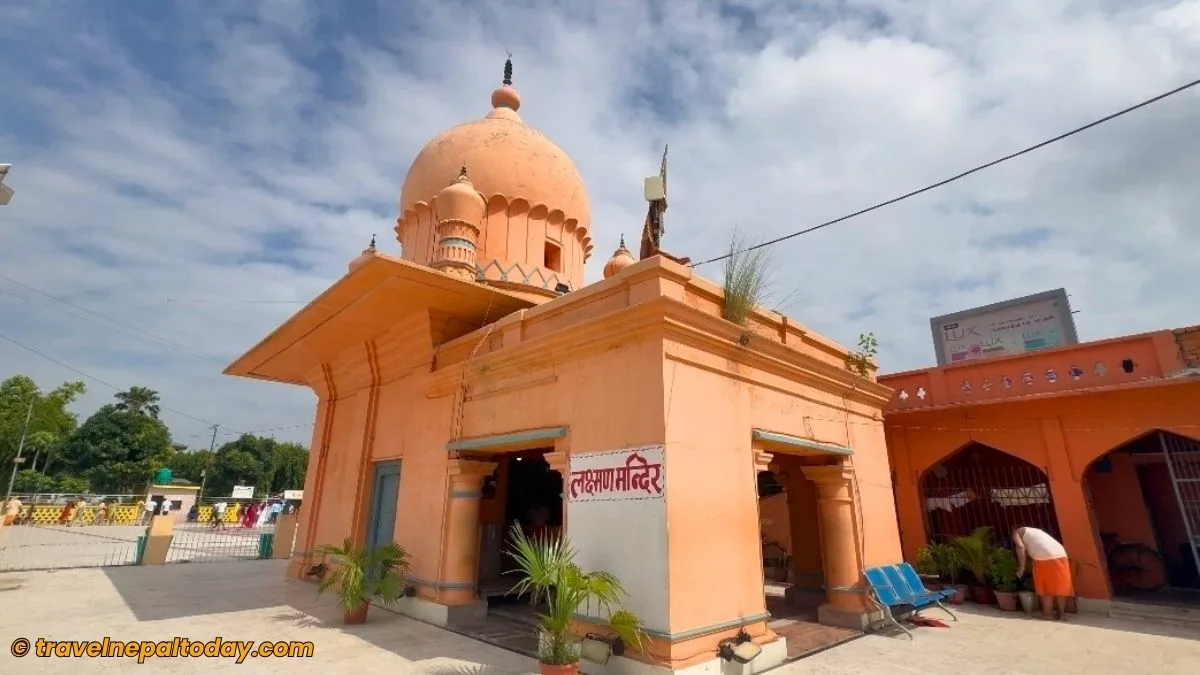
In the northeast of Janaki Temple, you’ll find a Mughal-style temple dedicated to Lakshman, the brother of Ram. I loved how he has also been provided a small temple within the Janaki Temple premises.
There’s not much here but just the shrine of Lakshman. So, my Hindu readers, do visit here and get some blessings from Lakshman too. The brotherhood of Ram and Lakshman sets a great example for all those who follow Hindu religion!
Take the Glimpse of Ram-Sita Vivah Mandap
In the northwest of Janaki Temple is another temple, the same place where Ram and Sita got married, as per the epics!
And to showcase that, there’s a complete model made, where you’ll find Ram and Sita on a Vivah Mandap itself. A traditional style Mithila marriage that happened eons ago.
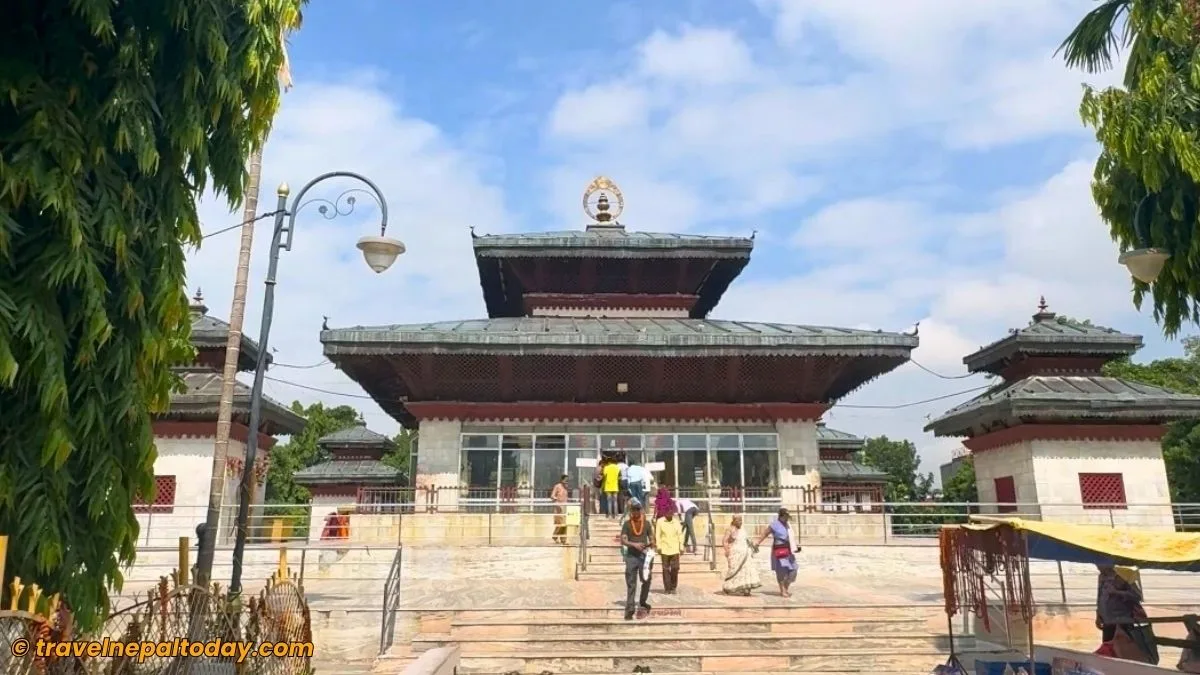
Since the place clearly stated that you couldn’t take pictures, I didn’t. But the temple I’ve attached above is where the Mandap is.
You aren’t allowed to enter but just take a glimpse from outside. And there are also mini temples of Ram and Sita scattered around the the premises.
Moreover, you have to pay an entry fee here as well: NPR 10 per person.
Other Places to Visit Around Janaki Temple
Janaki Temple is just a part of the big Janakpurdham. Besides the main temple, we even paid a visit to the nearby Shiva Temple, Thela Madaha Pond, and Argaza Pokhari.
We were so disappointed by the two ponds, seeing how dirty they were, that we didn’t feel like visiting the other ponds. Thought that every other pond was in a similar condition!
Well, we did make a mistake here and regret it now. Because we should have visited other holy shrines too after all riding all the way up to there!
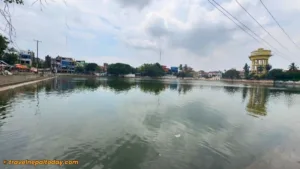
While we didn’t, make sure you guys pay a visit all the holy ponds here!
These are: Ratna Sagar, Bihar Kunda, Sita Kunda, Labki Pokhari, Sita Maiya Pokhari, Murli Sagar, Visahara Pond, Ram Sagar, Dhanusa Sagar, Ganga Sagar, Dahi Kund, Lakshman Sar, Purandar Sagar, Dasharath Pond, Kamal Pond, Dhoornochi, Bhidal Sagar, Rukmani Sagar, and actually plenty of others when getting out of Janakpurdham.
No wonder Janakpur is called the “City of Ponds.”
One thing I also noticed while circumambulating the Janaki Temple was that just near it lies a mosque (Barkati Masjid). This shows how two religions in Nepal, Hindu and Muslim (who mostly fight in other parts of the world) unite and live together in peace here.
Besides all these, you’d also want to visit Dhanusha Dham, where Parsuram Talau and Dhanush Mandir are located.
Don’t Miss Out on Mithila Food
There are plenty of Mithila dishes to try, which honestly deserve a separate article of their own. I’ll definitely cover them after tasting more varieties during my next trip to Janakpur.
For this particular trip, we tried the Mithila Khana Set, which is somewhat similar to the Nepali-style Dal Bhat or Thakali Khana Set, but with a lot of unique makeovers.
Firstly, there’s no meat served around the Janaki Temple area for obvious reasons.
But still, many Mithila people do enjoy fish and chicken in their meals (outside the holy place), which weren’t present in our dish. So instead, paneer was served for protein!
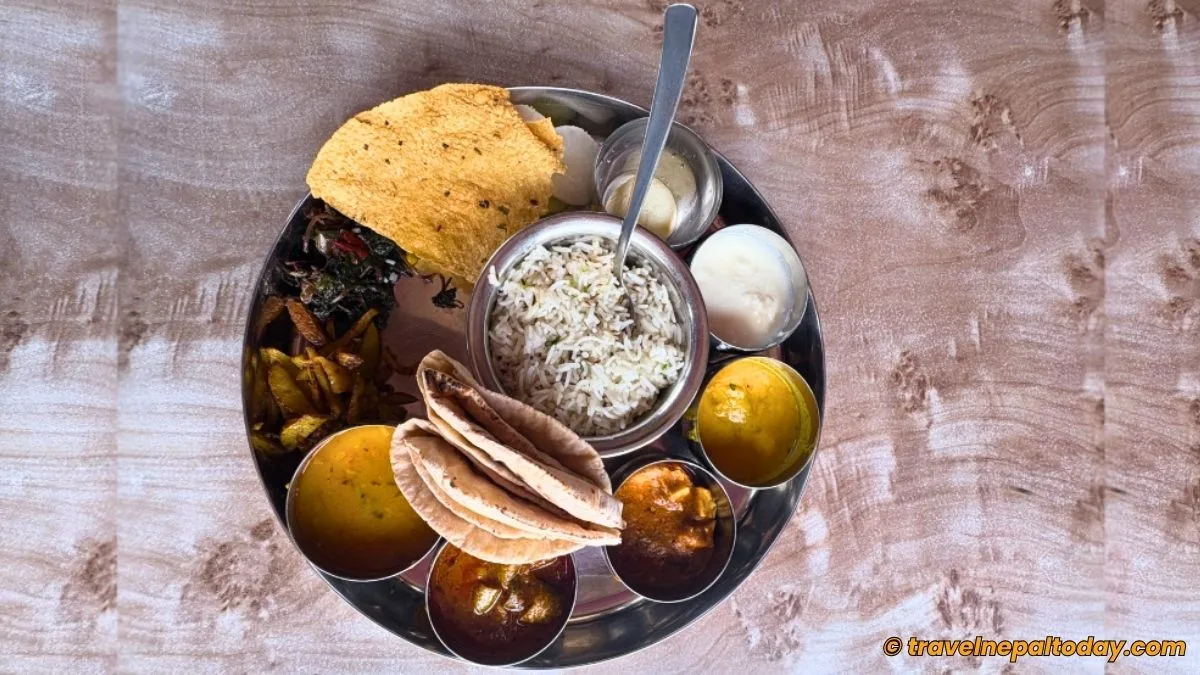
The inclusions in our set were: rice (properly mixed with ghee), dal, tons of vegetables, chapati (roti), and a sweet item (rasgulla or rasbari, whatever you say).
The plate was full, and unlike in typical Nepali sets, there wasn’t much room or need for refills. At least for me. It was more than enough!
What we also tried was Janakpuri Lassi, which I personally found a bit too sweet. But it’s definitely one drink you shouldn’t miss out here!
Mithila restaurants are available right outside the Janaki Temple premises. Don’t worry! We’ll help you pick the right ones by updating the list right here in this guide. So, bookmark this page and come back later.
How to reach Janaki Temple in Janakpur?
Depends on how you’re planning to visit.
We went on a 3-day trip to Janakpur that not only covered Janaki Temple but also several places across Madhesh Pradesh.
Starting from the Kathmandu–Dakshinkali–Hetauda route, we visited Simara Park, Nijgadh View Tower, Nunthar Mahadev, Bharat Lake, and then finally to Janaki Temple.
From here, we continued to nearby Argaza Pokhari, followed by Dhanusha Dham and Sindhuli Gadhi, before returning to Kathmandu via the BP Highway.
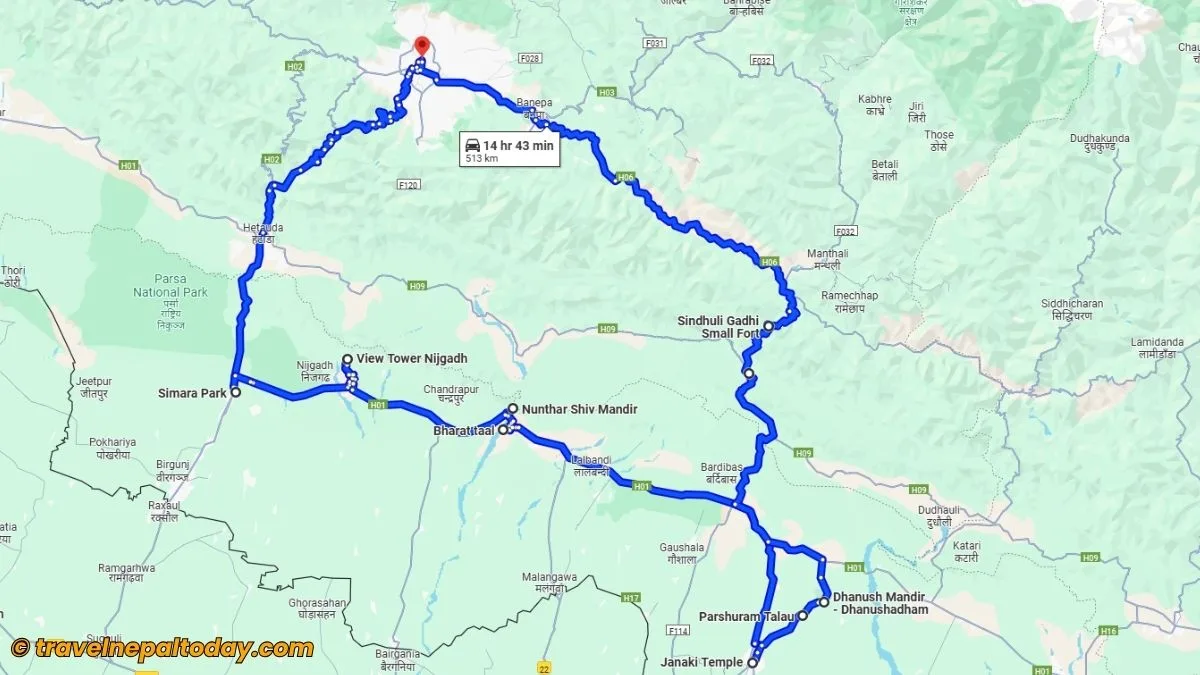
So, if you’re up for that, you can take your private vehicle and go for it. But if you’re only planning to visit Janakpur from Kathmandu or any other district, you need to get a direct bus to Janakpur. From the Janakpur bus stop, you can take a tuk-tuk to reach Janaki Temple.
For night stays, I’m going to update this article soon with the best hotels in the area. So, stay tuned!
How Much Does a Trip to Janakpur Usually Cost?
As mentioned earlier, we had a 3-day trip, and that cost us around NPR 5,150 per person.
Remember that we were on a budget. For you, the cost can vary accordingly!
In case you’re also following the same itinerary like ours, expect your budget to be around NPR 5,000 to 6,000 per person.
Let me share our expenses for two people to help you plan your budget accordingly:
| Kulekhani Breakfast | 210 |
| Simara Park | 30 |
| Nijgadh Lunch | 470 |
| Nunthar Mahadev Total cost | 45 |
| Bharat Lake Visit (Motorboating + Camel Ride + Water) | 750 |
| Janakpur Hotel Stay | 1700 |
| Janakpur Temple Darshan | 455 |
| Janakpur Dinner | 360 |
| Janakpur Lunch | 795 |
| Fuel | 2000 (approx.) |
| Sindhuli Khuwa | 200 |
| Sindhuli Hotel (Bed + Breakfast + Dinner) | 2200 |
| Sindhuli Gadhi Visit | 110 |
| Extra | 1000 |
| Total | NPR 10,325 |
Final Words
Hope you’ve learned a lot about Janaki Temple from this article.
It’s a spot that every Nepali should visit at least once. It’s our national pride, and we must show love towards this part of Nepal as well!
So, I invite everyone to pay a visit here and tag us on your social media posts and stories.
I know I’m yet to visit more spots in Janakpur and learn more about their culture. But from a single visit, I can assure you that people here must comply with good sanitation to make the place worth visting.
Look at us. We visited a hotel just next to the Janaki Temple, yet we were deprived of even the basic amenities.
Lesson learned: Always opt for a reputable hotel!
Mithila has such a good history of respecting their guests, but it seems this culture is slowly disappearing? Or perhaps I chose the wrong hotel?
No worries! I’ll visit Janakpur again and research the best hotels near Janaki Temple to suggest for you guys! Stay updated until then…
Happy travelling to Dhanusa!
About The Author