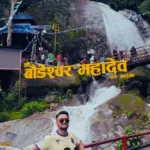
The Gurje Waterfall ride starts from Tokha, and it takes less than an hour to reach. However, you can’t take your vehicle all the way to the waterfall. A short hike is needed.
My recent visit to Gurje Waterfall was quite a memorable one. The water level had risen to its peak and was much better than what I had expected it to be.
If you want to learn more about this journey, you’ve landed on the right page! I’m going to cover every single detail you need to know about Gurje Jharana here. Let’s begin!
Key Facts About Gurje Waterfall
| Location | Samundradevi, Shivapuri, Nuwakot, Bagmati Province |
| Distance (from Tokha) | 15 km approx. |
| Time to Reach | 1 hour approx. |
| Modes of Transportation | Private Vehicle/Public Vehicle + Hiking |
| Best Time to Visit | August and September |
How to Reach Gurje Falls?
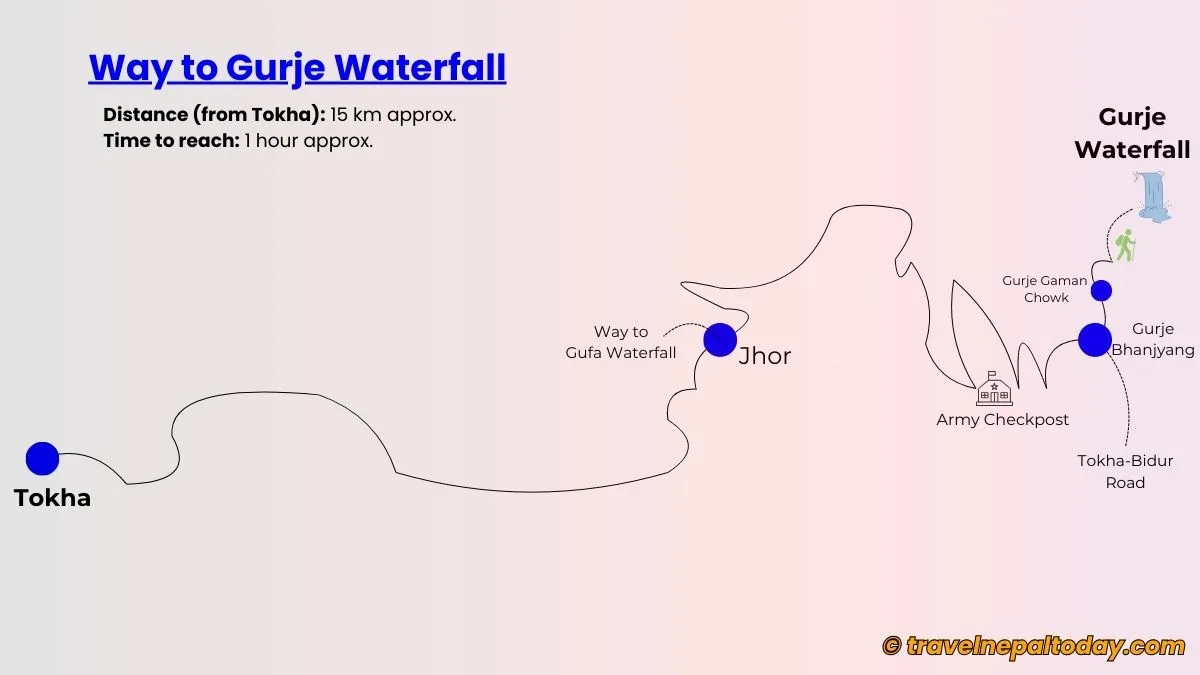
Gurje Falls is one of the closest waterfalls to Kathmandu, but it is actually located in the Nuwakot District. It can be a perfect short ride experience to include this Saturday.
Even during our visit, we were expecting the waterfall to be a busy one. But there were only a few people going. In fact, the two of us got enough time to enjoy ourselves here.
Clearly, it’s one of the least crowded waterfalls near Kathmandu. That is, unless it suddenly goes viral on social media. So, if you’re reading this, go start your bike right away :p!
Let me help you with the directions now.
Step 1: Reach Gurje Gaman Chowk
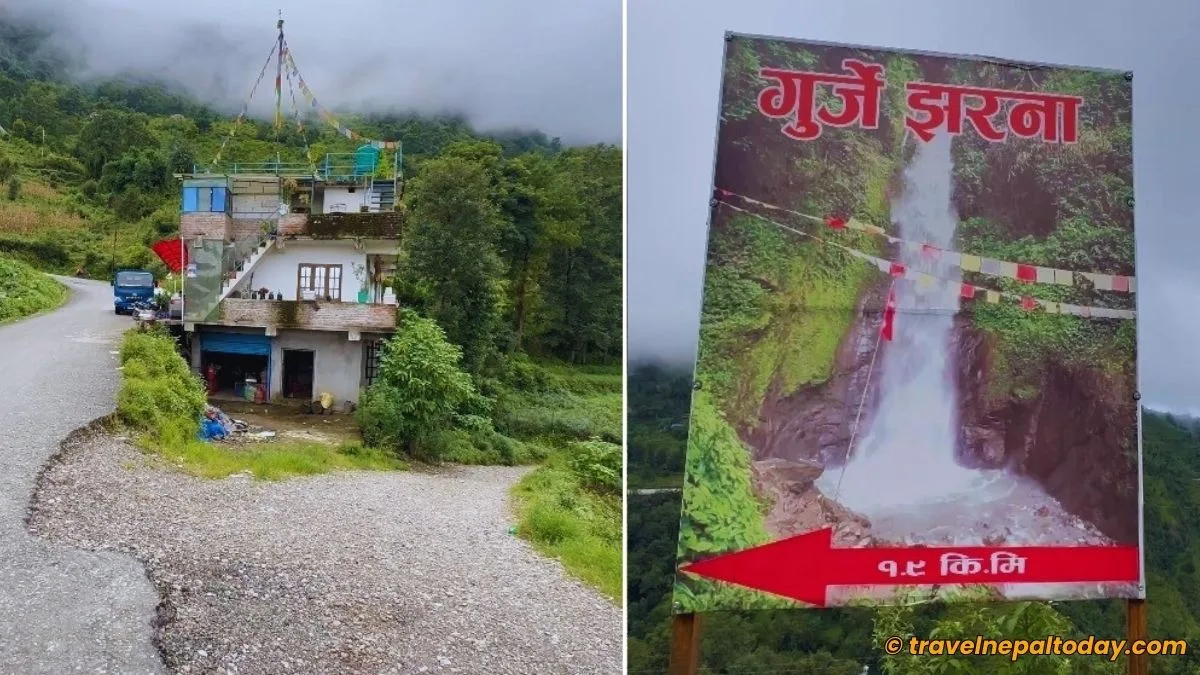
To get to the Gurje Jharana, you first need to reach Gurhe Bhanjyang in Shivapuri Rural Municipality, Nuwakot.
You can get here either by riding all the way or by taking a public vehicle and then walking to reach the actual destination.
There’s a diversion on the right side of the road with boards marked ‘Gurje Jharana’ and ‘Lakhinshwori Jharana’ to make it easier for you. In fact, this is the same route that takes you to Chilaune Gaun Jharana as well.
To reach Gurje Waterfall, you have to take yet another diversion from Gurje Gaman Chowk, and two more boards will assist you. For even clearer instructions, continue reading below:
Ride to Gurje Waterfall
First, for the riders out there! This is the exact route (which is also available on Google Maps):
First, reach Tokha > Continue on the Tokha-Bidur road > Gurje Bhanjyang Check Post > Gurje Bhanjyang > Take a right from the diversion that goes to Khole Gaun > Gurje Goman Chowk > Take a left > Reach Gurje Bhanjyang Hiking Point.
But do keep in mind that your motorcycle or scooter won’t reach the waterfall itself. Hiking is essential after reaching the parking area.
Going on a Public Vehicle

For those of you planning to reach Gurje Waterfall, you can hop on any electric van heading towards Rasuwa. These are the same ones that go up to Dhunche, Timure, or Rasuwagadhi.
Buses are also available, but from my experience, EVs are much faster!
Be sure to tell the driver to drop you at Gurje Bhanjyang, just a little downhill from the check post.
From the diversion (where a public restroom is also available), you’ll need to hike all the way to the Gurje Bhanjyang Hiking Point. This can be quite a long hike, taking nearly 1.5 hours to reach the waterfall itself.
So, a tip for you is to start your day early.
Step 2: Analyze Road Condition
The road condition is completely off-road from the final diversion.
All private vehicles can reach the hiking point. But if the road condition is bad, you can choose to park your vehicle wherever you can reach. That’s exactly what we did!
For us, it added just five minutes of extra hiking, and honestly, that’s not a big deal. After all, you have to walk anyway.
Step 3: Hike to Gurje Jharana
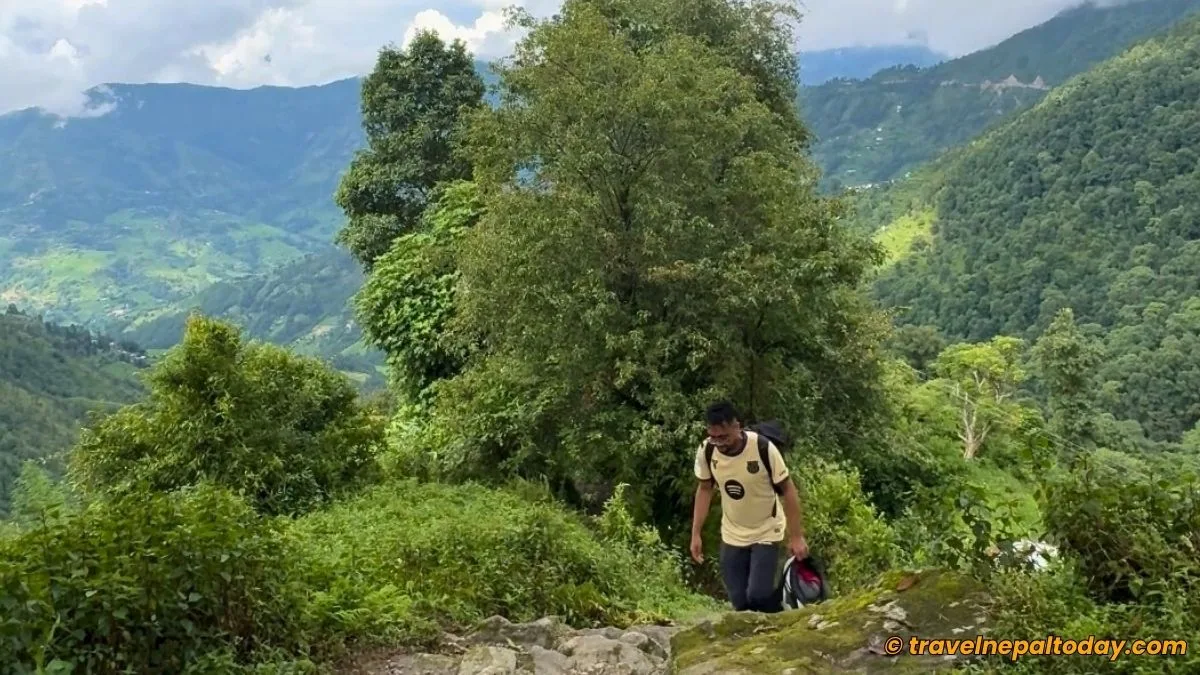
After you’ve reached the hiking point of Gurje Waterfall, the trail is mostly downhill.
Don’t go all the way down. You’ll come across a few local houses along the trail, and you’ll need to take a left once the straight downhill ends.
From here on, it’s mostly a straight path. Monsoon season can make the trail completely wet, so hike carefully.
The final section is a slight uphill that takes around five to seven minutes. Be extra careful on the steel ladder, as it can be very slippery during the monsoon.
Once you cross it, the beautiful Gurje Waterfall will be just a minute’s walk away. The mist completely refreshes you. My guarantee!
Note: Those who actually prefer hiking shouldn’t choose the route I’ve provided at all. Instead, there’s a complete hiking trail that takes you to Gurje Waterfall from Kakani.
Best Time to Visit Gurje Waterfall
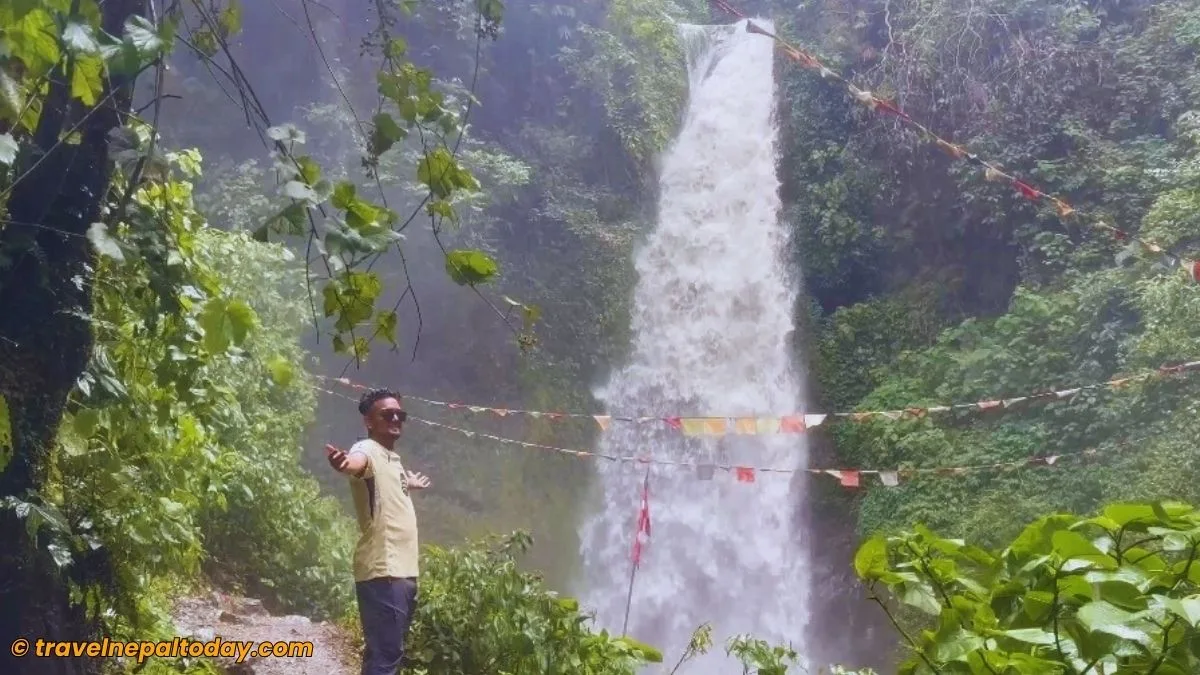
The best time to visit (in fact, the only time you should visit) Gurje Waterfall is during the monsoon season.
Autumn would be the second choice. But if you’re planning besides these two seasons, it’s better not to plan at all!
The prime months are August and September.
While previously July used to be a great time, the season has shifted in Nepal over the last two years. Although late July is still ideal, I’d say up to early October would be the better option.
You wouldn’t want to visit a waterfall that’s completely dried up, would you?
Essential Tips Before Your Trip to Gurje Waterfall
Even though the trip to Gurje Waterfall is a short one, there are a few things to keep in mind before visiting.
These come from my very own experiences, and to ensure your trip turns out perfect, I’d love to share them with you:
#1 Kindly Ride Safe!
The Tokha-Bidur road offers a scenic route outside of Kathmandu, and I know many of you riders would love it here!
But keep in mind that the road isn’t very wide; it’s quite narrow. The electric vans come here at full speed, and so do all the other drivers/riders.
There are many turns, so you have to keep your thumb on the horn at all times. Be aware of your speed and stick to your leftmost lane.
Once you reach the off-road section, be extra cautious. Some parts look crossable on the downhill, but these may require at least one more person to push you when returning uphill.
So, if you’re going solo, it’s safer to park your vehicle a little earlier. In case nobody is there to help you, you might end up in serious trouble. You know, always think of the worst-case scenario when traveling!
#2 Be Aware of Leech
The biggest issue when hiking in the monsoon is the presence of leeches. This short hike also comes with an abundance of these parasites.
Even though we were extra careful, some tiny ones somehow managed to get inside our trousers and suck some of our blood. If you want to prevent this, carry some salt with you.
Wear long sleeves, apply sanitizer near your feet and hands (where the risk is highest), and while hiking, don’t go too close to the bushes. Many choose to go barefoot, but that isn’t a good practice either.
These were just some of my tips. There are plenty more, which deserve a complete guide. I’ll soon bring that to you here on Travel Nepal Today.
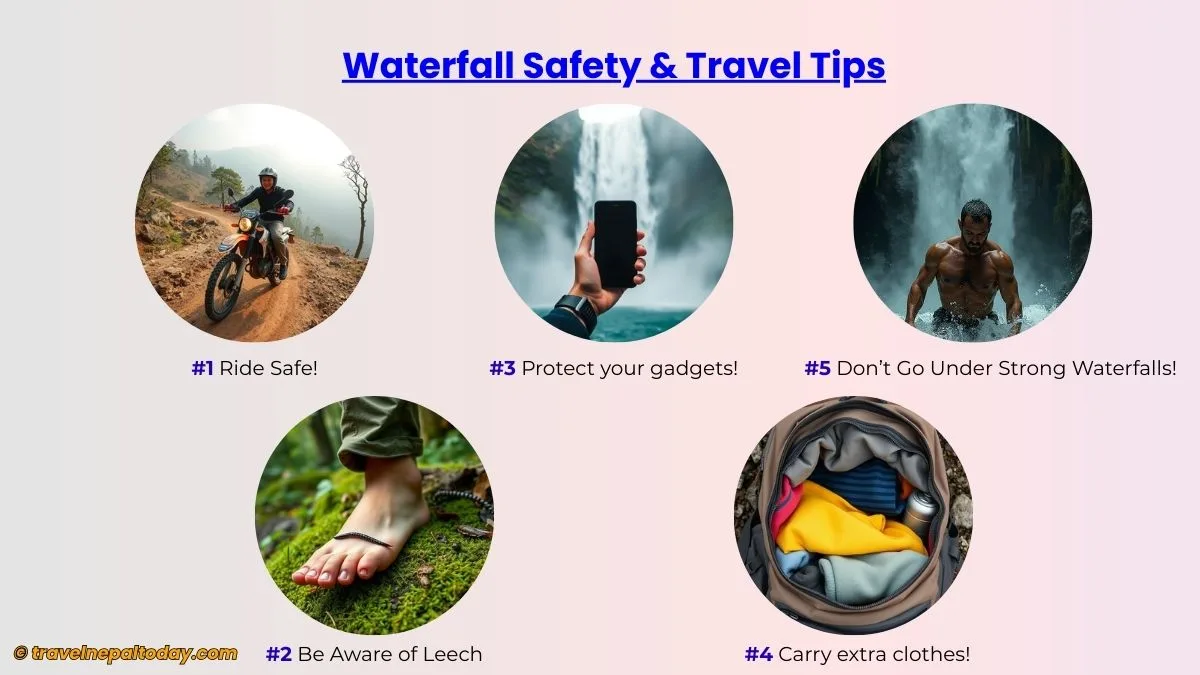
#3 Protect Your Electronic Devices
Let me share a bad experience I previously had at Lauke Waterfall. The mist was so powerful that it fogged up my phone’s camera lenses.
I thought it was temporary, but it stayed fogged for the next 24 hours. I was only able to fix the issue by immersing the lens part in a bucket of rice. Even today, the lens seems partially damaged and doesn’t take the best pictures it should.
You see, those IP ratings you read in the specs are just numbers and only helpful for particle water protection. Immersion and mist are two completely different scenarios. I always say, electronics and water should never go together.
So, no matter how proud you are of your so-called ‘waterproof’ gadgets, kindly be extra cautious!
I was very careful during this visit to Gurje Falls. I protected my camera by covering it with my jacket or keeping it behind me (protecting from the mist) when not in use. Really, the mist from this waterfall reaches at least 10 meters away.
#4 Take Extra Clothes
As we’re on the topic of mist, taking an extra cloth is actually a smart choice. We initially thought the waterfall wouldn’t be that huge and that we’d only sit and relax without participating in bathing.
However, thanks to the mist, we still got wet!
Lesson learned: always take an extra pair of clothes when going to any waterfall in the monsoon, even if you’re not planning to bathe or swim.
#5 Don’t Go Too Close to the Waterfall
For those of you willing to immerse yourself here, don’t try getting right under the waterfall. The force of Gurje Jharana is too strong and may actually crush you!
Seriously, the powerful currents of waterfalls can be fatal. While getting close is okay, getting too close should be avoided.
I don’t know if you’ve experienced this, but I have… Even reaching a certain point where the water force is too high, you start gasping for air. This could actually cause you to stop breathing completely, which is a sign of dry drowning, also called laryngospasm.
While having fun is one thing, safety should always come first!
Expected Budget For This Trip
We spent zero rupees (excluding the fuel) to explore Gurje Jharana. Unlike some other waterfalls in Nepal, you don’t even have to pay an entrance fee or a parking charge.
It’s a local hidden gem near Kathmandu that’s perfect to visit with your loved ones.
There are plenty of homestays around for lunch and snacks. I’ll update this article soon with the best places to visit here.
To sum up, the cost shouldn’t be much. I’d say NPR 500 in your pocket should be more than enough.
Bonus Tip: Things to Carry
When you’re chasing waterfalls, carrying a few essential items can make your travel much more hassle-free. I’m going to share some of the things I usually carry and personally recommend too:
| Item | Where to Get | |
| Amazon | Daraz | |
| Quick-dry Towel | Youphoria Microfiber Travel Towel | Quick Dry Towel Super Absorbent Compact |
| Water-resistent bag | YETI Panga 28 Airtight Waterproof Submersible Backpack | Arctic Hunter B00530 Waterproof Casual Backpack |
| Flip-flops | Archies Arch Support Flip Flops | Kito Walk Aa64M Black |
| Waterproof Phone Pouch | Case-Mate 2 Pack IP68 Waterproof Phone Pouch | Waterproof Mobile Phone Pouch |
Final Words
That was another waterfall covered here on Travel Nepal Today. Add this to your Saturday bucket list and tick it off immediately before the place goes super viral.
Of course, Nuwakot has even more waterfalls, and some of them can be visited in a single day. As I mentioned above, you could go to Lakhinshwori, Chilaune Gaun, and Lapse waterfalls in one trip.
However, that would make it a rush rather than allowing you to enjoy one waterfall at a time. A better approach is to opt for Gufa Waterfall in Jhor (Kathmandu). That’s what we did! Combined Gurje with the two waterfalls present there.
For more waterfall-related blogs, be sure to bookmark this website for reference.
Happy traveling to Nuwakot!
About The Author