

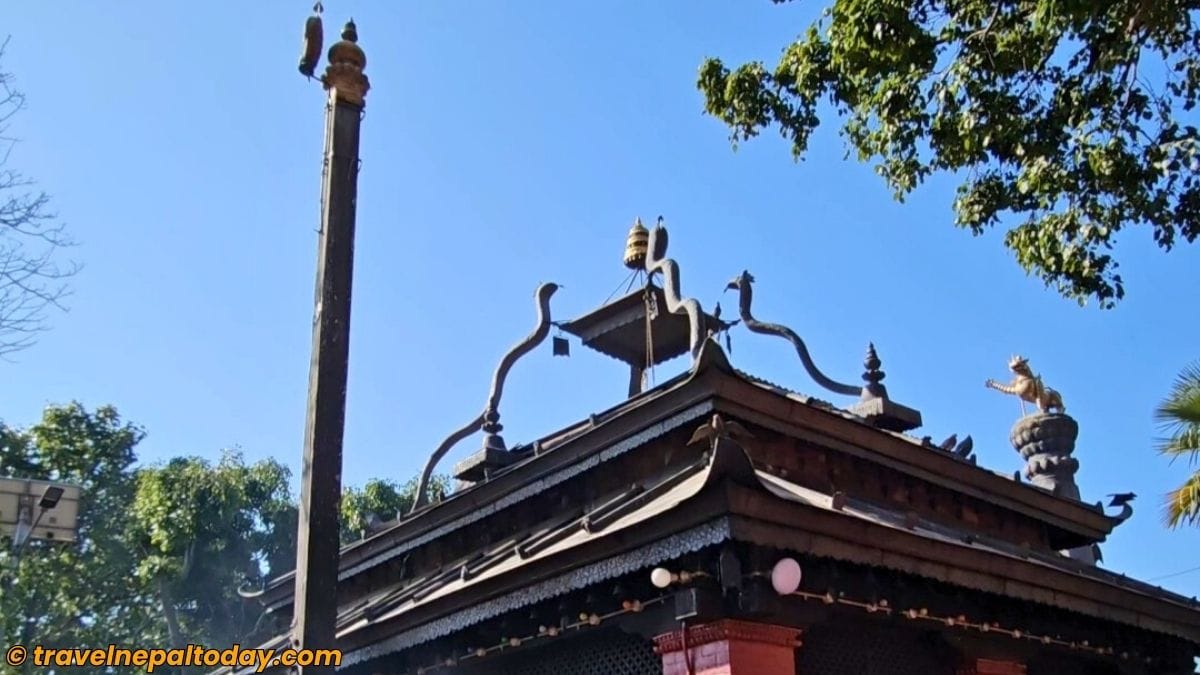
Dolakha Bhimsen is one of the many temples in Nepal that holds immense religious and cultural significance. However, what truly sets it apart is its mysterious ability to “sweat” and predict the future.
Sounds unbelievable? Well, every time the stone idol of God Bhimeshwor sweats, a Kshyama Pooja is organized. That too after the necessary ritual materials are sent by the head of state.
That makes it even harder to believe, right? But I’m not making this up.
If you look at historical records, Dolakha Bhimsen has perspired right before some of Nepal’s most tragic events.
But how true is this mythology? Are Nepalese simply holding on to superstitions? Or is there actual scientific evidence behind this phenomenon?
I’ll answer all your curiosities in this article and also guide you on how to reach Dolakha Bhimsen the right way. Let’s begin!
Key Facts About Dolakha Bhimsen Temple
| Location | Dolakha Bazaar, Bhimeshwor, Dolakha, Bagmati Province |
| Altitude | Above 1800m |
| Mode of Transportation | Private Vehicle / Public Vehicle + Local Transport |
| Distance (from Koteshwor) | 130 km |
| Time to Reach | 5 to 7 hours (depends on transport) |
| Best Time to Visit | All seasons |
How to Reach Dolakha Bhimsen From Kathmandu?
The distance from Kathmandu to Dolakha is about 130 km, and I recommend planning a one-night stay in Charikot during this trip.
I’ve visited Dolakha twice as of writing this article, and every time, Dolakha Bhimsen’s spiritual presence has drawn me closer.
I took two different approaches to visiting the temple on separate occasions. You can follow either of these approaches based on what suits you best:
- Visiting other places first: Take a public or private vehicle to explore other tourist spots in Dolakha, stay overnight in Charikot, and visit Dolakha Bhimsen in the morning.
- Just the temple? Take a public bus heading toward Rolwaling Valley (not the one that only reaches up to Charikot). This way, you can get off right at the Dolakha Bhimsen Temple entrance. From there, it’s just a 10-to-15-minute walk.
Here’s what I had done:
- During my Kuri-Kalinchowk tour: Headed to Charikot > Booked a Bolero to Kuri Village > Stayed overnight > Visited Kalinchowk in the morning > Returned to Kuri and took the same Bolero to Dolakha Bhimsen Temple entrance > Walked to the temple > Took a taxi to Charikot > Couldn’t find a bus, so ended up taking the same taxi to Kathmandu (Funny story, lol).
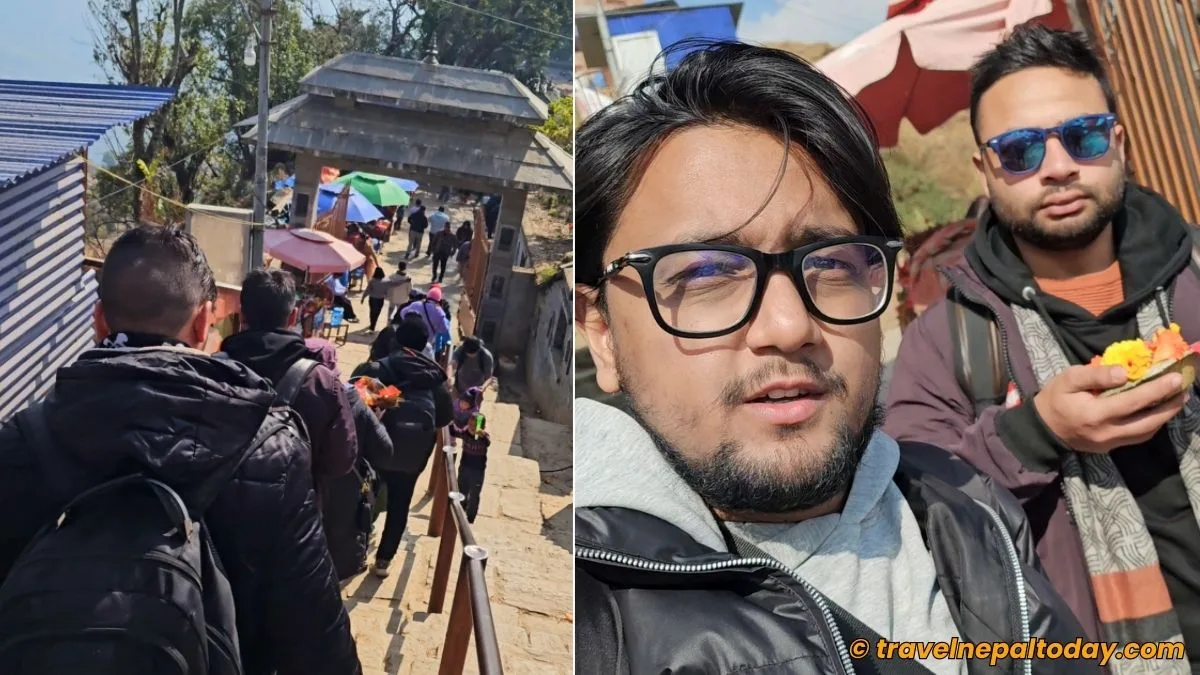
- During my Sailung bike ride: Rode to Sailung, the Land of 100 Hills > Headed to Charikot for an overnight stay > Rode to Dolakha Bhimsen Temple > Rode back to Kathmandu.
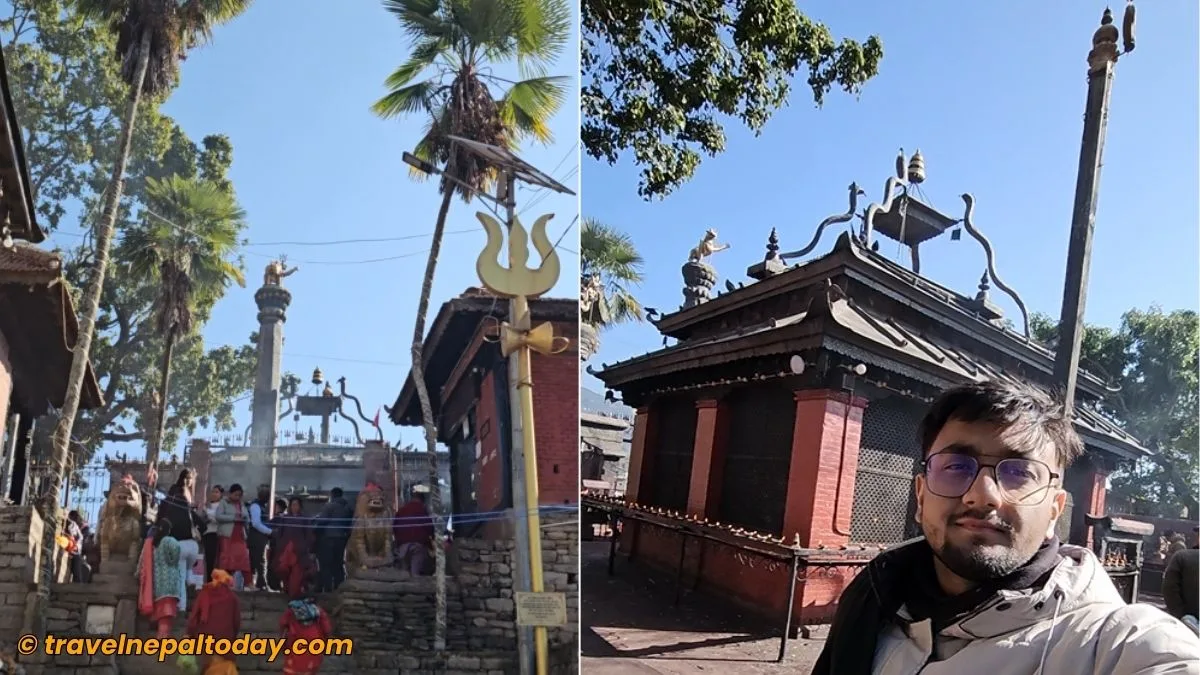
- During my Tsho Rolpa-Dudhkunda Trek: I only got a glimpse of the entrance gate and prayed for a safe trek from far away.
Basically, Dolakha Bhimsen Temple is just a 10-minute ride or drive from Charikot. Since temples are best visited in the morning, I’d suggest you do the same.
The Legend of Sweating Dolakha Bhimsen
Now, let’s talk about the extremely popular myth surrounding the sweating idol of the Dolakha Bhimsen Temple.
The triangular-shaped, black-colored idol has often been found “sweating.” No, I haven’t witnessed it myself, but many locals, mainly the priests, claim it to be true.
There’s no specific time when Dolakha Bhimsen sweats. So, unless you’re incredibly lucky (or should I say unlucky), you won’t be able to check it out for yourself.
That’s because there’s a belief that whenever Dolakha Bhimsen sweats, a national crisis follows. And interestingly, several tragic events in Nepal’s history have seemingly synchronized with this phenomenon. Let’s take a look at the history:
- 1934 Nepal-Bihar earthquake of 8.0 magnitude
- Four times before the four martyrs of Nepal were hung to death in 1941
- End of Rana Regime in 1951
- Death of King Tribhuwan in 1955 and death of King Mahendra in 1972
- Royal Massacre in 2001 that killed King Birendra’s entire family
- Multiparty democracy establishment in 1993
- 2006 People’s Movement II
- Nepal’s declaration as Federal Democratic Republic in 2008
- 2015 Gorkha earthquake of 7.8 magnitude
- Nationwide lockdown due to COVID-19 in February 2020
- 2024 Saurya Airlines Crash (a case that went viral on social media)
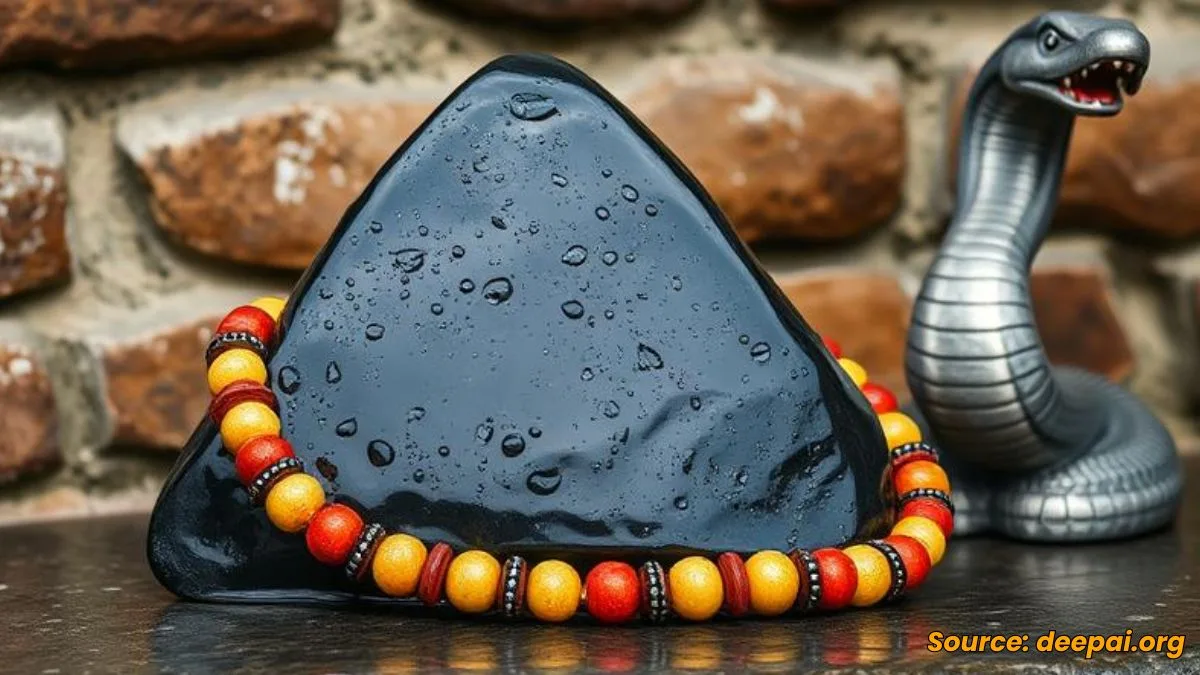
From political turmoil to natural disasters and major accidents, Dolakha Bhimsen seems to have a reputation as Nepal’s “fortune teller,” doesn’t it?
In fact, a Kshyama Pooja is performed whenever the idol sweats, and there’s a long-standing tradition for the head of state (formerly the King, now the President) to send a wad of cotton to wipe away the sweat.
This ritual, considered an act of seeking forgiveness, is believed to help stop the bad things before they really happen.
While this has become a deeply rooted religious practice, is it anything more than a superstition? Just because an idol sweats, does that mean it can predict the future?
Sure, the connections are intriguing, but ask yourself: are we interpreting it the right way?
Nepal is already in crisis. If this myth held absolute truth, Dolakha Bhimsen should be sweating every single day!
And let’s not forget the countless other national tragedies that weren’t foretold. Why didn’t Dolakha Bhimsen sweat during those times, then?
There’s no real logical explanation here, is there? It’s no wonder why we Nepalese are ranked among the lowest in global IQ statistics. And that’s not something to be proud of.
The Science Behind the Perspiration
I’m not an atheist, nor am I against my own Hindu religion. But we shouldn’t let superstitions that have no real religious connection take over our beliefs.
Forget scientific evidence. I haven’t even found any astrological proof that suggests the stone idol has the ability to predict the future. It all seems to stem purely from local beliefs.
What we do know is that there are several other Hindu idols around the world that also perspire.
A well-known example is the idol of Lord Murugan in the Sikkal Singara Velar Temple, Tamil Nadu.
However, unlike Dolakha Bhimsen, it isn’t associated with predicting the future. Or, perhaps no one has made the connection the way we Nepalese have.
Wouldn’t it make sense to study the idol scientifically? I’d love to hear what geologists in Nepal think about this siubject. If you’re one, feel free to share your thoughts in the comments.
For now, here’s what we do know: Sweaty rocks exist. And in the case of Dolakha Bhimsen, it appears to be nothing more than a natural phenomenon.
The water droplets seen on the idol’s smooth black surface are most likely due to condensation. Allow me to explain:
- The underground region of the temple likely contains moisture, which evaporates over time due to geothermal heat.
- Since the heat has limited escape points, the air inside the temple becomes relatively humid.
- Over time, the humid air comes into contact with the stone idol.
- Due to condensation, water droplets form on the Bhimsen idol’s surface.
That’s one possible scientific explanation. Another comes from an eyewitness, William Finke (a Peace Corps volunteer), who suggested that the sweating could be due to petroleum minerals present in the idol.
Either way, one thing is clear—there should be a proper study conducted on the stone idol.
But let’s be real. Locals would probably never allow it! And Nepal just isn’t ready for such studies yet.
Dolakha Bhimsen’s Untold Religious Significance
Of course, we all know Dolakha Bhimsen as Nepal’s sweating god. But there are even more mythological stories that I bet you haven’t heard of.
First, let’s dive into the history of how this temple came to be.
The History of Dolakha Bhimsen
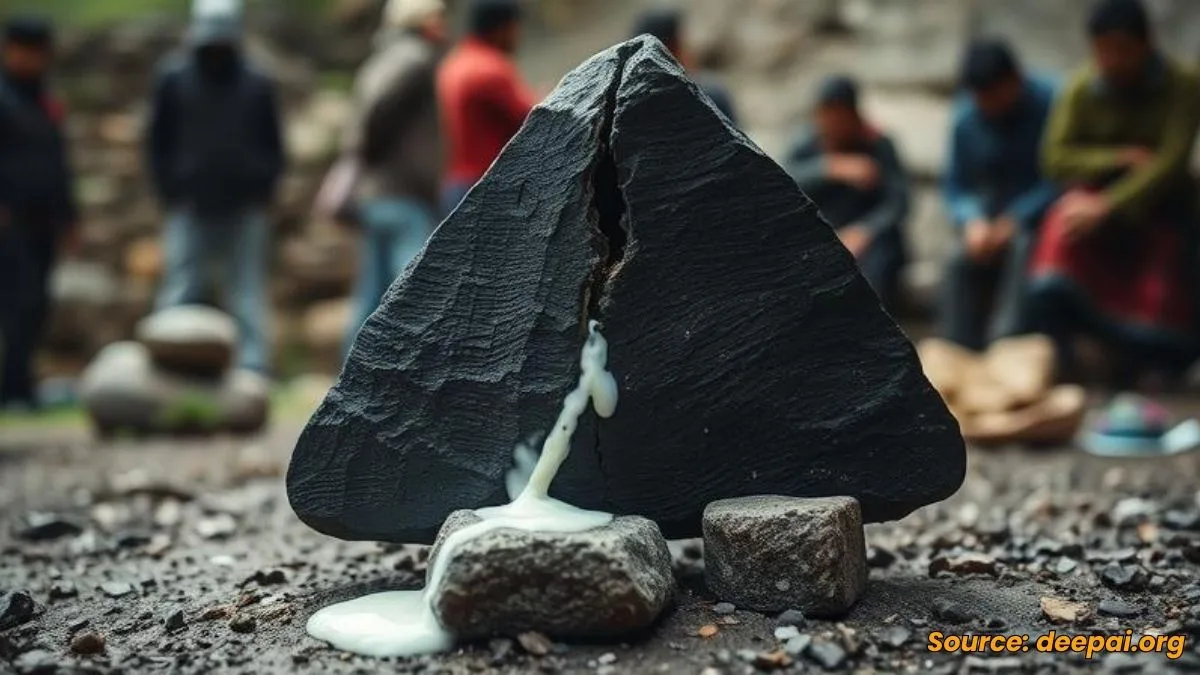
Ekadeshma… A group of porters were cooking food using a triangular-shaped stove made of three stones. However, one side of the pot remained uncooked.
Frustrated, one of the porters struck the stone in anger. To everyone’s shock, the broken stone began to bleed blood mixed with milk, a divine sign of holiness.
Realizing its sacred nature, the porters immediately started worshipping the idol as God Bhimsen and eventually established a temple at the site.
Dwalkha Bhindyo: The God of Business
Why Bhimsen? Because in Nepal’s Newar community, Bhimsen is worshipped as the god of trade, commerce, and business.
Ever since that day, the temple has been known as Dwalkha Bhindyo or Bhindeyo Aaju. Many Newari communities engaged in business visit this temple to worship the idol and pray for prosperity.
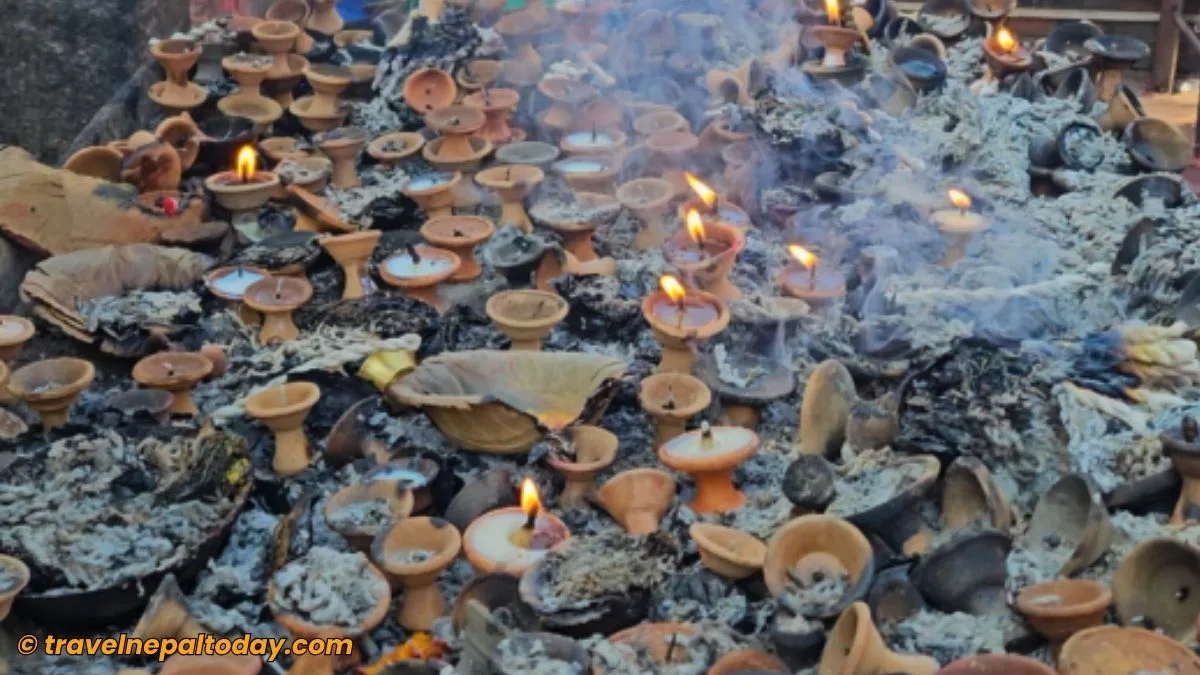
Moreover, during my visits, I learned that a Ras Puja is performed every afternoon. Devotees waiting in line are asked to pause while the ritual takes place.
From what I’ve gathered, the idol of Bhimeshwor is adorned with ornaments during Ras Puja, a tradition carried out by the temple priests.
Hopefully, I’ll get to learn more about it on my future visits and share the details with you here. So, stay tuned!
The Three Forms of Dolakha Bhimsen
The name itself suggests that the temple is dedicated to Bhimsen, one of the five Pandavas from the Mahabharat.
But remember that milk-bleeding story I mentioned earlier? That also indicates that the Bhimsen idol resembles Lord Mahadev, particularly Bhairava.
Some even believe that Narayana (Vishnu) resides within the idol rock.
This is why the deity here is often referred to as “Ek Sheela Teen Avatar” (One Stone, Three Forms).
So, when planning your visit to Dolakha Bhimsen, you can tailor your prayers accordingly:
- Shiva during Rudri and Bhairava if offering an animal sacrifice
- Vishnu for evening prayers
- Bhimsen if praying for business success
Not to forget that there are several other idols inside Bhimeshwor Temple. It’s best to receive blessings from all of them.
Don’t worry! The temple priest will guide you through the process (just like he helped me).
Expected Budget for the Trip
As I suggested earlier, don’t limit your trip to just Bhimsen Temple when visiting Dolakha.
You can easily add destinations like Kuri-Kalinchowk, Jiri, or Shailung to make the most of this short getaway from Kathmandu.
That being said, your budget for a one-night trip will largely depend on your hotel stay and package choices. Generally, it can be completed within Rs. 4,000 to 5,000.
Speaking from experience, I managed to complete my budget-friendly Shailung trip (including Dolakha Bhimsen and Palanchowk Bhagwati) for under Rs. 3,000. However, my Kuri-Kalinchowk trip ended up costing me nearly Rs. 8,000.
Final Words
Hopefully, I’ve been able to educate you on everything related to the Dolakha Bhimsen Temple. If you’re a Nepali, I highly recommend visiting this site at least once.
I understand that some of you might have mixed feelings after reading about the call for scientific evidence. If I’ve upset anyone, I apologize, but it’s essential to question these superstitions when necessary.
That being said, if you genuinely believe that Dolakha Bhimsen is a fortune teller of Nepal, don’t hesitate to share your thoughts below. I’d love to learn from your perspective as well.
For those of you reading from outside Nepal, these kinds of stories and controversies are what make Nepal such a unique and intriguing destination. So, if you’re looking to explore more, Travel Nepal Today!
Happy traveling to Dolakha!
About The Author


would love to perpetually get updated outstanding weblog! .
Thank you for your kind words, Caterina!