
Before you start worrying about altitude, weather, or those stunning views of Machhapuchhre, let’s clear one important thing first. Mardi Himal trek permit!
Trust me, once this part is sorted, the rest of the trek feels much lighter.
There’s a lot of mixed information online. Some say you need multiple permits. Some say TIMS is mandatory. Others say you don’t need anything at all. So let’s clear the confusion properly and simply.
Here’s the short and honest answer:
- Foreigners need permits.
- Nepali citizens don’t.
- SAARC nationals fall somewhere in between.
Also, let’s bust the biggest myth right away. You do NOT need a TIMS card to do the Mardi Himal Trek on your own. Yes, ACAP alone is enough as of 2026!
I’ll explain this properly below so you know exactly why.
Summary: Mardi Himal Trek Permits
| Permits | For Nepalese | For SAARC Trekkers | For International Trekkers | Children (below 10 years) |
| Annapurna Conservation Area Project (ACAP) Permit | Free | NPR 1000 | NPR 3000 | Free |
| TIMS Card (optional) | NPR 1000 | NPR 2000 |
All Mardi Himal Trek Permits With Cost Explained
If you’re short on time, the above table has already answered 80% of your questions. Now, let’s break it down properly.
Permits might sound boring, but they exist for a reason. And once you understand why they’re required, things start to make sense.
For Mardi Himal Trek, there’s mainly one permit that actually matters…
Annapurna Conservation Area Permit (ACAP)
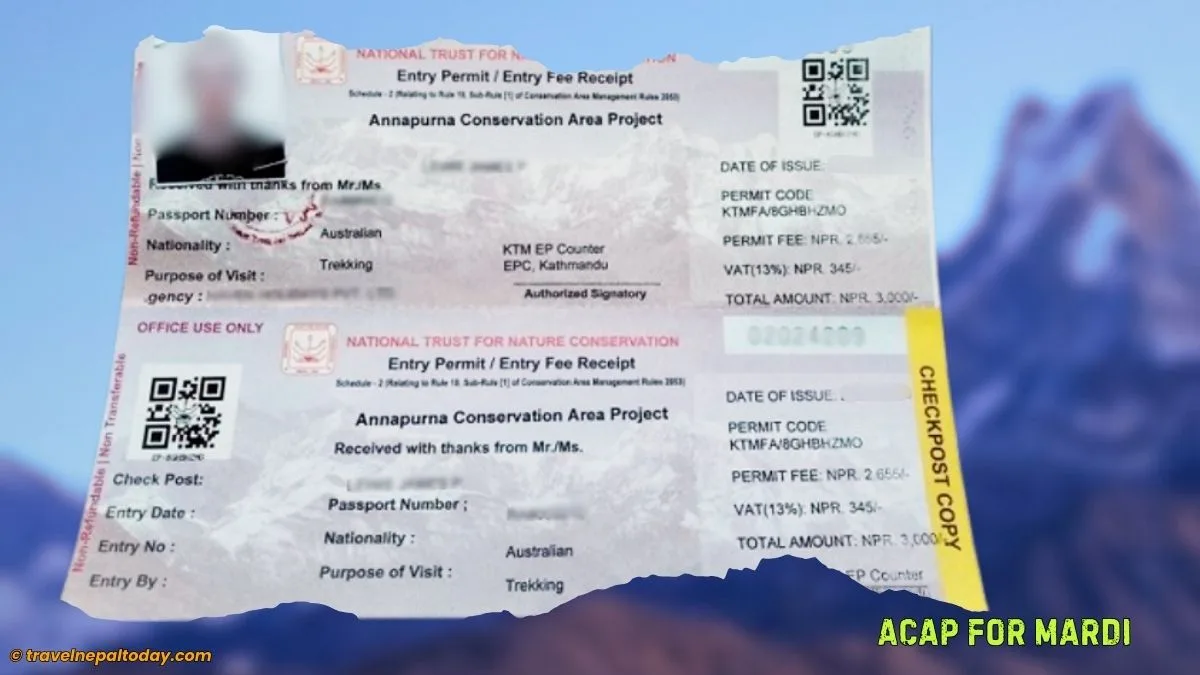
Mardi Himal Trek lies inside the Annapurna region, which is Nepal’s first and largest conservation area, managed by the National Trust for Nature Conservation (NTNC).
In simple words, this permit allows you to legally enter and trek inside the protected area. Your ACAP fee helps with trail maintenance, conservation of forests and wildlife, waste management, supporting local communities, rescues, and maintaining monitoring systems.
So yes, that permit money actually goes somewhere useful!
NTNC runs this project to balance tourism with conservation, making sure trekking routes like Mardi Himal remain open, safe, and sustainable.
ACAP Permit Cost:
- Nepali citizens: Free
- SAARC nationals: NPR 1,000
- Foreign nationals: NPR 3,000
- Children below 10 years: Free
TIMS: Is This Really Needed?
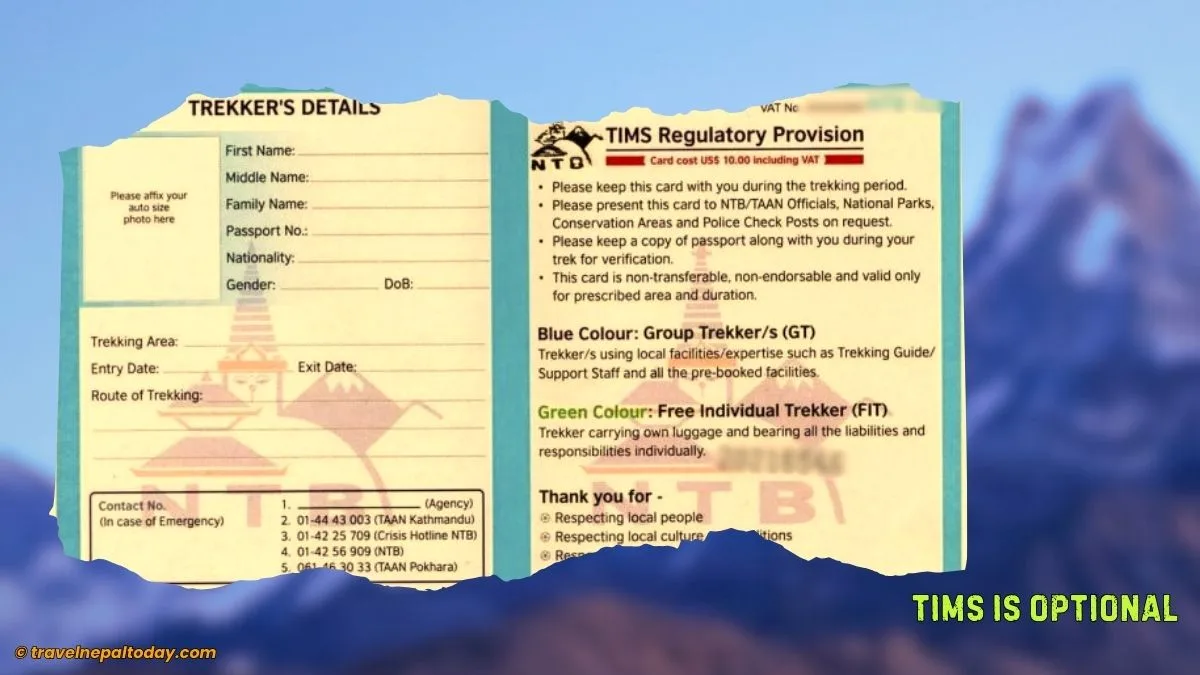
This is where most confusion comes from. TIMS (Trekkers’ Information Management System) was introduced to keep a record of trekkers, improve safety, help in rescue operations, and track trekkers in remote areas.
Sounds important, right? So why do people say it’s mandatory? On paper, yes, TIMS still exists!
But on the ground:
- There are no checkpoints checking TIMS.
- Nobody asks for it on the trail.
- If you’re trekking with a guide, they handle it anyway.
There’s also a newer system now (National Information System), which focuses more on safety, tracking, and accountability of foreign nationals.
So, should you still get TIMS? So, honestly, it’s not compulsory as of 2026. But I still recommended for safety.
Do note that you cannot apply for TIMS yourself. Only a registered trekking agency can issue it!
So if you really want TIMS, just tell your agency. Otherwise, don’t stress over it. I’ll soon come up with best agencies for Mardi Himal Trek too or you can simply fill up this form and I’ll help you more.
TIMS Cost:
- Nepali citizens: No need
- SAARC nationals: NPR 1,000
- Foreign nationals: NPR 2,000
- Children below 10 years: No need
What About Local Permits?
You might have noticed this trend recently. Many trekking routes are starting to introduce local permits. Something I experienced with my Manaslu Circuit Trek.
Mardi Himal Trail falls under the Machhapuchhre Rural Municipality. And as of now no local permits is required. So, no need to worry about extra fees and surprise charges on the trail!
Additional Permits
Most trekkers won’t need these. But it’s still good to know:
- Filming or documentary work requires permits from the Ministry of Communication and Information Technology (MoCIT) and the Film Development Board (FDB).
- For flying drones, you require separate approval needed from the Civil Aviation Authority of Nepal (CAAN).
- For scientific research or specimen collection, be sure to obtain prior approval from NTNC.
If caught without these permits, remember that you might be imposed heavy fines, your equipment may get confiscated, or you could even face legal trouble. So don’t take chances here!
Documents Required For Mardi Himal Permits
Before you rush to get permits, prepare these first. It saves time and hassle. Here’s what you’ll need:
- Passport copy or clear photocopy
- A few passport-size photographs
- Original passport (if visiting the office in person)
- Basic travel details (dates, route, contact number)
And one more important thing. Travel insurance! Honestly, it is not required to issue permits. But I highly recommend one that covers high-altitude trekking (up to 4,500 m), emergency evacuation, and medical treatment,
Well, you might never need it, but in case you do, you’ll be glad you had it!
Where Do I Get Mardi Himal Trek Permits?
Good news first. You don’t need a professional guide just to get permits. Yes, you can do this completely on your own!
Let me introduce you to all the possible ways of getting Mardi Himal Trek permits.
Get ePermit from NTNC
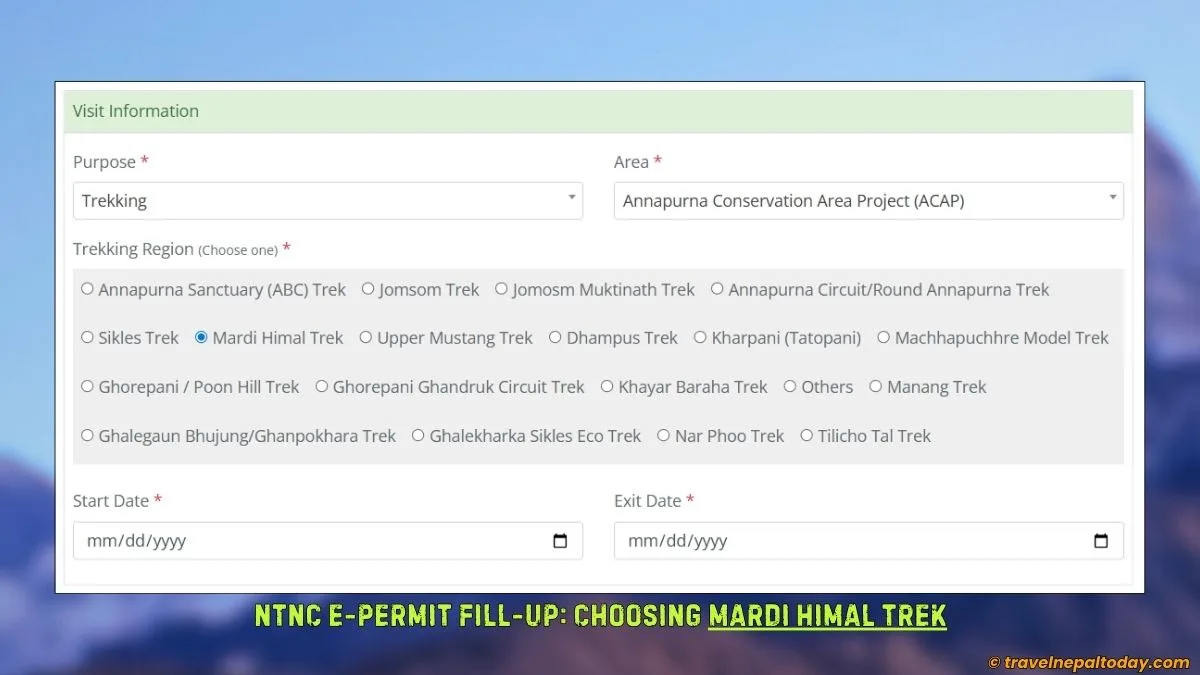
This is the easiest option if you like things done digitally. Steps to apply online:
- Visit the NTNC online permit page.
- Check “I agree to the terms and conditions”.
- Click on “Apply Permit”
- Fill in visitor information. Use “Add More” if travelling in a group.
- Enter visit purpose, contact details, and guide info (if any).
- Not to miss: Area > Annapurna Conservation Area > Mardi Himal Trek > Start Date and Exit Date.
- Proceed with on-screen instructions.
- Pay online and submit.
- Once verified, your permit will be emailed to you. And additional instructions will be shared if required.
Note: Online payment includes an extra 2.9% gateway charge.
Visit NTNC or ACAP Office On-site
If you prefer face-to-face, you can visit these offices to take your permits. It can take about half-an-hour to about an hour to get things done.
If your itinerary is 7 or 8 days, you can be more relaxed and take it a day before starting the trek.
Apply Through a Travel Agency
If you’re trekking with an agency, relax. Submit the aforementioned required documents and they will handle everything for you. In fact, permits are always included in the packages they offer.
Moreover, permits will be handed to your guide even on the Mardi Himal trails. You don’t even have to touch them!
On the Trails: Is it Possible?
Yes, technically. But I don’t recommend it.
Why? Because NTNC can fine you NPR 6,000 for foreigners and NPR 2,000 for SAARC nationals.
You got the idea. It’s much easier (and cheaper) to get it beforehand.
Mardi Himal Trek Permits Rules and Regulations
Now, let me highlight a few more important things you should know about the Mardi Himal trekking trail managed by NTNC:
The ACAP Permit is non-transferable and non-refundable.
- The permit is valid for a single entry only. So, make sure you carry it throughout the trek.
- You must show the ACAP when asked by authorities.
- You don’t require restricted area permits as Mardi Himal isn’t a restricted zone. In case, your agency or local tourists try selling you this, you’re now informed!
- New check-posts might be installed in the future. So, please be sure to register at check-posts along the route, even though I’ve mentioned only about Pothana here.
- Fauna is hard to find along the trail. But even if you find any, keep in mind that hunting is prohibited in the Annapurna Conservation Area.
- Follow minimum impact and eco-friendly practices. These include:
- throwing all trash and waste in respective dustbins or taking them back with you (throw them in Mardi lodges)
- travelling in a small group as far as possible
- not lighting fires in random forest places (especially before/during spring)
- not smoking in the trail, etc.
Permit Checkpoints in Mardi Himal Route
Currently, there’s only one checkpoint at Pothana, and that’s wher you need to show your ACAP. But keep in mind that new checkpoints may be introduced in Pitam Deurali, Kalimati, and Sidhing too.
For now, I suggest:
- Starting from Kande, Phedi, or Dhampus.
- Even if driving to Pitam Deurali (on a 3-day, 4-day, 5-day, or even 6-day itinerary), stop at Pothana. Ask your driver to take you there, even if you’re doing the trek independently. I’m sure they’ll help you out.
- If you’re with a guide or agency, they’ll manage this for you. So, no worries!
Another route from Landruk exists. If you’re combining Mardi Himal with Poon Hill trek or Annapurna Base Camp, permits are checked at Birethanti.
Final Thoughts
That’s everything about Mardi Himal trek permits. No confusion. No unnecessary paperwork. Just one permit (ACAP) that actually matters.
Once this is sorted, you’re free to focus on what really matters. The trail, the views, and the experience!
If you were confused before reading this, I hope things are crystal clear now. And if you’re still perplexed, just comment below and I’ll reply.
Happy travelling to Kaski!
About The Author