The Nepal Traffic Police have been conducting awareness class after speeding, lane-crossing, and violating other traffic rules for quite some time now.
I remember attending my first class back in 2018, and my most recent one in December 2024 was for overspeeding (at just 61 km/hr). These were the only times I’ve been fined in the 8 years since I got my driving license.
Both times, I had to attend a Traffic Awareness Class. After careful evaluation, I’ve put together this guide to help you understand why these classes are necessary and why they shouldn’t just be for violators.
Key Facts About Traffic Awareness Class
| Location | Kathmandu Valley Traffic Police Office, Ramshahpath , Kathmandu |
| Traffic Police Complex Satdobato , Lalitpur | |
| Traffic Police Complex Chundevi , Bhaktapur | |
| Time | 8:30 AM to 4:00 PM (depends on location) |
| Duration | 1 hour |
| Intended For | Drink and Drive, Different Lane, Red Light, and Overspeeding violations |
Is an Awareness Class Necessary After Traffic Violation?
Absolutely. This traffic awareness class has been introduced to ensure that we learn about something very serious and avoid repeating the same mistake.
For those of you whose driving licenses have been confiscated by the traffic police, there’s no other choice. To get it back, you’ll first need to pay the fine and then attend the awareness class.
And for those who have been fined digitally through the E-challan system, don’t think you’re off the hook. Your violation records are already in the database.
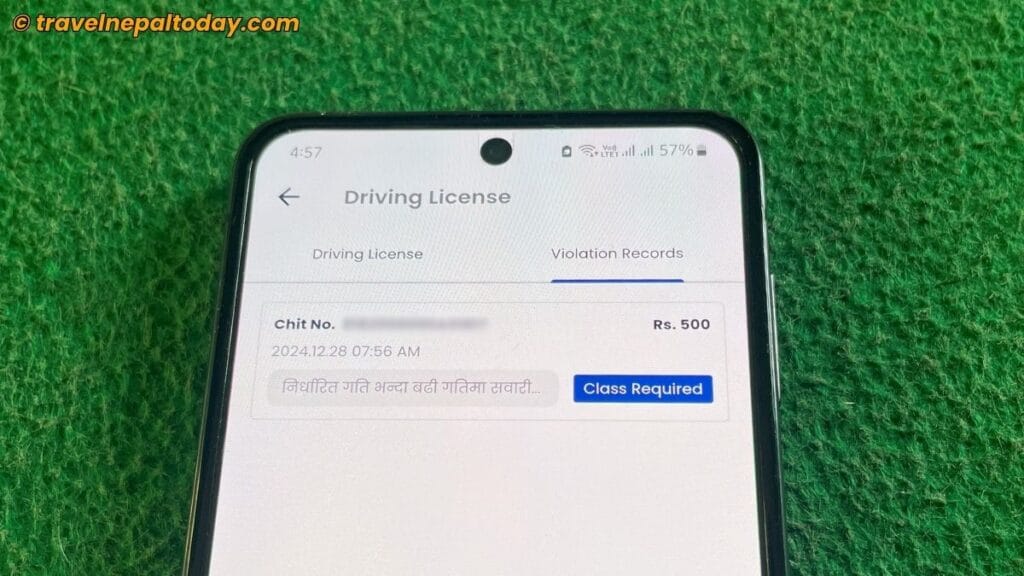
Some of us might assume that if our driving license isn’t taken, there’s no need to bother with the awareness class. But that’s incorrect!
Until and unless you attend the class, your records will not be updated; even if you’ve already paid the fine. Hence, this can cause other issues in the future.
Learn more about it here: How to Pay Traffic Fine Online in Nepal? E-Challan Explained
Timing & Location of Traffic Awareness Class
Currently, the Nepal Traffic Police is conducting traffic awareness classes for speeding and other violations exclusively for riders and drivers in the Kathmandu Valley.
For those of you whose licenses have been confiscated, you’ll need to visit the traffic office assigned to you by the police.
This could be the one in Ramshahpath, Kathmandu (commonly known as Baggi Khana), the Traffic Police Complex in Satdobato, Lalitpur, or the Traffic Police Complex in Chundevi, Bhaktapur.
For those who have received a digital chit (E-challan), simply visit one of the above locations that’s most convenient for you.
The best part about this program is that you can attend it at your convenience. All you need is about an hour to an hour and a half, and that’s it!
Plus, you’ll get to learn about new rules you might have been unaware of or had misconceptions about.
As per the official Nepal Traffic Police website, here are the timings for Sunday through Thursday:
| Class No. | Kathmandu Valley Traffic Police Office, Ramshahpath, Kathmandu | Traffic Police Complex Satdobato, Lalitpur | Traffic Police Complex Chundevi, Bhaktapur |
| 1 | 09:00 AM – 10:00 AM | 08:30 AM – 09:30 AM | 09:00 AM – 10:00 AM |
| 2 | 10:00 AM – 11:00 AM | 10:00 AM – 11:00 AM | 10:30 AM – 11:30 AM |
| 3 | 11:00 AM – 12:00 PM | 11:15 AM – 12:15 PM | 12:30 PM – 01:30 PM |
| 4 | 12:00 PM – 01:00 PM | 12:30 PM – 01:30 PM | 02:00 PM – 03:00 PM |
| 5 | 01:00 PM – 02:00 PM | 02:00 PM – 03:00 PM | |
| 6 | 02:00 PM – 03:00 PM | ||
| 7 | 03:00 PM – 04:00 PM |
On Fridays, all classes are conducted only up to 2:00 PM.
And if you’re someone with a packed schedule during weekdays, the Nepal Traffic Police has even arranged two classes each on Saturdays:
| Class No. | Kathmandu Valley Traffic Police Office, Ramshahpath, Kathmandu | Traffic Police Complex Satdobato, Lalitpur | Traffic Police Complex Chundevi, Bhaktapur |
| 1 | 10:00 AM – 11:00 AM | 08:00 AM – 09:00 AM | 09:00 AM – 10:00 AM |
| 2 | 11:00 AM – 12:00 PM | 09:00 AM – 10:00 AM |
While the actual class duration is 35 to 40 minutes, it can extend up to an hour due to pre-arrangements and post-speech discussions by the traffic instructor.
Note: Offices remain closed on all public holidays, so make sure to check your calendar before planning your visit.
What to Expect From Traffic Awareness Class?
After my two experiences attending the traffic awareness class, I can confirm that whether you’re there for overspeeding, lane-crossing, traffic-light violations, or even drink-and-drive case, it’s the same class for everyone.
Let’s first dive into the details of what you should do once you reach the traffic office. Since I went to Baggi Khana, I’ll be sharing the specifics from there:
- Park your vehicle (there’s enough space for both two-wheelers and four-wheelers).
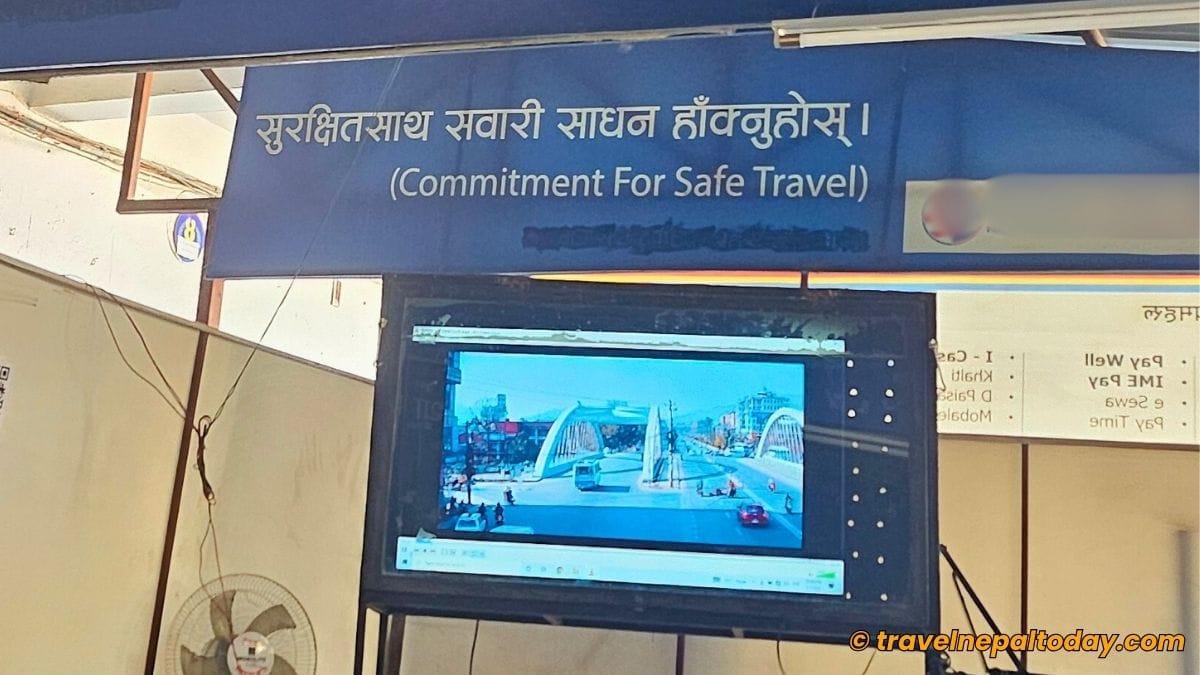
- Head over to Booth #21, where the traffic awareness class is conducted.

- Wait for the previous class to finish.
- Sometimes, you may need a token (in my case, it wasn’t mandatory).
- Get inside and choose a seat.
- If you have a physical chit, wait for one of the officers to collect it. You’ll need to show them your identity card.
- If you were fined digitally, register your name at the front desk.
- Watch the video and wait for the session to end.
- Once the class is over, collect your chit. Even if you were digitally ticketed, the traffic police will give you a card.
- Take that to Booth #6 (for overspeeding), Booth #4 (for drink-and-drive violations), or Booth #5 (for lane and traffic light violations). These booth numbers might change, but you’ll get the necessary information from the instructor there.
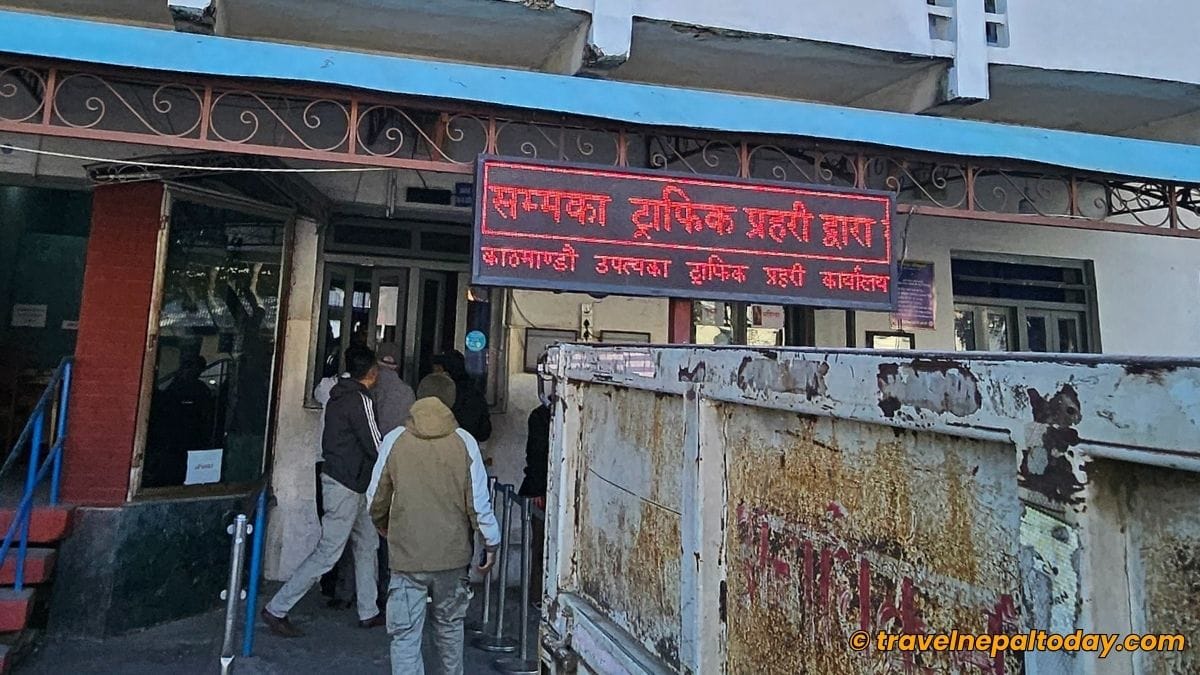
- After about 15-20 minutes, your record will be updated on the Nagarik app.
Sharing My Experience & Thoughts on the Awareness Class
The class primarily involves watching a 35-minute video. It includes:
- Accident videos
- Statistics from the previous year
- In-depth explanation of traffic rules
- Consequences of not following them
The video is interactive, featuring popular actors who appear on screen. The creators have tried to make it emotionally impactful by weaving in family stories.
Compared to my class back in 2018, I noticed plenty of new rules this time. Honestly, some of them were quite complicated, which means most of us likely break traffic rules every single day without even realizing it.
I won’t reveal everything about the video in this blog, though. You’ll have to experience it yourself.
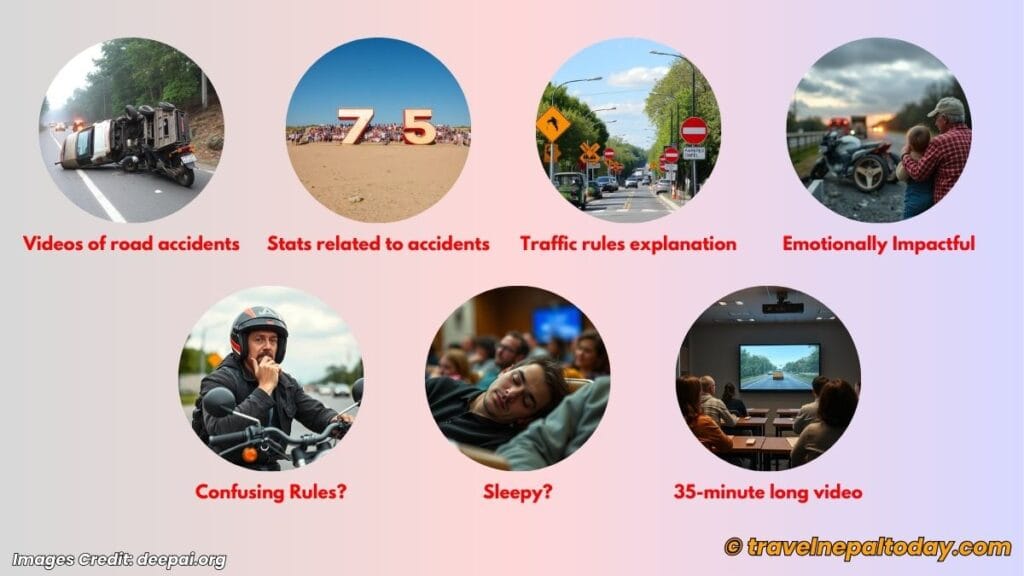
But one thing is for sure: we Nepalese aren’t the most patient, and some of us are so sleep-deprived that I caught a few people snoring during the session!
Even the traffic officers present didn’t seem too bothered, although they made it look like they were paying attention. After all, the traffic class felt more like a formality to fulfill a policy rather than a genuine effort to impart knowledge.
Keeping these things aside, I did watch the entire video. And honestly, I must praise the effort put into it. However, just one person learning about traffic rules isn’t enough.
The class has the potential to be impactful, but passively watching a video isn’t the most effective approach. Perhaps incorporating vocational training or hands-on tests could make it more informative and engaging.
In fact, I, along with many of you, probably have doubts about how people obtain driving licenses so easily.
The trial system has remained largely unchanged for decades, and we’ve all encountered individuals who lack even the most basic knowledge of riding or driving.
The root cause lies in issues like bribery and unprofessionalism. Many of us treat riding or driving as a “fun activity” rather than recognizing the serious consequences it can have.
Did you know Nepal witnesses at least 75 accidents daily, with seven people losing their lives? Isn’t THAT concerning?
Traffic congestion, reckless driving, unaware passengers, and pedestrians—these are major issues. So, I strongly believe that the awareness class shouldn’t just be for violators; it should be for everybody!
We often hear about the Nepal Traffic Police conducting awareness programs in various parts of the country. As responsible citizens, I believe we should all attend at least one session.
Final Words
I hope I’ve been able to bring a strong awareness on traffic issues of our country via this article
I was fined for 61 km/h in Ring Road. But we have to understand that there are cases where you need to make good decisions when riding.
Sometimes, sticking to the 50 km/h limit can be risky as we never know who’s following the rule or not. It’s for our own safety. And when we cross the limit, a police mama with a radar gun just happens to catch us.
Just letting you know—I don’t generally enjoy speed rides. It’s the situation that leads me to 60 ot 70 km/h sometimes. That’s the highest I go.
Even so, I was fined and I’m pretty sure many of you have been too. And of course, some riders are taking their bikes to more than 100 km/h, uploading that on social media, and still no fine for them.
The point is that the entire system needs to change in Nepal. It’s not just one thing that has a problem, there are plenty of others too.
Well, these were my thoughts that if I start writing, it could be a never-ending story.
While Travel Nepal Today is focused on exploring the beauty of Nepal, we’’ll definitely come up with these kinds of informative blogs too.
And if you liked this writing, don’t forget to share this with your friends and family members. Even they deserve to learn about the traffic awareness class. Who knows? They could be the next ones to be caught.
Happy traveling and safe riding!
About The Author